The story of David runs across forty-two chapters of the Bible, from 1 Samuel 16 to 1 Kings 2, a longer arc than any other Old Testament figure outside the patriarchs gets. Most retellings stop at the halfway point: the shepherd, the sling, the throne, maybe the dance in front of the ark. The other half: the king who has a woman's husband killed to cover up an affair, the prophet who points a finger and says 'you are that man,' the son who takes up arms against his own father, a dying man's last instructions that include settling two old blood debts, tends to disappear from the version told out loud to children. Below is the full story, chapter by chapter, with the verses behind each turn: the rise and the fall carrying the same weight, because that is how the text itself tells it.
Who David was, and where the story begins
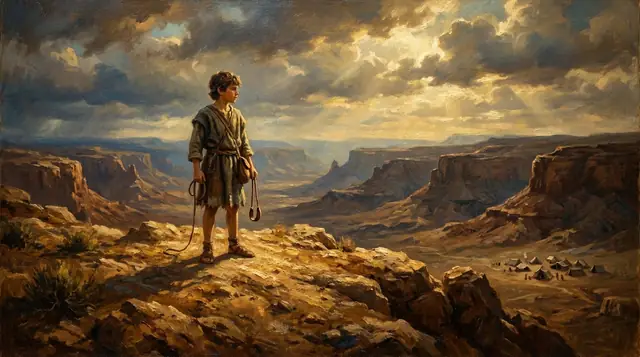
David was the youngest of Jesse's sons, from Bethlehem, of the tribe of Judah, so far outside the center of attention in his own house that when the prophet Samuel arrives in secret to anoint the next king, nobody even calls him in from the field, where he is tending the sheep (1 Samuel 16:11). Samuel had been sent after the LORD rejected Saul as king (16:1), and he walks David's seven older brothers past him one by one, sure that one of them will stand out by height or bearing. Standing before Eliab, the firstborn, Samuel nearly gets it wrong, and that is where the text interrupts the whole scene with the line that sums up the entire story before it even starts:
“But the LORD said to Samuel, 'Do not consider his appearance or height, for I have rejected him; the LORD does not see as man does. For man sees the outward appearance, but the LORD sees the heart.'”
None of the seven passes the test. Only when Samuel asks whether there is another son does Jesse mention the youngest, absent because he was out with the flock (16:11): a detail the text doesn't soften: not even David's own father had thought of him as an obvious candidate. Rushed in from the field, the young man is described physically before anything else: ruddy, with beautiful eyes, a handsome appearance (16:12). It's this same David, still smelling of the pasture, whom Samuel anoints in front of his brothers:
“So Jesse sent for his youngest son and brought him in. He was ruddy, with beautiful eyes and a handsome appearance. And the LORD said, 'Rise and anoint him, for he is the one.' So Samuel took the horn of oil and anointed him in the presence of his brothers, and the Spirit of the LORD rushed upon David from that day forward. Then Samuel set out and went to Ramah.”
The harp that calmed Saul
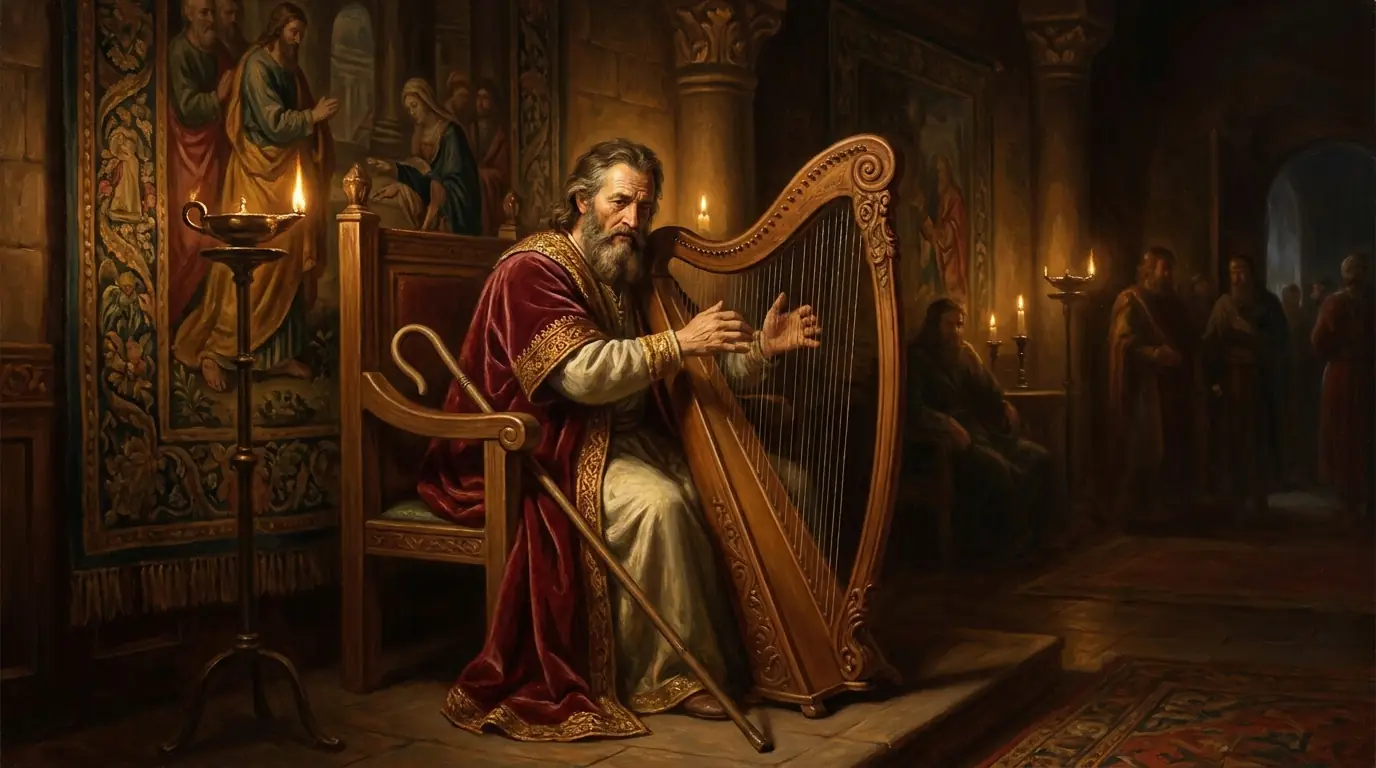
In the same chapter, the text records the flip side: the Spirit of the LORD departs from Saul, and a spirit of distress from God begins to torment him (16:14). Saul's attendants suggest finding someone skilled on the harp to ease him in his troubled moments (16:16), and the name that reaches the king turns out to be Jesse's youngest son, described by one servant as a brave man, a warrior, skillful in speech, and the LORD is with him (16:18). David enters Saul's household as a hired musician, with no general's rank and no war hero's name, and the text records the effect in plain terms: 'whenever the spirit from God came upon Saul, David would pick up his harp and play, and Saul would become well, and the spirit of distress would depart from him' (16:23).
Goliath: the giant no one else would face
Years later (the text doesn't number the exact gap between the anointing and the war) the armies of Israel and the Philistines square off in the Valley of Elah, and a Philistine champion described as roughly nine and a half feet tall, Goliath of Gath, challenges Israel to send one man to settle the battle by single combat (1 Samuel 17:4-10). For forty straight days he shows up, morning and evening, and no one in Saul's entire army takes the challenge (17:16). That's the moment David enters the scene as a messenger sent by his own father to carry food to his older brothers and bring word back home (17:17-19).
David hears Goliath's taunt and reacts the way no one else in the camp has reacted in forty days: he asks, indignant, what will be done for the man who kills that Philistine and removes the disgrace from Israel, calling Goliath an 'uncircumcised Philistine' and asking why he dares defy the armies of the living God (17:26). His oldest brother, Eliab, rebukes him for pride, accusing him of coming down just to watch the fighting (17:28); Saul tries to dress him in his own armor, but David turns it down (he had never worn anything like it (17:38-39)) and heads down into the valley with nothing but his staff, five smooth stones from the stream, and the sling he used to protect his flock from lions and bears (17:34-36, 17:40). His answer to the giant, before the first swing of the sling, is the most quoted line in the whole chapter:
“You come against me with sword and spear and javelin, but I come against you in the name of the LORD of Hosts, the God of the armies of Israel, whom you have defied. This day the LORD will deliver you into my hand. This day I will strike you down, cut off your head [...] And all those assembled here will know that it is not by sword or spear that the LORD saves; for the battle is the LORD's, and He will give all of you into our hands.”
A single stone, thrown from the sling, strikes Goliath in the forehead and drops him (17:49); David runs up, takes the giant's own sword, and cuts off his head, without ever having held a sword during the fight (17:50-51). The Philistines, seeing their champion dead, flee, and the army of Israel chases them all the way to the gates of their own cities (17:51-52).
Jonathan, the covenant, and the jealousy that turned into a manhunt
After the victory, the text records a friendship that runs through the rest of the story: 'the soul of Jonathan was knit to the soul of David, and Jonathan loved him as himself' (18:1), and the two make a covenant (18:3). It's also after Goliath that the mood shifts for David inside the palace itself. Coming back from the battle, the women come out to meet the soldiers dancing and singing a line that will keep chasing David for the rest of Saul's reign: 'Saul has slain his thousands, and David his tens of thousands' (18:7).
Saul doesn't hide the jealousy: the text records that he starts eyeing David with suspicion from that day on (18:9). In the next chapter, the suspicion turns into direct action: with the spirit of distress on him again, and David playing the harp as usual, Saul hurls his own spear at the musician, trying to pin him to the wall, twice, and both times David dodges (18:10-11). From there, what had been jealousy becomes open pursuit, and much of the rest of David's early life is spent on the run.
The fugitive years, and where some of the psalms came from
From Saul's manhunt onward, David's life plays out in caves, in the wilderness of Judah, and in foreign territory where he isn't always welcome. Twice the text records David with the chance to kill Saul himself, once in a cave at En-gedi (1 Samuel 24), once inside Saul's own camp at night (1 Samuel 26), and both times he pulls back, refusing to raise a hand against 'the LORD's anointed,' even though he himself is the next anointed king. According to the Hebrew text's own headings, at least three psalms come out of this same stretch: Psalm 34, written after David feigned madness to escape the Philistine king of Gath (1 Samuel 21) (the full story is on this site, in Psalm 34) Psalm 57, headed 'when he fled from Saul into the cave,' and Psalm 142, a prayer also described as written 'when he was in the cave.' Neither reads like the work of a man who felt confident the whole time; they're prayers written from inside the pressure, not after it had already passed.
King in Hebron, then king over all Israel
Saul and Jonathan die together at the battle of Gilboa (1 Samuel 31), and when David hears the news, he weeps and composes a lament for both of them, including the very man who had spent years trying to kill him (2 Samuel 1:17-27). The men of Judah anoint him king over their own tribe, in Hebron (2 Samuel 2:4), but the rest of Israel spends a few more years under Ish-bosheth, Saul's son, in a period of civil war between the two houses (2 Samuel 2-4). Only after Ish-bosheth's death do the elders of all the tribes come to Hebron and anoint David king over all Israel (2 Samuel 5:3). He was thirty when he began to reign, and he would reign forty years in all (2 Samuel 5:4). One of the new king's first moves is capturing the Jebusite stronghold of Jerusalem and making it his capital (2 Samuel 5:6-9).
The ark in Jerusalem
With the kingdom secured, David brings the ark of the covenant to Jerusalem, not without a first, failed attempt, in which a man named Uzzah dies after touching the ark to keep it from falling (2 Samuel 6:6-7), an episode that frightens David enough to delay the move for three months (6:9-11). When the ark finally enters the city, David dances before it 'with all his might' (6:14), and his wife Michal, Saul's daughter, despises him for it, seeing the king dancing in public as beneath his dignity (6:16, 6:20-23). It's a family clash recorded in the middle of one of the reign's biggest public celebrations, and the text doesn't hide it.
Bathsheba and Uriah, without euphemism
It's in the next chapter that David's reign changes direction, and the text softens none of it. One evening, while Israel's armies are on campaign against the Ammonites and David has stayed behind in Jerusalem (the text marks the detail: the king wasn't where he should have been (2 Samuel 11:1)) he sees a woman bathing from the palace roof.
“One evening David got up from his bed and strolled around on the roof of the palace. And from the roof he saw a woman bathing — a very beautiful woman. So David sent and inquired about the woman, and he was told, 'This is Bathsheba, the daughter of Eliam and the wife of Uriah the Hittite.' Then David sent messengers to get her, and when she came to him, he slept with her. (Now she had just purified herself from her uncleanness.) Then she returned home. And the woman conceived and sent word to David, saying, 'I am pregnant.'”
The text tells us she is married (the wife of Uriah the Hittite, one of David's own soldiers) before David even sends for her (11:3). There's no negotiation and no recorded consent on her side: the verb the text uses is that David 'sent messengers to get her.' Pregnant, Bathsheba sends word to David, and what he does next is try to cover it up, not own it: he calls Uriah back from the war, on the pretext of hearing news from the front, hoping Uriah will sleep with his own wife and the pregnancy will look legitimate (11:6-8). Uriah refuses, twice, arguing it wouldn't be right to enjoy his own house while the ark and the army of Israel are camped out in the field (11:11). David tries a third time, deliberately getting Uriah drunk (11:13); Uriah still doesn't go home. When the cover-up fails, David settles on the final option: he sends Uriah back to the front carrying, without knowing it, a letter to Joab. His own death sentence, ordering Joab to put him where the fighting was fiercest and then pull back the support, 'so that he may be struck down and killed' (11:14-15).
Joab carries out the order, and Uriah dies along with other of David's soldiers who fall in the same maneuver (11:16-17). After the formal mourning period, David sends for Bathsheba and takes her as his wife (11:27), and the chapter ends with the shortest, heaviest line in the whole passage: 'the thing David had done was evil in the sight of the LORD' (11:27).
Nathan: 'You are that man'
The LORD sends the prophet Nathan to David with a parable, not a direct accusation: a rich man, owner of many flocks, who instead of slaughtering one of his own animals to feed a traveler, takes the one pet ewe lamb belonging to a poor neighbor: the family's only possession, raised alongside their own children, treated almost like a daughter (12:1-4). David, hearing the story as if it were a real legal case, burns with anger and rules that the rich man deserves to die, and must repay the lamb fourfold (12:5-6). That's when Nathan, without hesitation, points at him:
“Then Nathan said to David, 'You are that man! This is what the LORD, the God of Israel, says: I anointed you king over Israel, and I delivered you from the hand of Saul. I gave your master's house to you and your master's wives into your arms. I gave you the house of Israel and Judah, and if that was not enough, I would have given you even more. Why then have you despised the command of the LORD by doing evil in His sight? You put Uriah the Hittite to the sword and took his wife as your own [...] Now, therefore, the sword will never depart from your house, because you have despised Me and have taken the wife of Uriah the Hittite to be your own.'”
David's answer, after the whole parable and the whole accusation, fits in one short line: 'I have sinned against the LORD' (12:13). Nathan replies that the LORD has taken away his sin and David will not die, but adds, in the same breath, that the newborn son will die (12:13-14). Forgiveness and consequence arrive together, and neither cancels the other: the boy falls ill and dies seven days later, despite his father's fasting and prayers (12:15-18). Tradition ties this same episode to one of the best-known psalms of repentance in the Bible: the Hebrew heading of Psalm 51 identifies the poem as written 'when Nathan the prophet came to him after his adultery with Bathsheba.' The psalm asks, plainly: 'Have mercy on me, O God, according to Your loving devotion [...] Wash me clean of my iniquity and cleanse me from my sin [...] Against You, You only, have I sinned and done what is evil in Your sight' (Psalm 51:1-4), and further on: 'Create in me a clean heart, O God, and renew a right spirit within me' (51:10).
Absalom: the son, the revolt, and the cost the prophecy had already named
The rest of 2 Samuel narrates, chapter by chapter, what Nathan had announced: 'I will raise up adversity against you from your own house' (12:11). Amnon, one of David's sons, rapes his sister Tamar (2 Samuel 13:1-14); Absalom, Tamar's brother, does nothing in the moment, but two years later has Amnon killed in revenge (13:23-29) and flees into exile, where he spends three years (13:37-38). Torn between missing his son and grieving the crime, David takes years to let Absalom back into Jerusalem, and even longer to receive him back into his own presence (14:23-24, 14:28-33). Once restored, Absalom spends years winning over the people at the city gate, undermining his own father's authority (2 Samuel 15:1-6), until he declares himself king in Hebron and forces David to flee Jerusalem on foot, weeping, his head covered (15:10-30).
The war between father and son ends in the forest of Ephraim, where Absalom's troops are defeated (2 Samuel 18:6-8). Before the battle, David had given his commanders an explicit order, 'deal gently for my sake with the young man Absalom' (18:5), but Joab, finding Absalom with his head caught fast in the branches of an oak while the mule under him kept going (18:9), kills him with three spears, defying the king's direct order (18:14-15). The news reaches David as a loss, with no victory in it:
“The king was shaken and went up to the gate chamber and wept. And as he walked, he cried out, 'O my son Absalom! My son, my son Absalom! If only I had died instead of you, O Absalom, my son, my son!'”
1 Kings 2: the death of David
David spends his last chapters managing the succession, another son, Adonijah, tries to crown himself king ahead of time, and it's Nathan, the same prophet who confronted David over Bathsheba, who steps in to make sure Solomon, Bathsheba's son, takes the throne (1 Kings 1). On his deathbed, David calls Solomon and gives him his final instructions:
“As the time drew near for David to die, he charged his son Solomon, 'I am about to go the way of all the earth. So be strong and prove yourself a man. And keep the charge of the LORD your God to walk in His ways and to keep His statutes [...] and so that the LORD may fulfill His promise to me: If your descendants take heed to walk faithfully before Me with all their heart and soul, you will never fail to have a man on the throne of Israel.'”
Right after, though, the tone shifts. David reminds Solomon what Joab did to two commanders in peacetime, killed Abner and Amasa in cold blood, 'staining with the blood of war the belt around his waist', and tells his son not to let Joab's 'gray head go down to Sheol in peace' (2:5-6). He also instructs that Shimei, a man who had cursed David years earlier and whom David himself had sworn not to kill, be handled differently after David is gone: 'bring his gray head down to Sheol in blood' (2:8-9). These are the last recorded instructions of a king who, in the same chapter, had just told his son to walk in the LORD's ways with all his heart: two old blood debts, settled by proxy, in the same breath as the blessing. The text offers no comment on the contrast and simply records both sides, one after the other.
David dies shortly after and is buried in the City of David. The text closes the account of his reign with an exact figure: forty years in all, seven in Hebron and thirty-three in Jerusalem (1 Kings 2:10-11). Solomon takes the throne, and the book moves on without him.
What the story doesn't say
At no point between 1 Samuel 16 and 2 Samuel 11 does the text signal that the fall is coming: no warning, no prophecy that the anointed king, the killer of Goliath, Jonathan's loyal friend, will one day have one of his own soldiers killed to cover up an affair. The fall arrives with no advance notice inside the narrative, exactly the way it arrives in real life. And the text doesn't soften the scene on the roof or treat Bathsheba as a willing accomplice: the verb it uses is that David 'sent messengers to get her' (11:4), and Nathan himself, in the parable, compares her to a lamb taken from a defenseless man, not sold or handed over.
The second thing the text doesn't do is let forgiveness erase the consequence. After Nathan says 'the LORD has taken away your sin; you will not die' (12:13), the expected move would be for the story to move on without another mention of the case. That's not what happens: the newborn dies within seven days (12:18), and the rest of 2 Samuel, Tamar's rape, Absalom's fratricide, a son's armed revolt against his own father, is narrated as the direct playing-out of the sentence Nathan had given: 'I will raise up adversity against you from your own house' (12:11). The forgiveness was real; so was the consequence, and the text leaves both standing side by side without explaining why one didn't cancel the other.
'A man after God's own heart'. What the phrase means, and what it doesn't
The most repeated line about David doesn't even first appear with his name attached. Back in 1 Samuel 13, before David is even mentioned, Samuel tells Saul that the LORD 'has sought a man after His own heart' to replace him as ruler (13:14): a line about the choice of a successor, with no character reference issued after years of watching someone's life. It's only in Acts, in the New Testament, that the phrase is explicitly applied to David by name, in a speech by the apostle Paul about the history of Israel:
“After removing Saul, He raised up David as their king and testified about him: 'I have found David son of Jesse a man after My own heart; he will carry out My will in its entirety.'”
Reading that line as a synonym for moral perfection doesn't survive 2 Samuel chapter 11: the same text that narrates David's anointing as God's chosen one is the text that narrates, without disguise, the adultery, the cover-up, and the ordered killing of Uriah. What the rest of the story suggests is the direction of the heart when confronted with sin. Facing Nathan, David defends nothing, blames no one, minimizes nothing. He confesses in four words and accepts the consequence (12:13-14). That pattern, more than any absence of failure, seems to be what the Bible calls a heart after God's own: a heart that fails and, once confronted, does not hide from the failure.
Reading and listening guide: 1 Samuel 16 to 1 Kings 2
David's story spans forty-two chapters, across three books. Read straight through, at the same 200-words-per-minute pace used in this site's reading-time guide, it takes about 2 hours 58 minutes, close to the time the guide gives to the whole book of Genesis (3 hours 12 minutes), except spread across three different books instead of one. The narrated version, at roughly 175 words per minute, the same pace used for this site's audio Bible, runs about 3 hours 27 minutes, with background music and speed control, available on Terra Gospel Premium.
- 1 Samuel 16-17: the secret anointing in Bethlehem and the duel with Goliath in the Valley of Elah
- 1 Samuel 18-20: the covenant with Jonathan and the start of Saul's jealousy
- 1 Samuel 21-31: the fugitive years, up to the deaths of Saul and Jonathan at Gilboa
- 2 Samuel 1-5: the lament for Saul, the reign in Hebron, and then over all Israel
- 2 Samuel 6-10: the ark brought to Jerusalem and the wars that secured the kingdom
- 2 Samuel 11-12: Bathsheba, Uriah, and Nathan's confrontation
- 2 Samuel 13-18: Amnon and Tamar, Absalom's revolt, and his death
- 2 Samuel 19-24: the return to Jerusalem and the closing chapters of the reign
- 1 Kings 1-2: Solomon's succession and the death of David
What are the turning points in David's life?
David's story is long, so this table gives you the main turning points in order, with the passage to read for each one.
| Turning point | Passage | What happens |
|---|---|---|
| Anointed as a shepherd boy | 1 Samuel 16:12-13 | Samuel anoints David among his brothers. |
| Goliath | 1 Samuel 17 | David faces the giant with trust in God. |
| Jonathan and Saul | 1 Samuel 18-20 | A covenant of friendship, and a king's jealousy. |
| The fugitive years | 1 Samuel 21-31 | David runs, spares Saul, and writes psalms. |
| King in Hebron, then over all Israel | 2 Samuel 2-5 | David is crowned and takes Jerusalem. |
| The ark in Jerusalem | 2 Samuel 6 | David brings the ark of God to the city. |
| Bathsheba and Uriah | 2 Samuel 11 | David takes Bathsheba and arranges Uriah's death. |
| Nathan's confrontation | 2 Samuel 12 | David is told he is the man, and he confesses. |
| Absalom's revolt | 2 Samuel 15-18 | David's son rebels, and David mourns his death. |
| The last words | 1 Kings 2 | David charges Solomon and dies. |
Keeping it all together
On Terra Gospel you can highlight any part of David's story in one of four colors, write your own note, and save it all to Favorites, useful especially in a story with this many turns, where it's worth marking both 'the LORD sees the heart' and 'you are that man' in the same document. Reading, highlighting, notes, favorites, and the verse of the day are free in English, Portuguese, and Spanish; the narrated Bible, including these forty-two chapters read aloud, with background music and speed control, is part of Premium.
David's psalms tell the same story from the inside: read Psalm 34, Psalm 27 and Psalm 139. For the sin and repentance at the center of the story, see Bible verses about forgiveness.