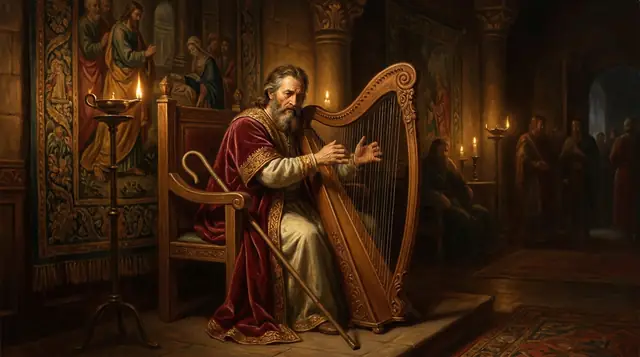

"You have searched me and known me" ended up on wrist tattoos, nursery wall art, and sonogram captions: almost always cut off long before the middle of the psalm. Few people who ink that verse onto their skin know that, a handful of verses after that same promise of intimacy, the same poet asks God to kill the wicked and declares that he hates his enemies with "perfect hatred." Nothing here comes from a copying error or a second author slipping in halfway through: it is the same Psalm 139, whole, with the most quoted part and the part almost nobody publishes sitting side by side. Below is the complete psalm, read it straight through, or listen to it narrated while you follow along, and after that, section by section, what each part actually says, including the stanza most summaries avoid showing.
Psalm 139, in full
“O LORD, You have searched me and known me. You know when I sit and when I rise; You understand my thoughts from afar. You search out my path and my lying down; You are aware of all my ways. Even before a word is on my tongue, You know all about it, O LORD. You hem me in behind and before; You have laid Your hand upon me. Such knowledge is too wonderful for me, too lofty for me to attain.”
“Where can I go to escape Your Spirit? Where can I flee from Your presence? If I ascend to the heavens, You are there; if I make my bed in Sheol, You are there. If I rise on the wings of the dawn, if I settle by the farthest sea, even there Your hand will guide me; Your right hand will hold me fast. If I say, "Surely the darkness will hide me, and the light become night around me" — even the darkness is not dark to You, but the night shines like the day, for darkness is as light to You.”
“For You formed my inmost being; You knit me together in my mother's womb. I praise You, for I am fearfully and wonderfully made. Marvelous are Your works, and I know this very well. My frame was not hidden from You when I was made in secret, when I was woven together in the depths of the earth. Your eyes saw my unformed body; all my days were written in Your book and ordained for me before one of them came to be. How precious to me are Your thoughts, O God, how vast is their sum! If I were to count them, they would outnumber the grains of sand; and when I awake, I am still with You.”
“O God, that You would slay the wicked — away from me, you bloodthirsty men — who speak of You deceitfully; Your enemies take Your name in vain. Do I not hate those who hate You, O LORD, and detest those who rise against You? I hate them with perfect hatred; I count them as my enemies.”
“Search me, O God, and know my heart; test me and know my concerns. See if there is any offensive way in me; lead me in the way everlasting.”
The text above follows the Berean Standard Bible (BSB), released into the public domain and free for any use without permission.
Who wrote Psalm 139, what the attribution to David actually says, and what stays open
The Hebrew title of Psalm 139 is short, with no episode attached the way Psalm 34 has: "For the choirmaster. A Psalm of David": an indication of authorship and, at the same time, a liturgical instruction, directed at whoever led the singing in the temple. The Hebrew preposition behind "of David" is ambiguous by nature, and it sits in front of a good share of the psalm titles: it can indicate direct authorship, dedication to David, a poem written in David's style, or a collection of psalms tied to his tradition. It is an ancient editorial heading, much older than any modern signature, and there is no way to confirm with certainty which of those readings applies to this particular psalm.
A second point calls for honesty over easy comfort: the Hebrew of Psalm 139 carries unusual vocabulary, with rare words and some forms that resemble Aramaic, the language that would become dominant in Israel long after the period traditionally attributed to David. One group of scholars uses that detail as an argument for dating the text to a later period of Israel's history; another group answers that poetic Hebrew, in any era, can produce unusual vocabulary, without that necessarily pointing to a later date. There is no settled consensus on this point among specialists, and it is more honest to say so than to fake a certainty biblical scholarship does not have. What the title itself states, without ambiguity, is that the psalm has come down to us tied to David's name, inside the same tradition that preserves the other texts attributed to him.
Psalm 139:1-6, omniscience: nothing about me escapes what You know
“O LORD, You have searched me and known me. You know when I sit and when I rise; You understand my thoughts from afar. You search out my path and my lying down; You are aware of all my ways.”
The psalm opens with two verbs that work as a frame for the rest of the poem: "searched" and "known." This is a God who knows from up close, involved in every detail. It is a knowledge that covers the most ordinary gesture of the day, sitting down and standing up, and the thought that has not yet become a word. Verse 3 uses the image of surrounding: God "searches out" the path and the lying down, the way someone circles another person, leaving no side uncovered. Verse 6 closes this first section with an admission of limit: this kind of knowledge is "too wonderful" for the psalmist himself to reach: the text makes no attempt to explain how God knows all of it and admits the idea outruns human capacity to grasp it whole.
Psalm 139:7-12, omnipresence: 'if I ascend to the heavens... if I make my bed in Sheol'
“Where can I go to escape Your Spirit? Where can I flee from Your presence? If I ascend to the heavens, You are there; if I make my bed in Sheol, You are there.”
The second section changes tone: after describing a knowledge that reaches everything, the psalmist tests whether there is some place that knowledge would not follow him, and the answer is no, in any direction. "Sheol" is the Hebrew word for the realm of the dead in Old Testament thought, the general dwelling of anyone who has died, good or bad, an idea distinct from the hell of later Christian theology. Saying God is present even in Sheol is saying that not even death marks the edge of that presence. The following lines widen the test to physical space: "the wings of the dawn" describe sunlight spreading fast across the horizon at daybreak, and "the farthest sea" points to the most distant place anyone in the ancient world could imagine traveling to. Even there, God's hand guides and holds fast. The block ends by testing darkness as a last possible hiding place, and the answer undoes that idea too: "the night shines like the day" in God's eyes.
Psalm 139:13-18, 'You knit me together in my mother's womb'
“For You formed my inmost being; You knit me together in my mother's womb. I praise You, for I am fearfully and wonderfully made. Marvelous are Your works, and I know this very well. My frame was not hidden from You when I was made in secret, when I was woven together in the depths of the earth.”
The third section shifts tense and subject: after describing a present knowledge and a presence with no borders, the psalm turns back to the very beginning of the psalmist's own existence. The image behind "knit together" and "woven together" is textile: something interlaced thread by thread, like embroidery done in secret, away from any eyes that could watch the process. "The depths of the earth," in the next line, is a Hebrew poetic expression for what is hidden, out of ordinary sight, comparing the womb to a place as secret as the earth's interior. Verse 16 adds another layer: the still "unformed" body was already written in God's book, with the days ordained before a single one of them existed: a way of saying God's knowledge of this person began before birth and before the forming of the body. It is a passage many families read on nursery walls and baby shower cards, and one others hold onto, with a very different weight, after a pregnancy loss. Both uses grow out of the same text, one that speaks of being known and formed by God before birth itself.
Verses 17 and 18 close the section by returning to the tone of wonder from the start of the psalm: God's thoughts, if anyone tried to count them, would outnumber "the grains of sand", another Hebrew way of saying "countless." The block's final line, "when I awake, I am still with You," extends the presence described in the previous section into sleep as well: there is no gap, not even overnight, where that companionship stops.
Psalm 139:19-22: the stanza most summaries skip
“O God, that You would slay the wicked — away from me, you bloodthirsty men — who speak of You deceitfully; Your enemies take Your name in vain. Do I not hate those who hate You, O LORD? I hate them with perfect hatred; I count them as my enemies.”
After three sections about intimacy, presence, and careful forming, the psalm turns sharply toward a plea for the death of the wicked and a declaration of "perfect" hatred. This passage is no oddity of Psalm 139, since this kind of language shows up across several other psalms, grouped by scholars under the term imprecatory psalms, poems that openly ask for the punishment of God's enemies. Context matters here: verse 20 identifies who those "enemies" are, people who "speak of You deceitfully" and take God's name in vain, with personal rivals over some unrelated grievance left out. The declared target of the hatred is whoever openly opposes God, and ordinary annoyances stay out of it.
Psalm 139:23-24, 'search me, O God': the psalm closes by returning to where it began
“Search me, O God, and know my heart; test me and know my concerns. See if there is any offensive way in me; lead me in the way everlasting.”
The final two verses repeat, almost word for word, the pair of verbs that opened the psalm: "search" and "know" appear again, now as a request instead of a statement. Many commentators point to this circular structure in the poem: the same total scrutiny described in the first six lines returns at the end, but this time called for by the psalmist himself, right after declaring perfect hatred toward God's enemies. Reading the two blocks in sequence suggests a deliberate move: someone who has just admitted an emotion as strong as hatred asks, in the very next breath, to be examined from the inside, as though checking whether that same anger might be hiding some "offensive way" of his own, something that needed correcting before moving forward. The psalm ends asking for direction, not confirmation: "lead me in the way everlasting" closes the poem by handing God back the same authority over the psalmist that the opening lines had already described.
What Psalm 139 promises, and what it does not
The whole psalm does not promise easy comfort, or a life free of inner tension. It describes a knowledge of God that covers every thought, reaches any place, formed the body before birth, and sits, in the same poem, next to declared rage and a plea for judgment against those who oppose God. What comes through clearly from beginning to end is the direction of the movement: the psalmist hides nothing he feels, not the wonder, not the discomfort of being known this completely, not the fury at other people's wickedness. He carries all of it, unedited, into the conversation with God, and ends by asking to be examined too.
When people search for this psalm
Psalm 139 shows up with force in at least three different moments. The first is the search for identity: the opening verses, about being fully known in every thought and every path, work as a direct answer to anyone who doubts their own worth or feels reduced to a label. The second is loneliness, especially the sharpest kind: verses 7 through 12, about there being no place that presence does not reach, including Sheol, tend to be read by people who feel too isolated to be reached by anything, God included. The third is pregnancy and, carrying a very different weight, perinatal loss, verses 13 through 16, about being woven together in the womb before taking any recognizable shape, show up both at pregnancy celebrations and at moments of loss, and deserve the same care in both settings, without turning a text about being known by God into ammunition for debates the psalm itself never enters.
What does each part of Psalm 139 say?
Psalm 139 has five short stanzas. Each one answers a different question about how God relates to you.
| Verses | Theme | Question it answers |
|---|---|---|
| 1-6 | God knows me | Does anyone really understand me? |
| 7-12 | God is everywhere | Can I ever be too far away or too lost? |
| 13-18 | God made me | Do I matter, and was my life planned? |
| 19-22 | Anger at evil | What do I do with the anger I feel at cruelty? |
| 23-24 | Search me | Will I let God look inside and lead me? |
Keeping it together
In Terra Gospel you can highlight any section of Psalm 139 in one of four colors, write your own note, and keep it all under Favorites, so the verse you needed once is easy to find again. Reading, highlights, notes, favorites and the verse of the day are free in English, Portuguese and Spanish; the narrated audio Bible, including Psalm 139 read aloud, with background music and adjustable speed, is part of Premium.
For the other psalms that speak to being known, read Psalm 23 and Psalm 34. Verse 23 mentions anxious thoughts, and Bible verses about anxiety picks up that thread.