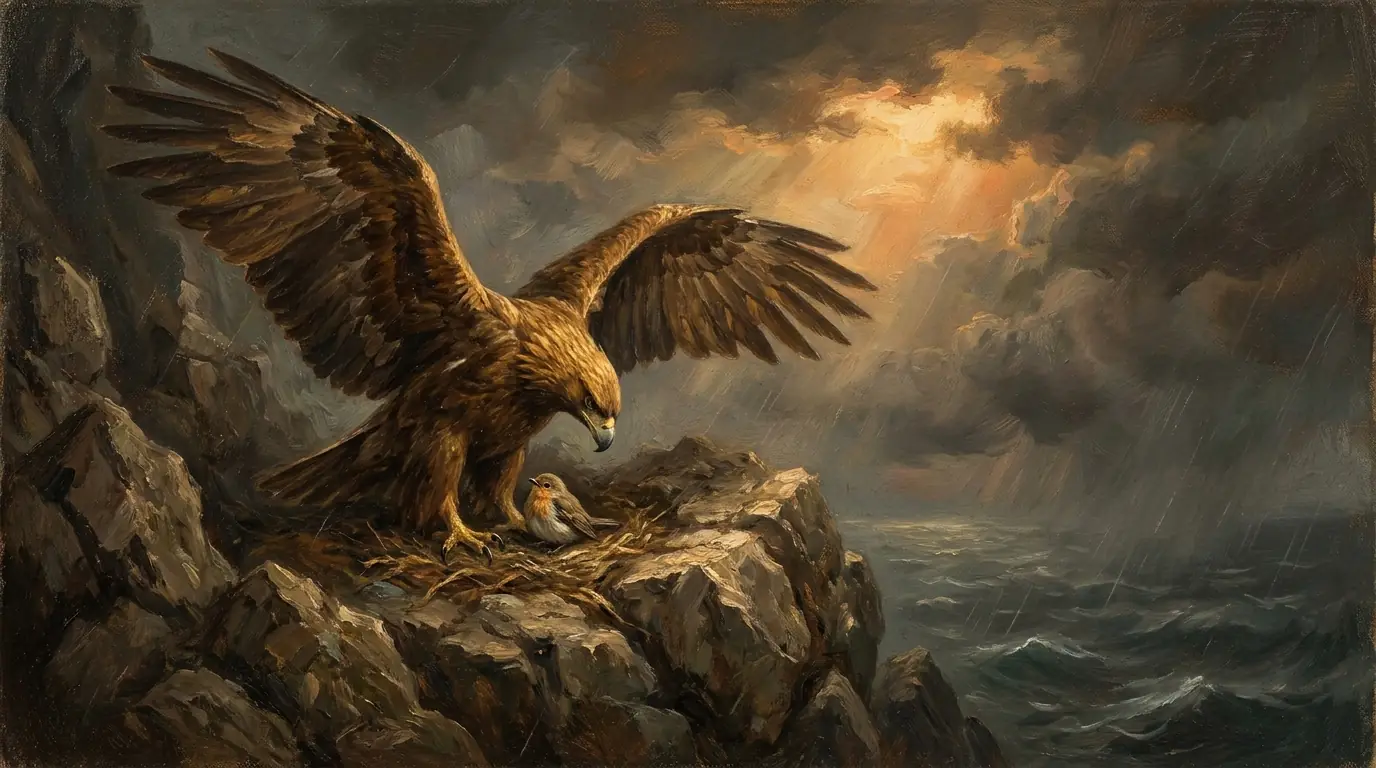
Few passages in the Bible circulate as detached from themselves as Psalm 91. One verse ends up on a phone lock screen, another on a framed print, a third under a travel photo. Each fragment works fine on its own, and that is exactly why most people who read Psalm 91 never read it whole. Below is the complete psalm, read it straight through, or listen to it narrated while you follow along, and after that, section by section, what each part actually says, including the piece most summaries leave out.
Psalm 91, in full
“He who dwells in the shelter of the Most High will abide in the shadow of the Almighty. I will say to the LORD, "You are my refuge and my fortress, my God, in whom I trust."”
“Surely He will deliver you from the snare of the fowler, and from the deadly plague. He will cover you with His feathers; under His wings you will find refuge; His faithfulness is a shield and rampart. You will not fear the terror of the night, nor the arrow that flies by day, nor the pestilence that stalks in the darkness, nor the calamity that destroys at noon. Though a thousand may fall at your side, and ten thousand at your right hand, no harm will come near you. You will only see it with your eyes and witness the punishment of the wicked.”
“Because you have made the LORD your dwelling — my refuge, the Most High — no evil will befall you, no plague will approach your tent. For He will command His angels concerning you to guard you in all your ways. They will lift you up in their hands, so that you will not strike your foot against a stone. You will tread on the lion and cobra; you will trample the young lion and serpent.”
“"Because he loves Me, I will deliver him; because he knows My name, I will protect him. When he calls out to Me, I will answer him; I will be with him in trouble. I will deliver him and honor him. With long life I will satisfy him and show him My salvation."”
What do the images in Psalm 91 stand for?
Psalm 91 is built from pictures. The table lists the main ones, the verse where each appears and what it points to. Reading the images one by one makes the whole psalm easier to hold.
| Image | Verse | What it points to |
|---|---|---|
| Shelter and shadow | Psalm 91:1 | A place to live, with cover from the sun and the heat of danger. |
| Refuge and fortress | Psalm 91:2 | A strong place to run to when things fall apart. |
| The fowler's snare | Psalm 91:3 | Hidden traps that catch people who did not see them coming. |
| Feathers and wings | Psalm 91:4 | The close, protective care of a parent bird. |
| Shield and rampart | Psalm 91:4 | Faithfulness that stands between you and what threatens you. |
| Terror by night and arrow by day | Psalm 91:5 | Fears that come at any hour. |
| Angels lifting you up | Psalm 91:11-12 | Care that reaches the small, ordinary steps. |
| Lion and cobra | Psalm 91:13 | Dangerous things that God's people can walk over. |
| God speaks | Psalm 91:14-16 | A promise to answer, to be present and to rescue. |
Notice how the pictures move from a quiet shelter to open danger, and end with God himself speaking. The psalm moves from a place of safety to a personal promise.
Who wrote Psalm 91, and when
The Hebrew text of Psalm 91 carries no title and no name, unusual within the Psalter itself, where a good share of the poems open with an attribution. The psalm right before it, Psalm 90, does have a title: "A Prayer of Moses, the man of God." That placement is what led Jewish tradition to associate Psalm 91, and several psalms after it, with Moses as well: a reasoning based on position in the scroll, with no signature in the text itself. Greek tradition took a different path: the Septuagint, the Greek translation of the Old Testament made a few centuries before Christ, labels the psalm "of David." Both traditions are old, neither comes from the psalm's own wording, and they disagree with each other. The honest answer is that the author is unknown, and the date cannot be fixed precisely from what survives: some features of the Hebrew suggest a later period in Israel's history, but that is a stylistic observation and falls short of proof.
Psalm 91:1-2, dwelling, not visiting
“He who dwells in the shelter of the Most High will abide in the shadow of the Almighty. I will say to the LORD, "You are my refuge and my fortress, my God, in whom I trust."”
The verb in the opening line is "dwells," a stronger word than "visits" or "passes through." The protection the rest of the psalm describes belongs to the one who lives there, and the person who shows up only in a crisis has to remember the address. Notice, too, the shift in person between the two verses: the first speaks of "he who dwells" in the third person, almost as an observation; the second switches to the first person, "I will say to the LORD", as if the psalmist is placing himself inside the description he just made. The structure reads as an invitation rather than an automatic guarantee: the safety that follows comes from living turned toward that shelter as a habit, and never from being in the right place by accident.
Psalm 91:3-8, from the snare to the fate of the wicked
“Surely He will deliver you from the snare of the fowler, and from the deadly plague. He will cover you with His feathers; under His wings you will find refuge; His faithfulness is a shield and rampart.”
The snare of the fowler is a bird trap: something hidden, built to catch someone who does not see danger coming. The image that follows, of feathers and wings, is maternal: a bird sheltering its young under its own body. The psalm then lists four dangers in pairs (the terror of the night and the arrow of the day, the pestilence in darkness and the calamity at noon) covering the full stretch of time, light and dark, visible and hidden. It is a deliberately complete list, in the Hebrew habit of naming the extremes to mean "everything." Verse 7, about a thousand falling at your side and ten thousand at your right hand, uses the same device: it is the war language of the period for describing a siege or a battle, with the one who trusts God pictured as walking through that scene untouched. Verse 8 is the most uncomfortable line in the passage: the one praying the psalm will "witness" the punishment of the wicked, which assumes the harm happened, just not to the speaker.
Psalm 91:9-13: the promise widens, the angels appear
“For He will command His angels concerning you to guard you in all your ways. They will lift you up in their hands, so that you will not strike your foot against a stone.”
These two verses are the most quoted outside the full psalm, and also the most misused: the reason shows up in the next section. Inside the psalm, they continue the earlier logic: protection that covers "all your ways," not only the moments of obvious danger. Verse 13, about treading on the lion and the cobra, closes the block with an image of dominion over what threatens by force (the lion) and what threatens by concealment (the serpent, which hides): the two kinds of danger the psalm has been naming since the snare of the fowler.
Psalm 91:14-16: the voice changes: now God answers
“"Because he loves Me, I will deliver him; because he knows My name, I will protect him. When he calls out to Me, I will answer him; I will be with him in trouble."”
Through verse 13, the psalmist has been speaking, describing God in the third person. In the final three verses, the voice changes: God begins to speak, in the first person, answering everything said before directly. It is a rare device within the Psalms, and it works almost like a signature at the bottom of a letter, after verses describing the shelter, God confirms the promise in his own voice. Notice that the promise is not the absence of trouble: verse 15 says "I will be with him in trouble," not "he will have no trouble." The presence is promised inside the difficulty, not as a substitute for it.
What Psalm 91 promises, and what it does not
This is the part most summaries of Psalm 91 skip, and it matters most to anyone praying the psalm expecting a specific outcome. The New Testament itself shows the risk of reading these verses as a physical guarantee: in Matthew 4:6, it is the devil who quotes verses 11 and 12 of Psalm 91 to tempt Jesus into jumping from the highest point of the temple, "for it is written: 'He will command his angels concerning you...'" Jesus does not correct the psalm, and he does not say it is wrong. He refuses the test, answering with a different passage instead: "Do not put the Lord your God to the test." The scene is precisely about turning a promise of refuge into proof of protection on demand, and that is exactly what Psalm 91 never offered.
When people search for this psalm
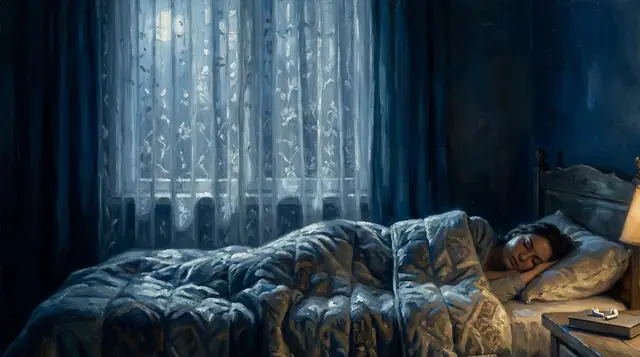
Psalm 91 comes up more at certain moments than others: before sleep, when fear grows on its own in the quiet of the night; before a trip, a surgery or a risky decision; during periods of concrete threat, like illness in the family or financial instability; and as a repeated prayer, almost a daily habit, for people who have already lived through some kind of deliverance and want to keep returning to the same text. None of these uses is wrong. Everything about the psalm suggests it was written to be recited in situations of real danger, close to a liturgy of protection. The caution is the one above: use it as a place to put your trust, not as a guarantee of outcome.
How can you pray Psalm 91 in your own words?
- 01Read verses 1 and 2 slowly and say them back as a personal statement: You are my refuge and my fortress.
- 02Name one fear you are carrying today, in one sentence.
- 03Read verses 4 to 6 aloud and ask God to be your shield in that specific area.
- 04Read verses 14 to 16 and listen to the promises God makes to the person who loves Him and calls on Him.
- 05Close with thanks for one way you have already seen His care.
A short prayer might sound like this. Lord, You are my shelter and my fortress. I bring You my fear about this day, and I trust You with it. Be with me in trouble, as You promised, and help me walk in Your care. Amen.
Keeping it together
In Terra Gospel you can highlight any section of Psalm 91 in one of four colors, write your own note, and keep it all under Favorites, so the verse you needed once is easy to find again. Reading, highlights, notes, favorites and the verse of the day are free in English, Portuguese and Spanish; the narrated audio Bible, including Psalm 91 read aloud, with background music and adjustable speed, is part of Premium.
Read Psalm 23 and Psalm 121 alongside it, and if you pray it at night, the audio Bible for sleep guide explains how to set up narration so it stops when you fall asleep.