"God is our refuge and strength" and "Be still, and know that I am God" are today two of the most reused lines on wall art, journal covers, and social captions: almost always standing alone, cut off from the rest of the psalm that holds them. The second one, especially, almost always shows up as an invitation to rest: stop, breathe, let God handle it. Few people who have repeated those lines have read Psalm 46 straight through, or know that its most quoted verse was written as an order aimed at nations at war, telling them to stop fighting and recognize who God is. Below is the complete psalm, read it straight through, or listen to it narrated while you follow along, and after that, section by section, what each part actually says, including its documented link to one of the most sung hymns of the Protestant Reformation.
Psalm 46, in full
“God is our refuge and strength, an ever-present help in times of trouble. Therefore we will not fear, though the earth is transformed and the mountains are toppled into the depths of the seas, though their waters roar and foam and the mountains quake in the surge. Selah”
“There is a river whose streams delight the city of God, the holy place where the Most High dwells. God is within her; she will not be moved. God will help her when morning dawns. Nations rage, kingdoms crumble; the earth melts when He lifts His voice. The LORD of Hosts is with us; the God of Jacob is our fortress. Selah”
“Come, see the works of the LORD, who brings devastation upon the earth. He makes wars to cease throughout the earth; He breaks the bow and shatters the spear; He burns the shields in the fire. "Be still and know that I am God; I will be exalted among the nations, I will be exalted over the earth." The LORD of Hosts is with us; the God of Jacob is our fortress. Selah”
The text above follows the Berean Standard Bible (BSB), produced by the Berean Bible Translation Committee in cooperation with Bible Hub, and dedicated to the public domain.
Who wrote Psalm 46, and when
The Hebrew heading of Psalm 46 does not credit the text to a single person: "For the choirmaster. Of the sons of Korah. According to Alamoth. A song." The sons of Korah were a Levite family responsible for temple music (a guild of singers and musicians, not one author) , and the same heading opens other psalms in the collection, such as Psalm 42, 44, and 84. "Alamoth" is a technical musical term whose exact meaning has been lost: the most widely accepted reading connects the word to high voices or high-pitched instruments, possibly "maidens' voices", and the same term shows up describing instruments or voices in 1 Chronicles 15:20. Unlike the heading of Psalm 27, which opens with "A Psalm of David," Psalm 46 carries no individual authorship claim and no specific episode from anyone's life.
That has not stopped commentators from trying to place the psalm in time. Many connect Psalm 46 to the siege of Jerusalem by the Assyrian king Sennacherib, during Hezekiah's reign: the episode recorded in 2 Kings 18-19 and Isaiah 36-37, in which the city escapes destruction after a siege that looked impossible to survive. The connection is plausible: the psalm describes a city that "will not be moved" while nations around it fall into panic, and it closes with God ending wars by force. But it is worth saying plainly that this link is a historical reading proposed by scholars, and the psalm's own heading says nothing of the kind. The text itself names no siege, no king, no year.
Psalm 46:1-3, refuge in the middle of the worst scenario imaginable
“God is our refuge and strength, an ever-present help in times of trouble. Therefore we will not fear, though the earth is transformed and the mountains are toppled into the depths of the seas, though their waters roar and foam and the mountains quake in the surge.”
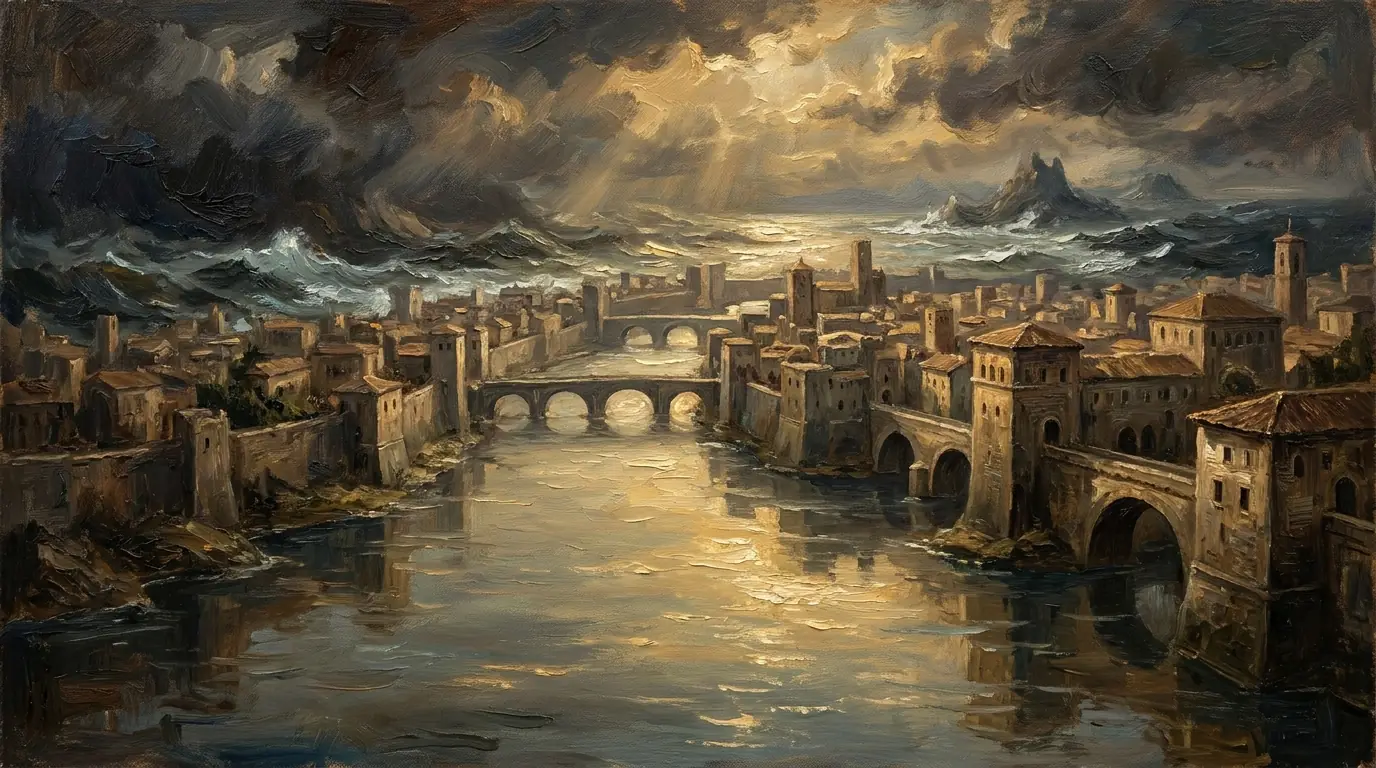
The psalm opens with a direct claim (God as refuge, as strength, as help that arrives right on time) and immediately tests that claim against the most extreme scenario Hebrew imagination could produce: the earth transformed, mountains toppled into the sea, waters roaring, mountains quaking. In an ancient world where mountains stood for the most stable thing in the landscape, describing mountains themselves being swallowed by the sea is describing the collapse of the world's own order, far beyond a passing scare. "We will not fear" is said staring straight at the most unstable scene the text can picture.
The word used for "trouble" in verse 1 is broad enough to cover both personal suffering and collective catastrophe, and the psalm does not choose which one is in view. It leaves the promise open to both. The "Selah" that closes verse 3 is a musical instruction whose exact meaning is also lost, but most scholars read it as a pause: an invitation for the reader, or the singer, to stop and let the image of chaos settle before moving to the next scene.
Psalm 46:4-7: the river that does not exist, and the city that cannot be moved
“There is a river whose streams delight the city of God, the holy place where the Most High dwells. God is within her; she will not be moved. God will help her when morning dawns.”
Verse 4 switches scenes without warning: from waters that roar and topple mountains to a river whose streams delight a city. The contrast is deliberate, and it carries a detail few modern readers notice. Jerusalem, unlike capitals such as Babylon on the Euphrates or Egyptian cities on the Nile, never had a major river. The city depended on smaller springs, such as the Gihon. A "river" whose streams delight the city of God points past literal geography, then, to something closer to God's own constant, life-giving presence, the same image that reappears, in different words, in Ezekiel 47 and Revelation 22.
Verse 5 answers verse 2 directly: there, "the earth is transformed" described the worst possible scenario; here, "she will not be moved" uses the same root idea of motion to describe the exact opposite, applied to the city where God dwells. The psalm's logic grants that the world around it shakes. It claims that the one fixed point in the middle of the shaking is God's nearness, with the natural stability of the ground playing no part. Verse 6 returns to chaos, now among nations, "nations rage, kingdoms crumble", and verse 7 closes the stanza with a refrain that repeats again at the end of the psalm: "The LORD of Hosts is with us; the God of Jacob is our fortress."
The hymn this psalm produced: Luther's "A Mighty Fortress Is Our God"
Psalm 46 has a well-documented historical link to one of the best-known hymns in Protestantism. In 1529, Martin Luther wrote "Ein feste Burg ist unser Gott", "A Mighty Fortress Is Our God", directly paraphrasing this psalm's images: God as an unshakable fortress in the middle of enemies and chaos. The hymn became so tied to the text that it is still called, in Bible reference sources and Reformation commentary, "Luther's Psalm." Charles Spurgeon, the 19th-century Baptist preacher, called Psalm 46 a "song of holy confidence," reinforcing the same reading. According to the traditional account of Luther's life, in his darkest moments he would tell his friends something like "come, let us sing the 46th psalm, and let them do their worst": a line the Reformation's biographical tradition attributes to him, not a quote with a dated primary source.
It is worth marking the difference between the two levels of certainty here: that Luther wrote "A Mighty Fortress Is Our God" in 1529, and that the hymn draws directly on Psalm 46's imagery, are well-established facts repeated across hymnology history sources. The specific line attributed to Luther about singing the psalm "and letting them do their worst," on the other hand, belongs to the Reformation's oral biographical tradition: the kind of anecdote passed down by later biographers, a story that can be neither proven nor disproven word for word as a quote recorded at the moment it was said.
Psalm 46:8-9: the God who ends wars, not just wins them
“Come, see the works of the LORD, who brings devastation upon the earth. He makes wars to cease throughout the earth; He breaks the bow and shatters the spear; He burns the shields in the fire.”
After two stanzas describing natural chaos and chaos among nations, the psalm invites the reader to witness something concrete: "come, see." What there is to see is the end of war as a category, "throughout the earth," far beyond one military victory over one specific enemy. The three verbs that follow are physical and final: breaking the bow, shattering the spear, burning the shields in the fire. This destroys the instrument of war itself, an image of ending, where a temporary disarming would leave an army free to fight the next battle with better weapons.
Psalm 46:10, what "be still and know that I am God" actually commands
“"Be still and know that I am God; I will be exalted among the nations, I will be exalted over the earth."”
This is the psalm's most quoted verse, and today it circulates almost exclusively as an invitation to personal relaxation, stop, breathe, let go of control. That reading carries a partial truth, but it is not what the verse says in the setting it actually sits in. The Hebrew verb behind "be still" literally means "let go," "release," or "stop": the same root used elsewhere to describe hands that drop from exhaustion or surrender. It is a plural imperative, aimed at a group, not a whispered word of individual comfort.
Who is the order aimed at? The verse itself answers in its second half: "I will be exalted among the nations, I will be exalted over the earth." "Nations" is the same word used in verse 6, describing peoples in uproar, and verse 10 arrives right after verses 8-9, which describe God ending wars and burning weapons. Read inside that sequence, "be still" sounds far less like an invitation to inner rest and far more like a ceasefire order aimed at hostile nations and their armies: stop fighting Me, stop resisting, and recognize who I am.
The verse keeps its devotional use, within the limits of what it can honestly support. The same Hebrew root behind "be still" appears in Exodus 14:13, when Moses tells the people, terrified in front of the Red Sea, to stand still while the LORD fights for them. There, the order really is addressed to God's own people, not an enemy: the difference in audience between the two passages is real, and worth knowing instead of treating both as saying the same thing. What Psalm 46 offers someone reading verse 10 for personal comfort is the same confidence the psalm opens with in verse 1: God remains refuge and strength even while nations roar like the sea of verse 3, and the final word, spoken in God's own voice, is that this uproar ends one day, even if it has not ended yet.
What Psalm 46 promises, and what it does not
The psalm's own structure answers that question before the reader even asks it. The text does not promise that the earth will stop shaking, that nations will stop raging, or that war will never come close. It describes exactly those things happening, at the peak of possible chaos, and places the promise somewhere else: in God's presence "within her," with danger still all around her. The city in verse 5 "will not be moved," and the reason is that God is inside it when the threats arrive. It is the same logic behind the refrain repeated in verses 7 and 11: "the LORD of Hosts is with us," said while the danger is still present.
When people search for this psalm
Psalm 46 shows up strongly in situations that closely mirror the images it uses. The first is fear in front of something that feels bigger than anyone can control: a natural disaster, a health crisis, news that shakes the ground the way the mountains do in verse 2. The second is anxiety over collective chaos: war, political instability, news that makes the world feel like it is "in uproar," the same language as verse 6. The third is the moment someone has to stop trying to fix everything through their own effort and trust something larger, because their own striving is no longer enough, with the problem still there, the same movement described in verse 10, even though the original order there was aimed at nations, not individuals.
What does each part of Psalm 46 say?
Psalm 46 has three stanzas and a refrain. Here is the whole shape of it in one table.
| Verses | Scene | What it means for you |
|---|---|---|
| 1-3 | Earthquake and roaring sea | God is a refuge and strength, so fear does not have the last word even when the world shakes. |
| 4-7 | A river and a city that stands | God is in the middle of His people, and the refrain says the LORD of hosts is with us. |
| 8-9 | The end of war | God stops the fighting and breaks the weapons, which is a promise of peace. |
| 10-11 | Be still | Stop striving and know that He is God. The refrain returns: the LORD of hosts is with us. |
Keeping it together
In Terra Gospel you can highlight any section of Psalm 46 in one of four colors, write your own note, and keep it all under Favorites, so the verse you needed once is easy to find again. Reading, highlights, notes, favorites and the verse of the day are free in English, Portuguese and Spanish; the narrated audio Bible, including Psalm 46 read aloud, with background music and adjustable speed, is part of Premium.
Psalm 46 belongs beside Psalm 91 and Psalm 121, and Bible verses about peace continues with the peace that holds while the ground is moving.