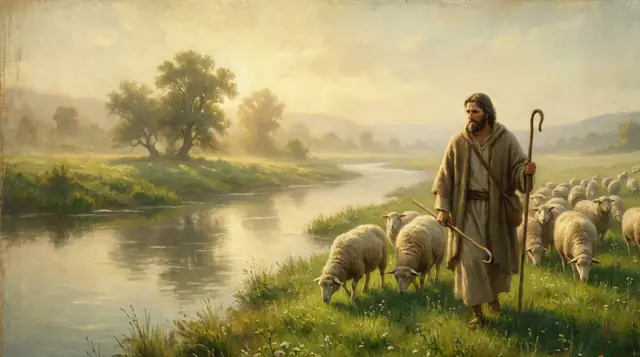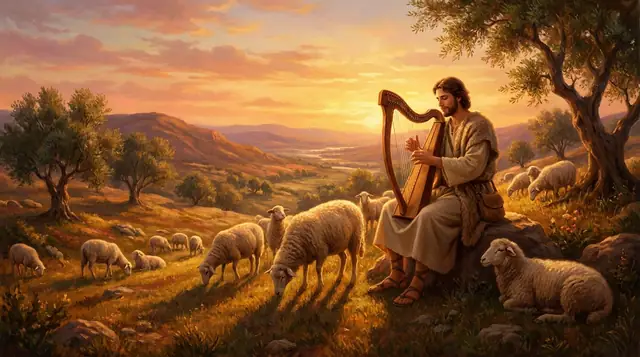
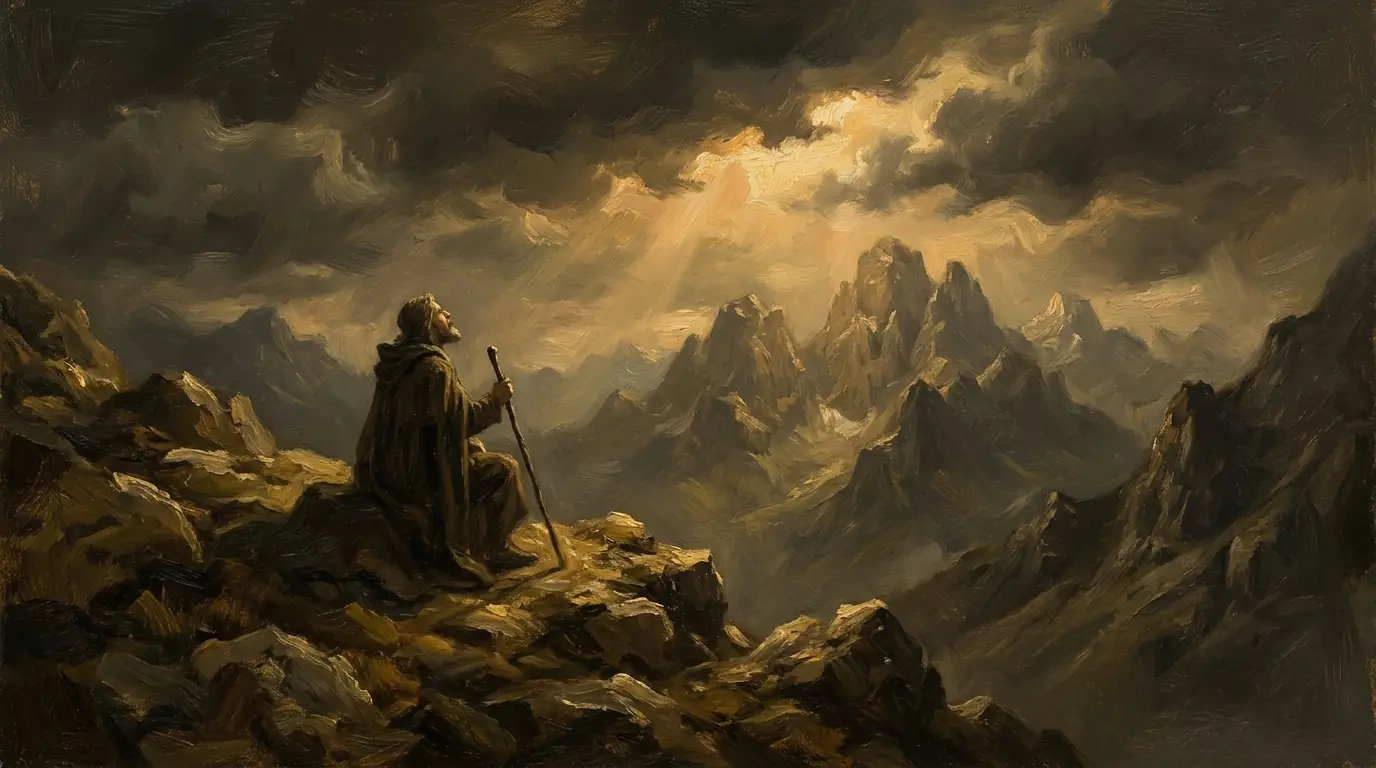
"I lift up my eyes to the hills" shows up today on hiking photo captions, car decals, and travel group chat headers, almost always on its own, stripped of the rest of the verse and the question it asks right after. Few people who have used that line have ever read Psalm 121 straight through, or know it belongs to a set of fifteen psalms sung by pilgrims climbing an actual road toward an actual city. Below is the complete psalm, read it straight through, or listen to it narrated while you follow along, and after that, verse by verse, what each part actually says, including a question scholars still argue over: were the hills in verse 1 a source of fear or of hope?
Psalm 121, in full
“I lift up my eyes to the hills. From where does my help come? My help comes from the LORD, the Maker of heaven and earth.”
“He will not allow your foot to slip; your Protector will not slumber. Behold, the Protector of Israel will neither slumber nor sleep. The LORD is your keeper; the LORD is the shade on your right hand. The sun will not strike you by day, nor the moon by night.”
“The LORD will guard you from all evil; He will preserve your soul. The LORD will watch over your coming and going, both now and forevermore.”
Who wrote Psalm 121, and when
The Hebrew heading on Psalm 121 carries no author's name. It carries a genre label instead. "Shir HaMa'alot," rendered here as "A song of ascents," is the same heading that opens Psalms 120 through 134, a block of fifteen poems known as the Songs of Ascents, or Pilgrim Songs. None of them names an author inside that heading; a few, like Psalm 122, 124 and 131, add "of David" as a second line, but Psalm 121 does not. The honest answer, as with Psalm 91, is that the author is unknown.
There are two old explanations for what "ascents" means, and neither cancels out the other. The more widely held one ties the title to pilgrimage: the law in Deuteronomy 16:16 required every Israelite man to appear at the sanctuary three times a year, for the feasts of Passover, Weeks, and Booths, and these fifteen psalms appear to have been composed or gathered to be sung on that climb. Jerusalem sits on elevated ground, and anyone coming up from Galilee or the Jordan Valley was, quite literally, ascending to get there. A second reading, recorded later in rabbinic tradition, ties the title to fifteen steps that connected the Court of the Women to the Court of Israel in the temple, on which, according to that tradition, the Levites stood to sing. Both explanations can hold at once: one describes the road up to the temple, the other the staircase inside it.
Psalm 121:1-2: the hills: danger, or the direction help comes from?
“I lift up my eyes to the hills. From where does my help come? My help comes from the LORD, the Maker of heaven and earth.”
Verse 1 is a question, not a statement, and the tone of that question is debated among people who study the text closely. One reading takes the hills as a source of threat: the roads leading up to Jerusalem cut through rough terrain where bandits could hide: the same kind of stretch described in the parable of the good Samaritan, in Luke 10:30, about a man beaten and robbed on the road between two towns in that region. Add to that the fact that in the Old Testament, "the hills" were also where the "high places" stood, shrines to other gods that Israel's kings repeatedly failed to tear down (2 Kings 17:9-11). Under that reading, the pilgrim looks up and sees exactly what he should fear: the dangerous road, and the temptation to look for help in the wrong place.
The opposite reading takes the same verse as hope, not fear: Jerusalem and Mount Zion sit surrounded by hills, "as the mountains surround Jerusalem, so the LORD surrounds his people," says Psalm 125:2, and the pilgrim, catching sight of the hills where the temple stands, would be lifting his eyes in the right direction, not the wrong one. Neither reading gets settled by the Hebrew alone; verse 1 ends on a question on purpose. What verse 2 does, either way, is redirect the answer: help comes "from the LORD, the Maker of heaven and earth," whether the hills mean danger or the skyline of the temple: the Creator stands behind whatever hill happens to be in view.
Psalm 121:3-4, "your Protector will not slumber"
“He will not allow your foot to slip; your Protector will not slumber. Behold, the Protector of Israel will neither slumber nor sleep.”
Starting at verse 3, the voice changes: up to this point the pilgrim has been speaking about himself; now a second voice answers him, in what many read as a call-and-response format between two parties, maybe the traveler and a companion, maybe a priest or Levite greeting pilgrims on arrival. The word repeated across this pair of verses is "Protector", in Hebrew, shomer, from the same root that shows up six times across the whole psalm, almost like a refrain.
"Will not slumber" carries more weight next to another Old Testament passage: in 1 Kings 18:27, the prophet Elijah taunts the prophets of Baal, suggesting their god might be "asleep" and need waking, since their shouting is getting no answer. It is a joke with theological weight behind it, several religions of the ancient Near East pictured their gods as beings who slept, traveled, or got distracted. Psalm 121 rules that out directly, twice in the same pair of verses: the guardian of Israel does not clock out.
Psalm 121:5-6, shade at your right hand, sun by day, moon by night
“The LORD is your keeper; the LORD is the shade on your right hand. The sun will not strike you by day, nor the moon by night.”
"On your right hand" is not a decorative detail. In Hebrew poetry, the position at someone's right side is the place of a defender or ally: the same place described in Psalm 16:8, when the psalmist says "because He is at my right hand, I will not be shaken." Placing God as "the shade on your right hand" puts Him where He covers the traveler's most exposed flank, ready to act, not as a distant presence watching from far off.
Verse 6 names two dangers that span the full day, from sunrise to night, in the same habit of pairing extremes to mean "everything" found elsewhere in the Psalms. Strong sun was a real risk for anyone walking for hours along shadeless roads, heatstroke is still a genuine danger on any long trek on foot. Fear of the moon, on the other hand, reflects a belief common across the ancient world, linking nighttime exposure to moonlight with sickness or mental disturbance: the English word "lunatic" itself carries that history. The psalm says that neither fear, the rational one and the superstitious one, reaches anyone under this guardian's care, and it stays silent on astronomy.
Psalm 121:7-8, "your going out and your coming in"
“The LORD will guard you from all evil; He will preserve your soul. The LORD will watch over your coming and going, both now and forevermore.”
"Coming and going" is another complete-pair expression in Hebrew, like "day and night" in the verse before it. It describes the entire arc of a life, well beyond two specific moments: leaving home and returning to it, setting out and arriving, starting and finishing. The same pairing shows up in the priestly blessing of Numbers 6:24-25, "the LORD bless you and keep you," built on the same Hebrew root, shamar, to guard, that carries the whole psalm. The closing verse stretches that coverage across time: "both now and forevermore" closes a psalm that opened with an anxious question aimed at the horizon, and ends by saying that the answer to it never expires.
What Psalm 121 promises, and what it does not
The psalm's own setting hints at the limit of the promise. It appears to have been written for pilgrims who genuinely faced the risks the text names, mountain roads, heat, exposure, bandits. Nothing in biblical history suggests pilgrims stopped having accidents, getting sick, or being robbed once they started singing this psalm; the parable of the good Samaritan itself, told centuries later in a very similar setting, describes exactly the kind of harm Psalm 121 promises to guard against. The central promise is a guardian who never leaves the post on any stretch of a road that still holds danger.
When people search for this psalm
Psalm 121 shows up strongly in three fairly distinct moments. The first is before a trip, by car, by plane, or on foot, echoing almost literally the setting it was written for. The second is at goodbyes: when a child leaves home for school far away, when someone moves to a new city or country, when a family member travels for treatment somewhere distant. The third is as a prayer over children, especially once they are out of a parent's direct reach, at school, at college, on the road alone for the first time, reaching for verse 8's picture of a guardian who covers the going out and the coming in even when no one else is watching. None of these uses is wrong; the caution is the usual one, read the psalm as trust for the road, not as exemption from every risk on it.
What does each part of Psalm 121 say at a glance?
Keep this table nearby when you want the one verse you need. Each row is one stanza, with the picture it uses and what it tells you.
| Verses | Picture | What it tells you |
|---|---|---|
| 1-2 | Eyes lifted to the hills | The question about where help comes from gets its answer: help comes from the LORD, who made heaven and earth. |
| 3-4 | A guard who never sleeps | Your Protector does not slip and does not doze, so you can rest while He watches. |
| 5-6 | Shade at your right hand | God stays close through the heat of the day and the dark of the night. |
| 7-8 | Going out and coming in | Every trip, every return and every ordinary day is under His keeping, now and always. |
Keeping it together
In Terra Gospel you can highlight any section of Psalm 121 in one of four colors, write your own note, and keep it all under Favorites, so the verse you needed once is easy to find again. Reading, highlights, notes, favorites and the verse of the day are free in English, Portuguese and Spanish; the narrated audio Bible, including Psalm 121 read aloud, with background music and adjustable speed, is part of Premium.
Psalms of protection often travel together, so read Psalm 91 and Psalm 46 next, and take Bible verses about strength with you for the hard road ahead.