The book of Esther runs ten chapters, and not one of them mentions God by name, not once, in either of the two Hebrew textual traditions that survive today. It is the only book in the Hebrew Bible with that feature, which is probably why Esther tends to disappear from the version told out loud before it gets halfway through: people remember the beauty contest and the line about 'such a time as this,' and the rest quietly drops out: the extermination decree sealed with the king's own ring, the real position of a young woman brought to the palace without being consulted, and the armed response of the Jews in chapter 9, with numbers the text does not hide. Below is the full story, chapter by chapter, with the verses behind every turn, including the parts the read-aloud version usually skips.
Vashti, the queen who said no
The story opens in the court of King Xerxes, generally identified by historians with Xerxes I of Persia, at a feast that ran a full 180 days to display the wealth of the kingdom, followed by another seven days of feasting for everyone in the citadel of Susa (Esther 1:3-5). On the seventh day, with his heart merry with wine, the king sends for Queen Vashti so his guests can see her beauty, and she refuses (1:10-12). The text never says why. Tradition offers more than one reading: some read the refusal as a matter of dignity, a queen declining to be paraded before a hall of drunk men; others point out that Vashti was hosting her own banquet for the women at that same hour (1:9), and that not wanting to leave it is also a plausible motive. The text simply does not settle the question, and any confident answer goes beyond what is written.
What the text does make clear is the king's reaction: fury, and a council of seven princes summoned to decide what the law requires (1:13-15). One of them, Memucan, argues that Vashti's refusal will teach every woman in the empire to despise her own husband, and proposes an irreversible decree.
“So if it pleases the king, let him issue a royal decree, and let it be recorded in the laws of Persia and Media so that it cannot be repealed, that Vashti shall never again enter the presence of King Xerxes, and that her royal position shall be given to a woman better than she.”
The decree is approved, and letters go out to every province of the empire, in each people's own script and language, proclaiming that every man should be master of his own household (1:21-22): an empire-wide law born out of a single household dispute. Vashti exits the story in this chapter and is never mentioned again in the nine that follow.
The contest, and Esther's vulnerable position
With the throne empty, the king's attendants propose gathering the most beautiful young women of the empire into the citadel of Susa so he can choose a new queen (2:2-4). Among them is Hadassah, better known by her Persian name Esther, orphaned of both parents, raised by her cousin Mordecai as his own daughter (2:5-7). The text does not romanticize what follows: the young women are taken, 'Esther was also taken to the palace' is the text's own phrasing (2:8), and each spends a full year under beauty treatments in Hegai's care before she is even considered (2:9, 2:12). None of them chose to enter the contest. None of them was asked.
On Mordecai's instruction, Esther does not reveal her Jewish identity to anyone in the palace (2:10): a secret she keeps for years, one that will grow expensive later, once silence stops being safe. When each young woman's turn came to go before the king, the text describes the arrangement without softening it: she would go in the evening, and in the morning return to a second harem under a different eunuch in charge of the concubines, and she would not return to the king unless he delighted in her and summoned her by name (2:13-14). It is that system, and no palace fairy tale, that puts Esther on the throne: she pleases the king more than any of the others, and he crowns her queen in Vashti's place (2:17).
Mordecai, Haman, and the decree to destroy
Still in chapter 2, sitting at the king's gate, Mordecai uncovers a plot by two of the king's eunuchs to assassinate him, tells Esther, who reports it to the king in Mordecai's name, and the event is written into the palace chronicles, with no reward given at the time (2:21-23). It looks like a minor detail. It is not: the text is quietly setting up the piece that decides everything, three chapters later.
In chapter 3, the king promotes Haman the Agagite above every other official and orders everyone to bow to him. Mordecai refuses (3:1-2): the text never says whether it is religious conviction, ethnic pride, or both, only that he had already identified himself as a Jew (3:4). Haman is filled with rage, and decides that laying hands on Mordecai alone is not enough. He sets out to destroy all of Mordecai's people (3:5-6). He casts the Pur (the lot, in Hebrew, and the origin of the name Purim) to pick the day, then proposes an extermination decree to the king, offering ten thousand talents of silver for the royal treasury (3:7-9). The king hands Haman his own signet ring without even asking the name of the people in question (3:10-11), and the decree goes out:
“And the letters were sent by couriers to each of the royal provinces with the order to destroy, kill, and annihilate all the Jews—young and old, women and children—and to plunder their possessions on a single day, the thirteenth day of Adar, the twelfth month.”
The chapter closes on an image that sums up the whole book's contrast in a single sentence: 'the king and Haman sat down to drink, but the city of Susa was in confusion' (3:15).
'For such a time as this'
When Mordecai hears of the decree, he tears his clothes, puts on sackcloth and ashes, and goes out into the middle of the city, where no one dressed for mourning is allowed through the gate (4:1-2). Esther, still not knowing why, sends clothes for him, refused, then sends a eunuch to find out what is wrong (4:4-5). Mordecai tells him everything and asks that she go to the king to beg for her people (4:6-8). Esther answers with the actual risk that request carries: entering the king's presence unsummoned is a death sentence unless he extends the gold scepter, and it had been thirty days since she was last called (4:11). That is when Mordecai answers with the book's most quoted line, rarely quoted in full:
“Do not imagine that because you are in the king's palace you alone will escape the fate of all the Jews. For if you remain silent at this time, relief and deliverance for the Jews will arise from another place, but you and your father's house will perish. And who knows if perhaps you have come to the kingdom for such a time as this?”
The detail the isolated quote always loses is the middle of it: Mordecai tells Esther that if she stays silent, relief for the people will come from somewhere else regardless, and that she and her father's house will perish for having stood apart from it. The question 'who knows' is an open question, put to someone who can still choose, and it guarantees no destiny and proves no single plan.
The fast
Esther answers by asking that every Jew in Susa fast for her, three days, night and day, while she and her maidens do the same, and only then will she go to the king, even though it is against the law.
“Go and assemble all the Jews who can be found in Susa, and fast for me. Do not eat or drink for three days, night or day, and I and my maidens will fast as you do. After that, I will go to the king, even though it is against the law. And if I perish, I perish!”
It is the one decision in the whole book made with no guarantee attached: no vision, no prophet, no direct promise. Just a communal fast and a sentence that accepts the worst possible outcome before acting at all.
The two banquets
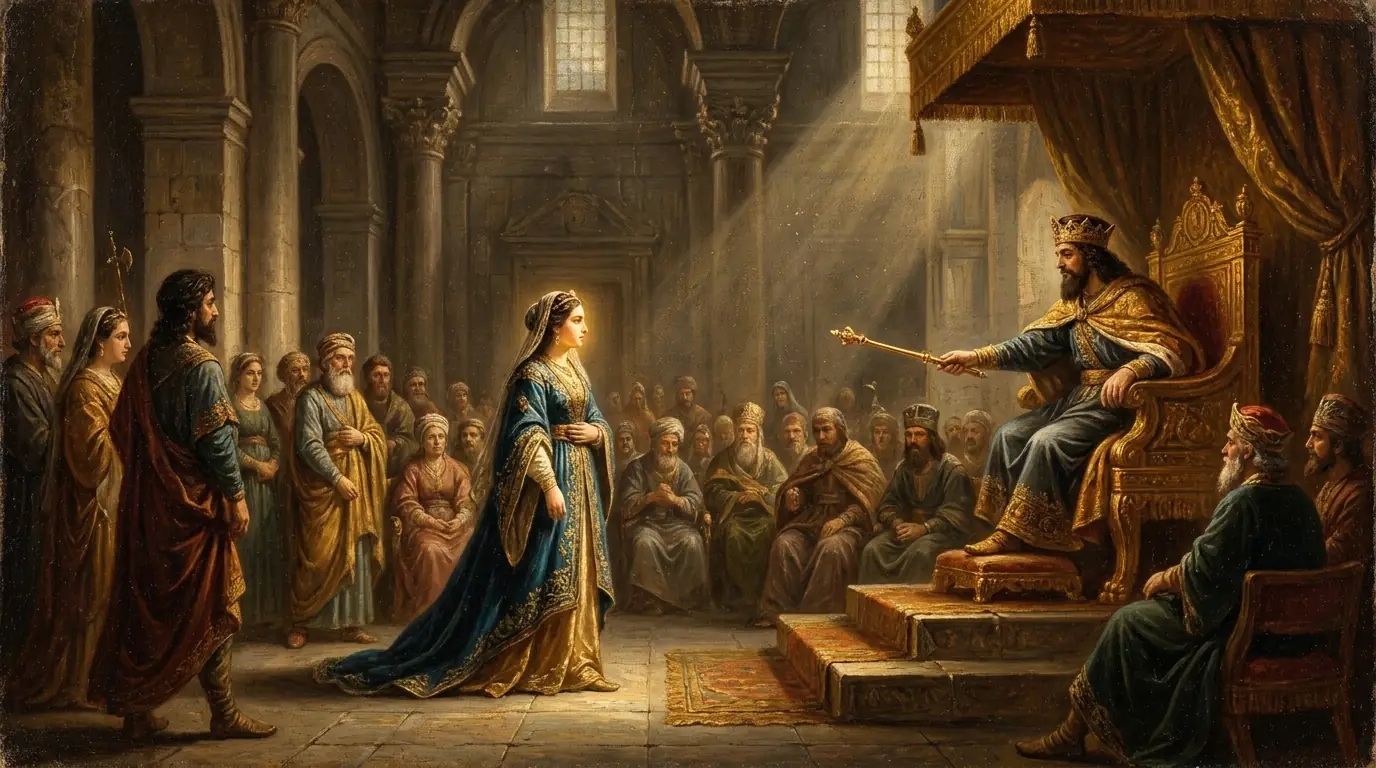
On the third day, Esther puts on her royal robes and stands in the inner court, and the king holds out the gold scepter (5:1-2). Instead of making her request there, she invites the king and Haman to a banquet; at the banquet, she invites them both to a second banquet the next day (5:3-8). Haman leaves elated, until he passes Mordecai, who again refuses to bow, and the joy curdles into rage (5:9). At home, on the advice of his wife Zeresh and his friends, Haman has a gallows built seventy-five feet high to hang Mordecai the very next morning (5:13-14).
The night the king could not sleep
It is that same night that the plot turns, and it turns without any character planning the turn. The text records what happens next flatly, the way you'd note a coincidence, and gives no reason at all.
“That night sleep escaped the king; so he ordered the Book of Records, the Chronicles, to be brought in and read to him. And there it was found recorded that Mordecai had exposed Bigthana and Teresh, two of the eunuchs who guarded the king's entrance, when they had conspired to assassinate King Xerxes.”
The king asks what honor Mordecai received for this, and the answer is: none (6:3). At that exact moment, Haman enters the outer court to ask permission to hang Mordecai, and before he can even say it, the king asks what should be done for a man the king wishes to honor. Haman, sure the compliment is meant for him, suggests the royal robes, the king's own horse, and a parade through the city (6:6-9). The king orders Haman to do exactly that, for Mordecai (6:10). It is Haman himself who leads his enemy's horse through the streets of Susa, proclaiming his honor.
Haman on the gallows he built
At the second banquet, the king again asks for Esther's request, and she finally answers, revealing that she is Jewish and that her people have been sold to be destroyed, killed, and annihilated (7:3-4). When the king asks who dared plot this, Esther's reply is direct: 'The adversary and enemy is this wicked man. Haman!' (7:6). The king storms out to the palace garden in fury; Haman, in a panic, falls on the couch where Esther is reclining to beg for his life, and it is at that exact instant that the king walks back in (7:7-8). One of the eunuchs remembers the gallows Haman had built for Mordecai.
“So they hanged Haman on the gallows he had prepared for Mordecai. Then the fury of the king subsided.”
The decree that let the Jews defend themselves
A royal decree, once sealed with the king's ring, cannot be revoked, not even by the king himself (8:8), which is why Haman's plot stays dangerous even after Haman is dead. The fix is a second decree authorizing the Jews to defend themselves, since the extermination decree cannot be canceled.
“By these letters the king permitted the Jews in each and every city the right to assemble and defend themselves, to destroy, kill, and annihilate all the forces of any people or province hostile to them, including women and children, and to plunder their possessions.”
The second decree mirrors the first almost word for word: the difference is the direction of the violence it authorizes, not the scale of the language itself. Mordecai, now wearing Haman's old signet ring, leaves the palace in royal robes, and the city of Susa celebrates (8:15-17).
Purim
On the thirteenth of Adar, the very day Haman had chosen for the extermination, the Jews gather to defend themselves. In Susa, they kill five hundred men, including Haman's ten sons, who are then hanged on the gallows at Esther's own request (9:6-14). Across the rest of the provinces, the number reaches 75,000 (9:16), and the text notes, three separate times, the exact same detail: even though the decree permitted plunder, 'they did not lay a hand on the plunder' (9:10, 9:15, 9:16). It is a precision the book itself insists on repeating, and it is worth keeping intact, without rounding it off or dramatizing it: the text narrates a state-authorized civil conflict, with concrete numbers, never celebrating the body count as a triumph and never hiding that it happened.
Out of relief after the killing comes the holiday. Mordecai writes letters to every Jew in the empire, establishing the fourteenth and fifteenth of Adar as an annual observance, days of feasting, joy, sending food to one another, and giving to the poor (9:20-22).
“Therefore these days are called Purim, from the word Pur. Because of all the instructions in this letter, and because of all they had seen and experienced, the Jews bound themselves to establish the custom that they and their descendants and all who join them should not fail to celebrate these two days at the appointed time each and every year... These days should be remembered and celebrated by every generation, family, province, and city.”
The book closes with two short verses on Mordecai's greatness, now second in command under the king, 'as he became more and more powerful' and worked for the good of his people (10:3).
What the story does not say
God's absence from the book of Esther is not a transmission accident. Both major Hebrew manuscript traditions agree on the point, and that single feature, more than anything else, is what has fueled the oldest debate about the book inside Jewish tradition itself: should it even be in the canon? The answer that prevailed was yes, but the fact that the question got asked at all says something about how the book works. Instead of an angel, a voice from heaven, or a prophet spelling out the plan, what the text offers is a chain of coincidences that only make sense taken together: the king's sleeplessness on that exact night, the chronicles read at that exact passage, Haman walking into the courtyard at the exact moment the king decides to honor someone. No single coincidence, on its own, proves anything. Together, they carry the book's whole unstated argument.
The second thing the text refuses to do is dress up what happened to the young women brought to the palace, or the violence of chapter 9. Esther is taken, like every other young woman, into a system where one night with the king could mean never being summoned again (2:14), and the text gives her no choice in entering the contest. And the Jews' armed response, even though a royal decree authorized it against an extermination already set in motion, is not told as a weightless triumph: the text gives exact numbers, five hundred in Susa, another three hundred the next day, 75,000 across the provinces, and repeats three times that no one touched the plunder, a detail that marks the line between defense and looting without erasing the scale of what happened.
Reading and listening guide: Esther 1 through 10
The book of Esther runs ten chapters, one of the shortest historical books in the Old Testament. Read aloud at roughly 175 words per minute, the pace used for this site's audio Bible, it takes about 40 minutes, with background music and speed control, available on Terra Gospel Premium.
- Esther 1: the feast, Vashti's refusal, and her deposal
- Esther 2: the search for a new queen and Esther's rise
- Esther 3: Haman's rise and the decree to destroy the Jews
- Esther 4: Mordecai's appeal and 'for such a time as this'
- Esther 5: Esther approaches the king and the first banquet
- Esther 6: the king's sleepless night and Mordecai's honor
- Esther 7: the second banquet and Haman's fall
- Esther 8: the decree allowing the Jews to defend themselves
- Esther 9: the days of battle and the origin of Purim
- Esther 10: Mordecai's greatness and the book's close
Who are the main people in the story of Esther?
The book of Esther has a small cast. This table helps you keep track of who is who, and where each person turns the story.
| Person | Role | Turning point |
|---|---|---|
| Ahasuerus | King of Persia, also known as Xerxes | Removes Vashti, then chooses Esther (Esther 1 and 2). |
| Vashti | The queen who refused the king's summons | Her refusal ends her time as queen (Esther 1). |
| Esther | A Jewish orphan raised by her cousin, who becomes queen | Risks her life to approach the king (Esther 4:16). |
| Mordecai | Esther's cousin and guardian | Refuses to bow to Haman and urges Esther to act (Esther 4:13-14). |
| Haman | The king's highest official | Plans to destroy the Jews and ends on his own gallows (Esther 7:10). |
Keeping it all together
On Terra Gospel you can highlight any passage in the story of Esther in one of four colors, add your own note, and keep it all in Favorites, useful in a story where it's worth marking both 'who knows... for such a time as this' and the book's silence about God, so you can go back and hold the two side by side later. Reading, highlights, notes, favorites, and the verse of the day are free in English, Portuguese, and Spanish; the narrated Bible, including these ten chapters read aloud, with background music and speed control, is part of Premium.
Two more stories of reversal are worth reading next: the story of Joseph and the story of David. For courage in the face of fear, see Bible verses about strength.