The story of Joseph takes up fourteen chapters of Genesis, 37 through 50, more space than the book gives to Abraham or to Jacob, and most people who know the story only know the high points: the coat, the pit, Egypt, the forgiveness. Between those high points sit whole years of waiting with no explanation, a false accusation, a prison sentence, a man who promises to remember and forgets. Below is the full story, chapter by chapter, with the verses behind each turn, and at the end, what the text itself leaves out, including the exact count of how long Joseph waited.
Who Joseph was, and where the story begins
“This is the account of Jacob. When Joseph was seventeen years old, he was tending the flock with his brothers, the sons of his father's wives Bilhah and Zilpah, and he brought their father a bad report about them. Now Israel loved Joseph more than his other sons, because Joseph had been born to him in his old age; so he made him a robe of many colors. When Joseph's brothers saw that their father loved him more than any of them, they hated him and could not speak a kind word to him.”
Joseph was the eleventh of Jacob's twelve sons, and the first born to Rachel, the wife Jacob loved most. The text keeps the favoritism in full view and states plainly that Israel, Jacob's other name, loved Joseph more than all his other sons, and names the reason as Joseph being born in his father's old age. The robe of many colors made that favoritism visible every single day, out in the field, in front of the brothers working alongside him. Verse 2 adds a second detail that carries its own weight: Joseph brought their father bad reports about his brothers: the text does not say whether the reports were true, only that he carried them.
The coat, the dreams, and the hatred that grew at home
After the coat came the dreams. In Genesis 37:5-8, Joseph dreams that his brothers' sheaves of grain bow down to his sheaf; he tells them the dream, and they hate him even more for it. In 37:9-11, a second dream follows: the sun, the moon, and eleven stars bow down to him. This time even his father rebukes him, 'Are your mother and I and your brothers actually going to come and bow down to the ground before you?', but the text adds a line that changes the tone of the rebuke: his father kept the matter in mind, rather than dismissing it outright. His brothers, by contrast, kept nothing in mind. They simply hated him openly from then on.
The pit and the sale
Jacob sends Joseph out to Shechem, where his brothers were pasturing the flock, to check on them and bring back word (Genesis 37:12-14). The brothers see him coming from a distance and plot to kill him before he even reaches them (37:18-20). Reuben steps in and suggests throwing him into an empty cistern instead, without shedding blood: the text explains that Reuben's plan was to come back later and pull him out in secret, to return him to their father (37:21-22). Here is what happens next:
“So when Joseph came to his brothers, they stripped him of his robe—the robe of many colors he was wearing—and they took him and threw him into the pit. Now the pit was empty, with no water in it. And as they sat down to eat a meal, they looked up and saw a caravan of Ishmaelites coming from Gilead [...]. Then Judah said to his brothers, 'What profit will we gain if we kill our brother and cover up his blood? Come, let us sell him to the Ishmaelites and not lay a hand on him; for he is our brother, our own flesh.' And they agreed. So when the Midianite traders passed by, his brothers pulled Joseph out of the pit and sold him for twenty shekels of silver to the Ishmaelites, who took him to Egypt.”
The text itself names two groups in the same scene, Ishmaelites and Midianites, without explaining the difference between them; that is the language of the chapter as it stands, and this article smooths over no inconsistency. What comes through clearly is the mechanism: Reuben plans a rescue that never happens, because he is not there when Judah proposes selling Joseph instead of killing him. When Reuben comes back to the cistern, it is already empty, and he tears his own clothes in despair (37:29-30).
Jacob in mourning: the father who did not know
The brothers dip Joseph's robe in goat's blood and bring it to their father, letting him draw his own conclusion (37:31-33). Jacob concludes that a wild animal devoured his son.
“Then Jacob tore his clothes, put sackcloth around his waist, and mourned for his son many days. All his sons and daughters tried to comfort him, but he refused to be comforted. 'No,' he said. 'I will go down to Sheol mourning for my son.' So his father wept for him.”
Between that mourning and the next chapter of Joseph's story, Genesis opens an entire chapter's worth of parenthesis (the story of Judah and Tamar, in Genesis 38) important for the family's genealogy, but outside Joseph's arc, and left out of the summary below for that reason. It is a reminder that the Bible, even in the middle of a story already in motion, will stop to tell another one.
Potiphar and the false accusation
Joseph arrives in Egypt as a slave and is bought by Potiphar, captain of Pharaoh's guard (39:1). The text says the LORD was with Joseph, and Potiphar notices it. He puts Joseph in charge of his entire household, and everything prospers under his care (39:2-6). That is the setting in which Potiphar's wife begins to press him:
“No one in this house is greater than I am. He has withheld nothing from me except you, because you are his wife. So how could I do such a great evil and sin against God?”
Joseph refuses her, day after day, until the moment she grabs his garment and he flees, leaving it in her hand (39:10-12). Potiphar's wife uses that same garment as evidence for a false accusation against Joseph (39:13-18), and Potiphar sends him to the prison where the king's prisoners were kept, not execution, which would have been the normal punishment for the crime he was accused of, a detail the text does not explain (39:19-20). Even there, the same pattern holds: 'the LORD was with him and extended kindness to him, granting him favor in the eyes of the prison warden' (39:21).
Prison, and the dreams no one remembered
In prison, two of Pharaoh's officials (the chief cupbearer and the chief baker) are imprisoned, and each has a dream on the same night (Genesis 40:1-8). Joseph interprets both: in three days the cupbearer will be restored to his position, and in three days the baker will be executed (40:9-19). Joseph asks the cupbearer to remember him before Pharaoh once he is restored (40:14-15). Both dreams come true exactly as Joseph said, and still, the chapter ends on a line that carries more weight than it looks like on first read: the chief cupbearer did not remember Joseph; he forgot him (40:23). Two full years pass before the next chapter begins.
Pharaoh's dreams, and the turn
Two years later, Pharaoh has two dreams that no one in his court can interpret: seven fat cows devoured by seven gaunt cows, seven full heads of grain devoured by seven withered ones (41:1-8). Only then does the cupbearer finally remember Joseph (41:9-13). Pharaoh sends for him:
“Pharaoh said to Joseph, 'I had a dream, and no one can interpret it. But I have heard it said of you that when you hear a dream you can interpret it.' 'I myself cannot do it,' Joseph replied, 'but God will give Pharaoh a sound answer.'”
Joseph interprets both dreams as a single warning: seven years of abundance followed by seven years of famine (41:25-32), and suggests Pharaoh appoint someone to organize grain storage during the good years (41:33-36). Pharaoh decides that person is Joseph himself.
From prisoner to governor
In a handful of verses, Joseph goes from the dungeon to the second-highest authority in Egypt, given a new Egyptian name and a wife by Pharaoh's own hand (41:14, 41:37-45). After years without control over his own life, the text marks the moment with an exact number:
“Now Joseph was thirty years old when he entered the service of Pharaoh king of Egypt. And Joseph left Pharaoh's presence and traveled throughout the land of Egypt.”
What the story does not say
At no point between Genesis 37 and 41 does the text record God speaking directly to Joseph, explaining what was happening or why. That stands in contrast to Abraham, Isaac, and Jacob himself, who each receive visions and promises recorded in direct speech. About Joseph, the text only ever repeats that 'the LORD was with him' (39:2, 39:21, 39:23), presence, not explanation. The first time Joseph puts any meaning to what he went through is years later, when he reveals himself to his brothers, in hindsight, not a voice explaining anything to him while the suffering was happening.
The years of waiting are also real, and they can be counted straight from the text itself. Genesis 37:2 says Joseph was seventeen when the story begins, and it is in that same chapter that he is sold. Genesis 41:46 says he was thirty when he was presented to Pharaoh as governor. Thirteen years run between the two markers: time in Potiphar's house, the prison sentence, and two more full years after correctly interpreting the cupbearer's and the baker's dreams, forgotten by the very man who had promised to remember him (40:23; 41:1). Thirteen years is a major detail of chronology: the real size of the gap between the fall and the turn, larger than most retellings let on when they compress 'pit, prison, palace' into a sequence that sounds fast.
The brothers come down to Egypt: the test
Seven years of abundance pass, and the famine arrives exactly as Joseph predicted, across the whole region, Egypt and Canaan included (41:53-57). Jacob sends ten of his sons to Egypt to buy grain, but keeps back Benjamin, the youngest, the only remaining son of Rachel (42:1-4). The brothers bow before the Egyptian governor without recognizing him: the exact fulfillment of the dream that had enraged them twenty years earlier. Joseph recognizes them, but does not identify himself; he accuses them of being spies, holds Simeon as a hostage, and demands they bring Benjamin on their next trip to prove they are telling the truth (42:6-24).
Jacob resists letting Benjamin go for a long time. He only gives in once the famine worsens and Judah personally guarantees his younger brother's safety (43:1-14). On the second trip, Joseph weeps in private at the sight of Benjamin, then composes himself and hosts them at a feast, seating them in exact birth order, which leaves them baffled, unable to explain how this Egyptian stranger could know the correct order (43:29-34). Before they leave, Joseph has a silver cup hidden in Benjamin's sack, then sends men to overtake them and accuse them of theft (44:1-13). It is Judah (the same brother who, twenty years earlier, had proposed selling Joseph) who now offers himself as a slave in Benjamin's place, describing in detail what losing another son would do to their father (44:18-34). It is the moment Joseph sees that his brothers have changed.
"I am Joseph": the reveal
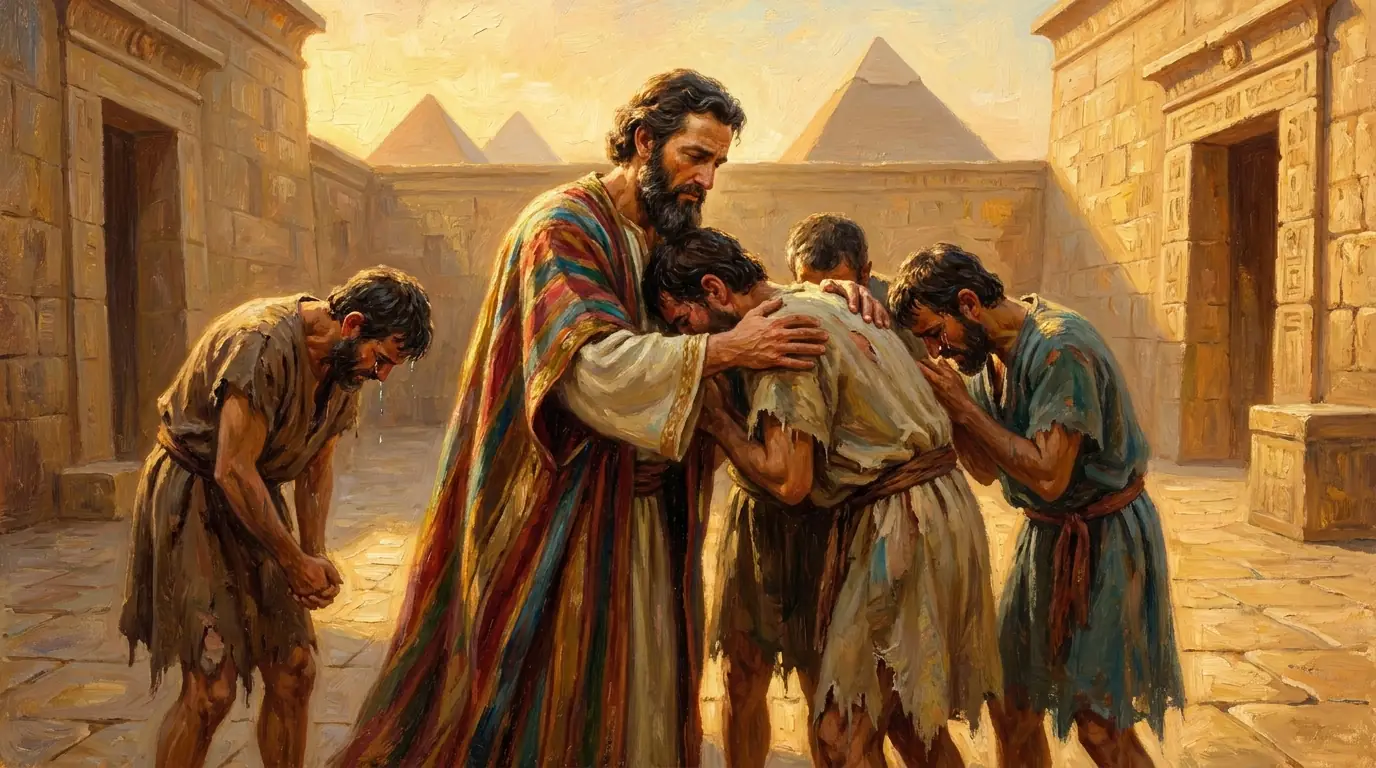
Joseph cannot hold back any longer. He sends every Egyptian out of the room and weeps so loudly that the Egyptians outside can hear him (45:1-2).
“Then Joseph said to his brothers, 'Please come near me.' And they did so. 'I am Joseph, your brother,' he said, 'the one you sold into Egypt! And now, do not be distressed or angry with yourselves that you sold me into this place, because it was to save lives that God sent me before you.'”
Joseph lays out the logic of the famine, two years gone already, five more still to come (45:6), and tells his brothers to hurry and bring their father back with them. Pharaoh approves the plan and offers wagons and provisions for the whole family's move (45:16-24). When the brothers return to Canaan with the news that Joseph is alive, Jacob at first cannot believe it, only when he sees the wagons Egypt had sent does 'the spirit of their father Jacob revived' (45:25-28).
The reunion, the final years, and what still remains
Jacob leaves for Egypt with his entire household, seventy people, by the text's own count (46:27), and God speaks to him in a vision at Beersheba, confirming the journey (46:1-4). The reunion between father and son is described in a single, direct sentence: Joseph 'fell on his father's neck and wept for a long time' (46:29). Joseph settles the family in Goshen, presents his father to Pharaoh, and manages the remaining years of famine, including the land policy that reorganizes property in Egypt around Pharaoh (47:1-26): a more administrative chapter that most retellings of the story skip past entirely. Jacob lives seventeen more years in Egypt and dies at one hundred forty-seven (47:28), not before blessing Joseph's two sons, Ephraim and Manasseh, deliberately crossing his hands to give the younger the blessing of the firstborn (48:1-20), and blessing each of his twelve sons individually before he dies (49:1-28).
"You intended to harm me... God intended it for good"
With Jacob dead, the brothers fear that Joseph, no longer restrained by their father, will finally settle the old score (50:15). They send word asking for forgiveness in their father's name; Joseph weeps when he hears the request (50:16-17).
“But Joseph replied, 'Do not be afraid. Am I in the place of God? As for you, what you intended against me for evil, God intended for good, in order to accomplish a day like this—to preserve the lives of many people. Therefore do not be afraid. I will provide for you and your little ones.'”
Verse 20 keeps the word 'evil.' Joseph names exactly what his brothers did, a real, intended harm, before saying that God directed it toward good. Both halves of the sentence stand at the same time, and neither cancels out the other. Joseph dies years later, at one hundred ten, having lived to see his great-grandchildren (50:22-23), and asks that his bones be carried out of Egypt whenever his people finally leave: a request that would not be fulfilled for generations, in the book of Exodus (50:24-26).
Honest themes: forgiveness that does not deny the harm, providence with no shortcut
It is easy to read the story of Joseph as a formula, suffer well, and God turns everything into a happy ending. The text itself resists that reading at two specific points. The first is Joseph's forgiveness: at no point does he tell his brothers that what they did was not that serious, or that it no longer matters. He names the harm plainly (50:20) and, even so, chooses not to retaliate, because he sees something else at work inside the very harm he suffered. It is forgiveness that lives alongside the truth of what happened, and it never needs to erase that truth in order to exist.
The second point is providence. Nothing in the text suggests the thirteen years between the pit and the palace could have been cut in half, or that Joseph felt, while he was living through them, that any of it made sense. The prison was real. The false accusation was real. The cupbearer's forgetting was real, and it lasted two years longer than it needed to, if it had depended only on one man keeping his word. The meaning Joseph sees in Genesis 45 and 50 is a retrospective reading, after the fact, not during it. That leaves the providence fully real and makes the promise more honest than the version that tends to circulate, the one where suffering always feels meaningful while it is happening.
Reading and listening guide: Genesis 37 to 50
The story of Joseph fills fourteen chapters of Genesis. Reading all of them straight through takes just under an hour: a fraction of the 3 hours 12 minutes the whole book of Genesis takes to read, at the same pace used in this site's time guide. The narrated version of the complete story, available in Terra Gospel Premium, runs about 1 hour 30 minutes, with background music and adjustable speed.
- Genesis 37: the coat, the dreams, the pit, and the sale to the Ishmaelites
- Genesis 38: a parenthesis: Judah and Tamar (outside Joseph's arc, part of the family's genealogy)
- Genesis 39: Potiphar's household and the false accusation
- Genesis 40, prison, and the dreams of the cupbearer and the baker
- Genesis 41: Pharaoh's dreams, and Joseph's appointment as governor
- Genesis 42: the brothers come down to Egypt for the first time
- Genesis 43: the second trip, with Benjamin
- Genesis 44: the test of the silver cup, and Judah's speech
- Genesis 45, "I am Joseph": the reveal to his brothers
- Genesis 46: Jacob sets out for Egypt with the whole family
- Genesis 47, meeting Pharaoh, and managing the famine
- Genesis 48: Jacob blesses Ephraim and Manasseh
- Genesis 49: Jacob's final blessing over his twelve sons
- Genesis 50: Jacob's death, the final forgiveness, and Joseph's death
How does Joseph's life unfold, stage by stage?
Joseph's story spans fourteen chapters of Genesis. The table follows him from a favored son to a governor and a forgiving brother.
| Stage | Passage | What happens |
|---|---|---|
| Favored son | Genesis 37:1-4 | Jacob loves Joseph most, and his brothers grow to hate him. |
| The pit and the sale | Genesis 37:23-28 | The brothers throw him in a pit and sell him. |
| Potiphar's house | Genesis 39 | Joseph serves well and is falsely accused. |
| Prison | Genesis 39:20 to 40:23 | He interprets two dreams and is forgotten. |
| Pharaoh's dreams | Genesis 41 | He explains them and is made governor. |
| The brothers test | Genesis 42-44 | His brothers arrive hungry and are tested. |
| The reveal | Genesis 45 | Joseph tells them who he is and forgives them. |
| The last years | Genesis 46-50 | Jacob's family moves to Egypt, and Joseph speaks of God's good purpose. |
Keeping it together
In Terra Gospel you can highlight any part of Joseph's story in one of four colors, write your own note, and keep it all under Favorites, so the verse you needed once is easy to find again. Reading, highlights, notes, favorites, and the verse of the day are free in English, Portuguese, and Spanish; the narrated audio Bible, including the story of Joseph read aloud, with background music and adjustable speed, is part of Premium.
For the forgiveness at the end of the story, read Bible verses about forgiveness. Two other stories of a life turned around are the story of Esther and the story of David.