Ruth is a short book with an enormous story. It takes place in the days of the judges, when Israel was going hungry, and it follows two widows, one older and one young, who refuse to give up on life. It has only four chapters, it can be read in under a quarter of an hour, and anyone can follow it without help. It is one of the best-loved books of the Bible. Its scenes are a woman who decides to stay, a barley field, a conversation at a town gate and, at the end, a baby being born.
Below we walk through the four chapters one by one, with a who's-who, a table of scenes and key verses, what the word “redeemer” means, and the family line down to David and Jesus. To meet Ruth's most famous great-grandson, read the story of David afterward.
Who was Ruth, and when does her story happen?
Ruth was a young woman from Moab, a country next to Israel, east of the Dead Sea. She married an Israelite and was widowed early. Her story opens like this: “In the days when the judges ruled, there was a famine in the land” (Ruth 1:1). The text gives no year. It says only that this was in the time of the judges, before Israel had a king.
Who is who in the book of Ruth?
There are only a few characters, and it helps to have them straight from the start. The table lists each one.
| Character | Who they are | What they do in the story | Where they appear |
|---|---|---|---|
| Naomi | Israelite woman from Bethlehem, a widow, mother-in-law of Ruth and Orpah | Leaves for Moab because of the famine, loses her husband and both sons, and returns to Bethlehem with Ruth | Ruth 1 to 4 |
| Ruth | Young woman from Moab, widow of Mahlon | Stays with Naomi, gleans grain, marries Boaz and becomes David's great-grandmother | Ruth 1 to 4 |
| Orpah | Young woman from Moab, widow of Chilion, daughter-in-law of Naomi | Kisses her mother-in-law goodbye and goes back to her people | Ruth 1:4 and 1:14 |
| Boaz | Relative of Elimelech, landowner in Bethlehem | Protects Ruth during the harvest, redeems her and marries her | Ruth 2 to 4 |
| The nearer relative | Another relative of Elimelech, closer than Boaz (his name is not given) | Could have redeemed the land and Ruth, but gives up his right | Ruth 3:12 and 4:1-8 |
| Obed | Son of Ruth and Boaz | His birth closes the story; he will be David's grandfather | Ruth 4:13-17 |
The four chapters of Ruth at a glance
Before the details, this table sums up each chapter with its main scene and one verse that stands for it. The quotations are from the Berean Standard Bible.
| Chapter | Scene | Key verse |
|---|---|---|
| Ruth 1 | Famine, deaths and the return to Bethlehem. Ruth stays with Naomi | “your people will be my people, and your God will be my God” (1:16) |
| Ruth 2 | Ruth gleans in Boaz's field | “May the LORD repay your work” (2:12) |
| Ruth 3 | Naomi gives advice and Ruth goes to the threshing floor at night | “you are a woman of noble character” (3:11) |
| Ruth 4 | Boaz redeems the land and marries Ruth; Obed is born | “A son has been born to Naomi” (4:17) |
Ruth 1: famine, loss and Ruth's decision
A severe famine hits Bethlehem in Judah. A man named Elimelech takes his wife Naomi and their two sons, Mahlon and Chilion, to live in Moab (Ruth 1:1-2). There Elimelech dies. The sons marry two Moabite women, Orpah and Ruth, and they live in that land about ten years. Then both sons die as well (1:3-5). Naomi is left alone in a foreign country, without husband or sons.
One day good news arrives: “the LORD had attended to His people by providing them with food” (1:6). Naomi decides to go home to Bethlehem, and her two daughters-in-law set out with her. On the road Naomi tells each of them to go back to her mother's house, and she blesses them: “May the LORD show you loving devotion, as you have shown to your dead and to me” (1:8). They weep and say they want to go with her.
Naomi argues with practical reasons: she is too old to have more sons. Orpah kisses her goodbye. Ruth stays: “Orpah kissed her mother-in-law goodbye, but Ruth clung to her” (1:14). Naomi tries once more and points out that her sister-in-law has gone back to her people and her gods. Then Ruth speaks the most famous words in the book:
“Do not urge me to leave you or to turn from following you. For wherever you go, I will go, and wherever you live, I will live; your people will be my people, and your God will be my God. Where you die, I will die, and there I will be buried. May the LORD punish me, and ever so severely, if anything but death separates you and me.”
Many couples read these verses at their weddings. Originally a daughter-in-law spoke them to her mother-in-law. They are a promise of lifelong loyalty from a young woman who had no obligation to keep it. Naomi sees that Ruth is determined and stops pressing her (1:18).
They reach Bethlehem and the whole city is stirred. The women ask: “Can this be Naomi?” (1:19). She answers with her pain right at the surface. She asks to be called Mara, which means bitter, and puts it in a very human sentence: “I went away full, but the LORD has brought me back empty” (1:21). The Bible leaves her complaint on the page, and that comforts anyone going through a bad stretch. The chapter ends with a hint: they arrived “at the beginning of the barley harvest” (1:22).
Ruth 2: the grain in Boaz's field
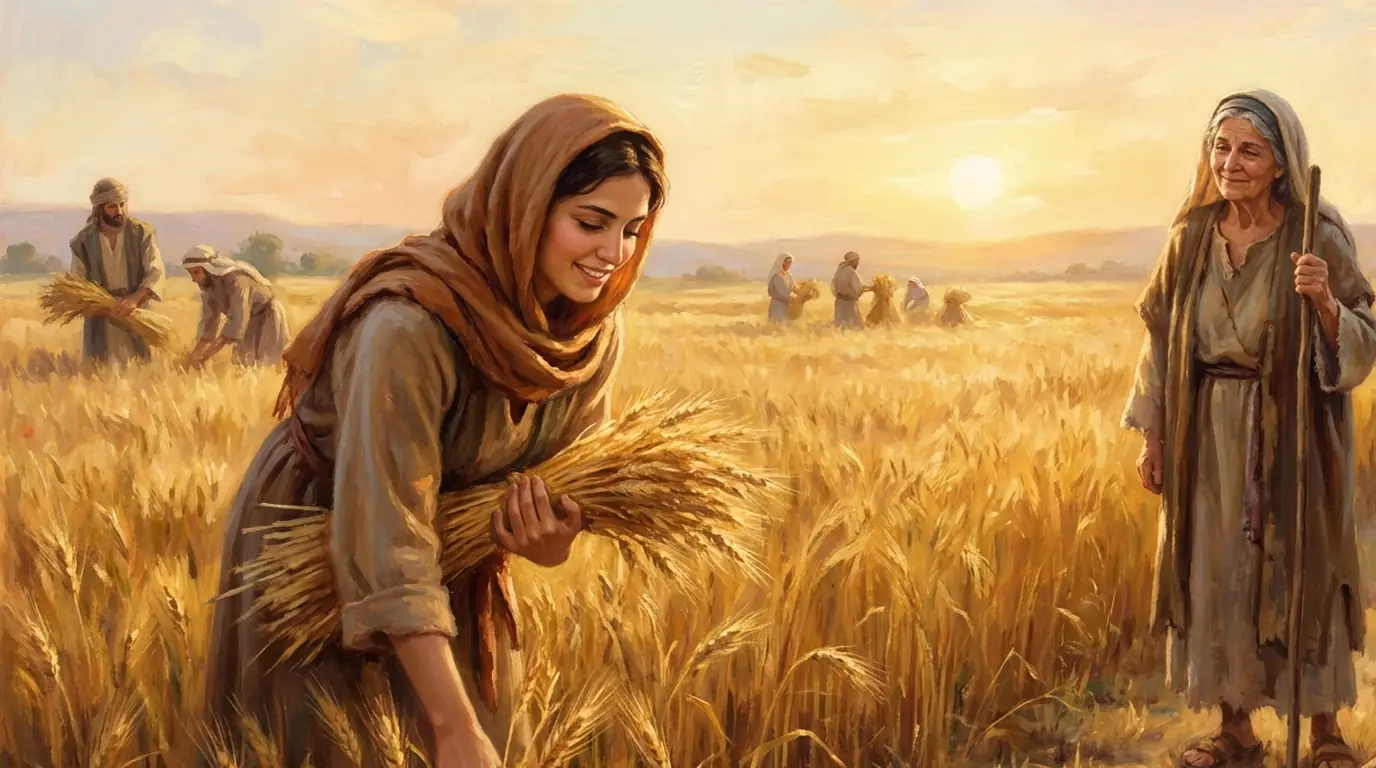
Chapter 2 introduces Boaz: “a prominent man of noble character from the clan of Elimelech” (2:1). Ruth asks Naomi's permission to go to the fields and glean, that is, to pick up the grain left behind by the harvesters. Naomi answers warmly: “Go ahead, my daughter” (2:2).
That custom came from the law God gave Israel. Leviticus 19:9-10 says not to harvest to the very edge of the field:
“When you reap the harvest of your land, you are not to reap to the very edges of your field or gather the gleanings of your harvest. You must not strip your vineyard bare or gather its fallen grapes. Leave them for the poor and the foreigner. I am the LORD your God.”
Ruth was poor and a foreigner, the two kinds of people the law protected. The text notes a small detail: “she happened to come to the part of the field belonging to Boaz” (2:3). Ruth did not know whose field it was. When Boaz arrives from Bethlehem he greets his workers with a blessing (“The LORD be with you”) and they answer with another. The foreman tells him who the unfamiliar young woman is.
Boaz speaks to Ruth with great kindness. He asks her to stay in his field, close to his servant girls, and says he has already ordered the young men not to touch her (2:8-9). Ruth bows to the ground and asks why she has found favor in his eyes, “even though I am a foreigner” (2:10). Boaz answers that he has heard everything she did for her mother-in-law, and how she left her father, her mother and her birthplace to live among a people she did not know (2:11). Then he says this:
“May the LORD repay your work, and may you receive a rich reward from the LORD, the God of Israel, under whose wings you have taken refuge.”
At mealtime Boaz invites her to sit with the harvesters and gives her food, and she “ate and was satisfied and had some left over” (2:14). Then he tells his young men to pull out stalks for her on purpose and not to rebuke her (2:15-16). By evening Ruth beats out what she gathered, about an ephah of barley, and brings it to Naomi along with what was left from her lunch.
Naomi is amazed at the amount and asks where she worked. When she hears Boaz's name, something changes. She blesses him and says: “He is one of our kinsman-redeemers” (2:20). This is the first time the idea of a redeemer appears. Ruth keeps working in Boaz's fields until the barley and wheat harvests are finished (2:23).
What is a kinsman-redeemer (goel) in plain words?
The Hebrew word is goel, translated as “redeemer,” “kinsman-redeemer” or “nearest of kin.” A goel was a relative who had the right and the duty to help another relative in trouble. Leviticus 25:25 shows one case: if an Israelite fell into poverty and sold part of his land, the closest relative could buy it back for the family. The verse says: “his nearest of kin may come and redeem what his brother has sold.” That way the family's land was not lost.
In the book of Ruth the role covers two things: the land of Elimelech, which Naomi had to sell because of poverty, and the family name, because Ruth was a widow with no children. Boaz can take on both, but there is another relative ahead of him in line.
Ruth 3: the night on the threshing floor
Naomi says to Ruth: “should I not seek a resting place for you, that it may be well with you?” (3:1). She wants her daughter-in-law to have a home. Boaz, their relative, will be at the threshing floor that night, the place where grain was separated from chaff. Naomi tells Ruth to wash, put on perfume and her best clothes, and go down to the floor without letting him know until Boaz has finished eating and drinking (3:2-4).
In that world, asking someone to spread his garment over a woman was asking for protection and marriage. Ruth obeys: “I will do everything you say” (3:5). She goes down and does as she was told. At midnight Boaz is startled and finds a woman at his feet. She tells him who she is and makes the request Naomi had planned: “Spread the corner of your garment over me, for you are a kinsman-redeemer” (3:9).
Boaz answers with respect. He blesses her, says her kindness now is greater than before because she did not run after the younger men, rich or poor, and tells her not to be afraid. This is the central verse of the chapter:
“And now do not be afraid, my daughter. I will do for you whatever you request, since all my fellow townspeople know that you are a woman of noble character.”
Boaz admits that a nearer redeemer exists (3:12). He promises that if that man refuses, he himself will redeem her, “as surely as the LORD lives” (3:13). Ruth stays until morning and leaves before it is light, because Boaz wants to protect her good name: “Do not let it be known that a woman came to the threshing floor” (3:14). Before she goes he fills her shawl with six measures of barley so she will not return to her mother-in-law “empty-handed” (3:17). Naomi tells Ruth to wait, because that man will not rest until he settles the matter today (3:18).
Ruth 4: the city gate, the wedding and the baby
At the gate of an ancient town the elders met to settle legal matters, much as people go to a courthouse today. Boaz goes up there, sits down, and calls over the nearer relative as he passes. He gathers ten elders as witnesses and lays out the case: Naomi is selling a piece of Elimelech's land, and the relative has the first right to buy it (4:1-4). The man answers plainly: “I will redeem it.”
Then Boaz adds the other part. Whoever buys the land must also take Ruth, “to raise up the name of the deceased on his inheritance” (4:5). The relative changes his mind. He says he would put his own inheritance at risk and hands the right to Boaz (4:6). To seal a deal there was a custom of the time: “a man would remove his sandal and give it to the other party” (4:7). The relative takes off his sandal and says: “Buy it for yourself” (4:8).
Boaz declares before the elders and all the people that he is buying everything that belonged to Elimelech, Chilion and Mahlon, and that he is taking Ruth as his wife so the dead man's name will not disappear. Those present answer “We are witnesses” and wish his house to be like that of Perez, the son of Tamar and Judah (4:9-12).
Then come the wedding and the birth: “So Boaz took Ruth, and she became his wife” (4:13). The Lord enables her to conceive and she gives birth to a son. The women of Bethlehem, the same ones who were stirred when Naomi arrived empty, now congratulate her:
“He will renew your life and sustain you in your old age. For your daughter-in-law, who loves you and is better to you than seven sons, has given him birth.”
Naomi takes the child, places him on her lap and cares for him (4:16). The neighbor women give him the name Obed. The woman who came home asking to be called Mara, bitter, now holds a grandson in her arms.
The line to David and the link to Jesus
The book does not end at the wedding. A short sentence explains why the story was told: “He became the father of Jesse, the father of David” (4:17). Then comes a list of ten generations, from Perez to David (4:18-22). The table sums it up.
| Generation | Name | Where it appears |
|---|---|---|
| 1 | Perez (son of Judah and Tamar) | Ruth 4:18 |
| 2 | Hezron | Ruth 4:18-19 |
| 3 | Ram | Ruth 4:19 |
| 4 | Amminadab | Ruth 4:19-20 |
| 5 | Nahshon | Ruth 4:20 |
| 6 | Salmon | Ruth 4:20-21 |
| 7 | Boaz (married to Ruth) | Ruth 4:21 |
| 8 | Obed | Ruth 4:21-22 |
| 9 | Jesse | Ruth 4:22 |
| 10 | David | Ruth 4:22 |
Ruth is therefore David's great-grandmother: Ruth and Boaz had Obed, Obed had Jesse and Jesse had David. A woman from Moab, a foreign people, appears in the family tree of Israel's most remembered king.
The New Testament names her in the genealogy of Jesus. Matthew 1:5 reads: “Boaz the father of Obed by Ruth.” Other women appear beside her, such as Rahab. To follow that line step by step, the Advent Bible reading plan walks through the genealogy of Jesus.
Simple lessons from the book of Ruth
- Loyalty. Ruth promised to stay and she kept her word, with nobody forcing her (1:16-17).
- Everyday kindness. Boaz looked after a stranger and gave her water, food and protection.
- A fresh start. Naomi came back to Bethlehem feeling empty and the book ends with a baby on her lap.
- Working with what you have. Ruth went out to glean on her own, without waiting for someone to fix her life.
- Saying what you feel. Naomi voiced her bitterness before God and her neighbors, and the Bible left it on the page unedited.
- Being welcomed. Ruth was a foreigner and the people of Bethlehem ended up blessing her.
A prayer inspired by the book of Ruth
How long does it take to read or listen to the book of Ruth?
The whole book, in the Berean Standard Bible text, has about 2,375 words. At 175 words per minute that comes to roughly 13 minutes and 34 seconds. These times are approximate, because the real length depends on the voice and the speed each person chooses. The table shows how long each chapter takes.
| Chapter | Approximate words (BSB) | Approximate time at 175 words per minute |
|---|---|---|
| Ruth 1 | 578 | 3 min 18 s |
| Ruth 2 | 708 | 4 min 03 s |
| Ruth 3 | 480 | 2 min 45 s |
| Ruth 4 | 609 | 3 min 29 s |
| The whole book | 2,375 | 13 min 34 s |
It is one of the shortest books. To place it among the 66, the guide on how many books are in the Bible explains the order, and if you would rather hear than read, here is how to listen to the Bible.
If you enjoyed this story, keep going with the story of Esther, another woman who changed the course of her people, and the story of Moses. For words of encouragement close at hand, there are also the Bible verses for women.