Advent is the countdown to Christmas, and the Bible is the best calendar for it. Every December the story is the same one: a promise made long ago, a long wait, a few faithful people, and then a baby in Bethlehem. Reading it in order, one small piece a day, turns the weeks before Christmas into something you look forward to instead of something you rush through.
This page gives you the whole plan for 2026. It has the exact dates, a reading for every one of the 26 days, a short verse for each of the four Advent candles, and a way to do it with your family in about five minutes. You need a Bible and nothing else. If you prefer to listen, there is a section for that too.
What is Advent, and when does it start in 2026?
Advent is the season of preparation before Christmas. The word comes from a Latin word meaning "arrival" or "coming." Christians use these weeks to remember that Jesus came to Bethlehem, and to look ahead to the day he comes again.
Advent always begins on the fourth Sunday before December 25. That Sunday moves from year to year, so the season is between 22 and 28 days long. In 2026, Christmas falls on a Friday, which gives Advent a comfortable length.
- First Sunday of Advent: November 29, 2026
- Second Sunday: December 6
- Third Sunday: December 13
- Fourth Sunday: December 20
- Christmas Eve: Thursday, December 24 (the last day of this plan)
- Christmas Day: Friday, December 25
Counting November 29 through December 24, you get 26 days. Week one and week two and week three have seven days each, and the last week has five. Catholic and Protestant churches in the West follow this same Sunday calendar, so your plan lines up with the sermons and songs you will hear at church.
How does this Advent reading plan work?
The plan follows the story in the order it happened. The first two weeks belong to the prophets, the people who spoke about a coming king centuries before he was born. Week three brings John the Baptist, the messenger who got the road ready. Week four opens with the angel and Mary, moves to Joseph, and ends in Bethlehem on Christmas Eve.
Each reading is short, between four and eighteen verses. Most take two or three minutes to read aloud. The plan lists references only, so you can use any translation you like, in print, on a phone, or in an audio Bible. If you want the birth story in full, the verses from Luke 2 are also collected in our post on Christmas Bible verses.
Week 1: Hope (November 29 to December 5)
The first week goes back to the beginning. God makes a promise in the garden, repeats it to Abraham and to David, and then the prophet Isaiah begins to describe what the promised one will be like.
| Day | Date | Reading | What to notice |
|---|---|---|---|
| 1 | Sun, Nov 29 | Genesis 3:8-15 | The first promise, given right after the first failure |
| 2 | Mon, Nov 30 | Genesis 12:1-3 | A blessing meant for every family on earth |
| 3 | Tue, Dec 1 | 2 Samuel 7:8-16 | God promises David a throne that lasts forever |
| 4 | Wed, Dec 2 | Isaiah 2:1-5 | Nations coming together and putting down their weapons |
| 5 | Thu, Dec 3 | Isaiah 7:10-14 | The sign of Immanuel, God with us |
| 6 | Fri, Dec 4 | Isaiah 9:1-7 | A great light for people living in darkness |
| 7 | Sat, Dec 5 | Isaiah 11:1-10 | A shoot from the stump of Jesse |
Week 2: Peace (December 6 to December 12)
Week two stays with the prophets. Micah names the town, Isaiah brings comfort to a tired people, and Jeremiah, Zechariah and Malachi describe the king and the messenger who comes ahead of him.
| Day | Date | Reading | What to notice |
|---|---|---|---|
| 8 | Sun, Dec 6 | Micah 5:2-5 | The small town of Bethlehem is named centuries early |
| 9 | Mon, Dec 7 | Isaiah 40:1-11 | God tells the prophet to comfort his people, and a voice calls in the wilderness |
| 10 | Tue, Dec 8 | Isaiah 52:7-10 | Good news arriving on foot over the mountains |
| 11 | Wed, Dec 9 | Isaiah 53:1-6 | The servant who carries the weight of others |
| 12 | Thu, Dec 10 | Jeremiah 33:14-16 | A righteous branch for David, and safety for Jerusalem |
| 13 | Fri, Dec 11 | Zechariah 9:9-10 | A humble king riding a donkey |
| 14 | Sat, Dec 12 | Malachi 3:1-4 | A messenger sent to prepare the way |
Week 3: Joy (December 13 to December 19)
Now the messenger arrives. John the Baptist is born to an older couple who had given up hoping for a child. His father goes silent, his mother rejoices, and he grows up to point people toward Jesus.
| Day | Date | Reading | What to notice |
|---|---|---|---|
| 15 | Sun, Dec 13 | Luke 1:5-17 | Zechariah and Elizabeth, and an angel in the temple |
| 16 | Mon, Dec 14 | Luke 1:18-25 | Zechariah doubts and loses his voice |
| 17 | Tue, Dec 15 | Luke 1:57-66 | John is born and the neighbors are amazed |
| 18 | Wed, Dec 16 | Luke 1:67-80 | Zechariah speaks again, in a song |
| 19 | Thu, Dec 17 | Matthew 3:1-12 | John preaches in the wilderness |
| 20 | Fri, Dec 18 | John 1:19-28 | Asked who he is, John says he is only a voice |
| 21 | Sat, Dec 19 | John 3:22-30 | John gladly steps aside, with the joy of a friend of the bridegroom |
Week 4: Love (December 20 to December 24)
The last week is only five days, and it is the one everyone knows. An angel visits Mary, Mary visits Elizabeth, Joseph is told in a dream to stay, and a young couple travels to Bethlehem. The final reading is the shepherds on Christmas Eve.
| Day | Date | Reading | What to notice |
|---|---|---|---|
| 22 | Sun, Dec 20 | Luke 1:26-38 | The angel Gabriel speaks to Mary, and she says yes |
| 23 | Mon, Dec 21 | Luke 1:39-56 | Mary visits Elizabeth and sings the Magnificat |
| 24 | Tue, Dec 22 | Matthew 1:18-25 | Joseph's dream and the name Jesus |
| 25 | Wed, Dec 23 | Luke 2:1-7 | The journey to Bethlehem and the birth |
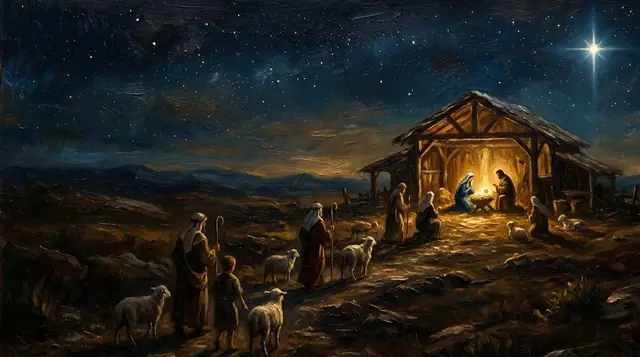
| 26 | Thu, Dec 24 | Luke 2:8-20 | The shepherds, the angels and the first visit |
If you want one more reading for Christmas Day itself, Luke 2:21-40 or Matthew 2:1-12 (the wise men) both fit well. Neither is part of the 26 days, so you can treat them as a gift.
What are the four Advent candles?
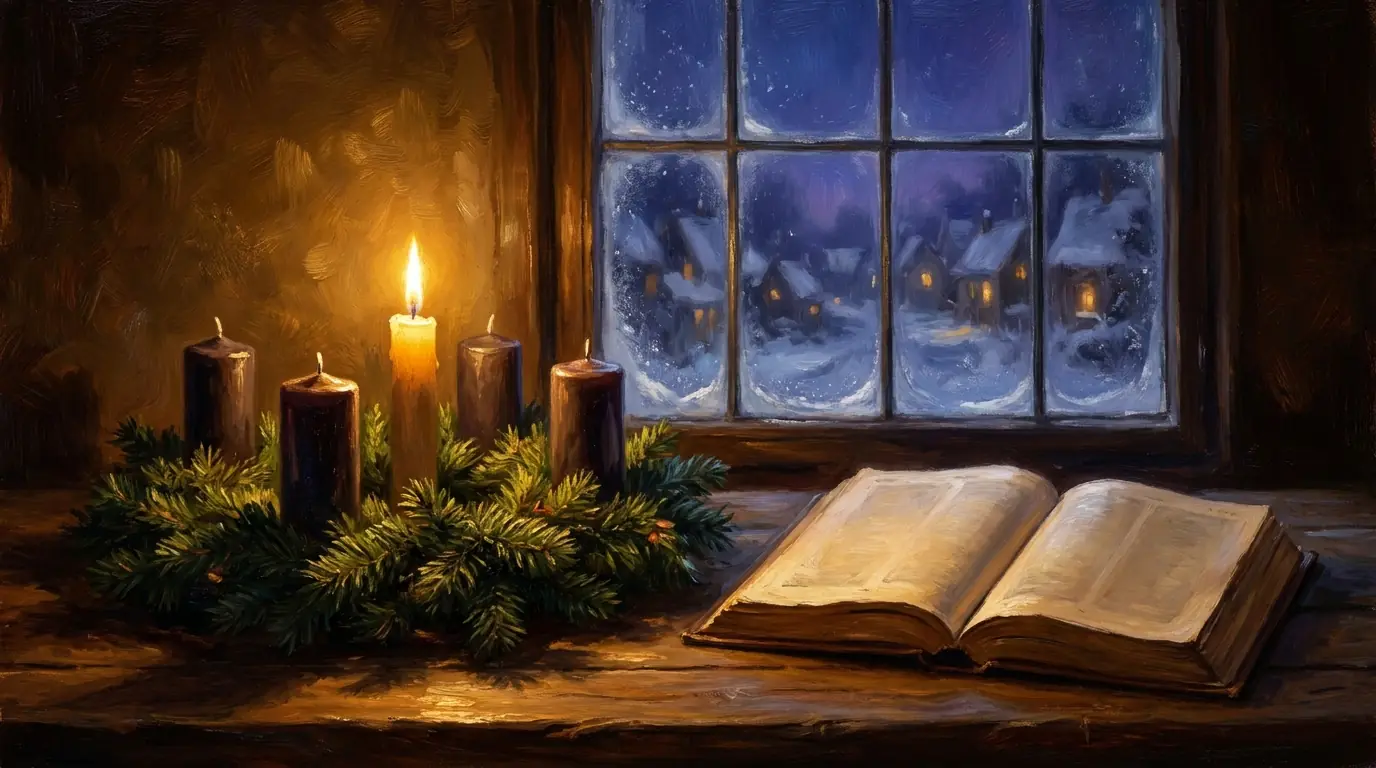
Many churches and families light one candle on each Sunday of Advent, adding another every week until all four are burning. A fifth, white candle for Christmas Day is common in some traditions. The themes differ a little from church to church, but the most widely used are hope, peace, joy and love. Each candle below comes with one short verse, so you can read it aloud when you light it.
| Sunday | Date | Candle | Verse to read |
|---|---|---|---|
| First | Nov 29 | Hope | Isaiah 9:2 |
| Second | Dec 6 | Peace | Luke 1:79 |
| Third | Dec 13 | Joy | Luke 2:10 |
| Fourth | Dec 20 | Love | 1 John 4:19 |
First candle: hope
“The people walking in darkness have seen a great light; on those living in the land of the shadow of death, a light has dawned.”
Second candle: peace
“to shine on those who live in darkness and in the shadow of death, to guide our feet into the path of peace.”
Peace is a big word in December. If you want a longer list to read with this candle, start with our Bible verses about peace.
Third candle: joy
“But the angel said to them, "Do not be afraid! For behold, I bring you good news of great joy that will be for all the people."”
Fourth candle: love
“We love because He first loved us.”
How do you do this with your family in 5 minutes a day?
The plan works best when it is small enough to survive a busy week. Pick one moment that already happens every day: breakfast, the car ride to school, the end of dinner, or bedtime. Attach the reading to that moment and keep it short.
- 01Read the day's passage aloud. One person reads, or everyone takes a verse. Two to three minutes.
- 02Ask one question from the "what to notice" column. Try "What surprised you?" or "Who is in this story?" One minute.
- 03Say one sentence of prayer. "Thank you, God, for keeping your promises." Thirty seconds is plenty.
- 04On Sundays, light the candle and read the candle verse before the daily passage.
Young children can act the story out, draw the scene, or add a small piece to a nativity set each day. Teenagers usually like the questions best. Grandparents can read over the phone or on a video call. Everyone reading the same short passage on the same day gives a scattered family something to talk about at Christmas.
Can you listen to the Advent plan instead of reading it?
Yes, and for many people listening is easier in December. Your hands are full of wrapping paper and dinner preparation, but your ears are free. Every passage in the plan is between two and four minutes of audio, which fits into a commute, a walk or the time it takes to cook.
If you have never listened to Scripture before, our guide on how to listen to the Bible covers the basics, from choosing a narrator to setting a speed that suits you. In the Terra Gospel app, you can open each day's chapter, press play, and listen to the narration in English, Portuguese or Spanish. The audio Bible is part of Premium, while reading in all three languages is free. Whichever way you go, the plan stays the same.
A verse a day also pairs well with the daily habit you may already have. The verse of the day gives you a short line to start with, and this plan gives you the longer story behind the season.
What comes after Advent?
Christmas Day is the natural place to pause and enjoy the family, but the habit you built is worth keeping. If 26 days felt easy, the Bible reading plan for beginners is a gentle next step. And if you have wanted to start reading the whole book, January 1 is only a week after Christmas, and reading the Bible in a year has a plan that fits.
Advent teaches something worth carrying into the new year. Waiting is easier when you know what you are waiting for, and reading a little every day makes the waiting warm. The people in these stories waited far longer than 26 days, and each of them received what was promised.