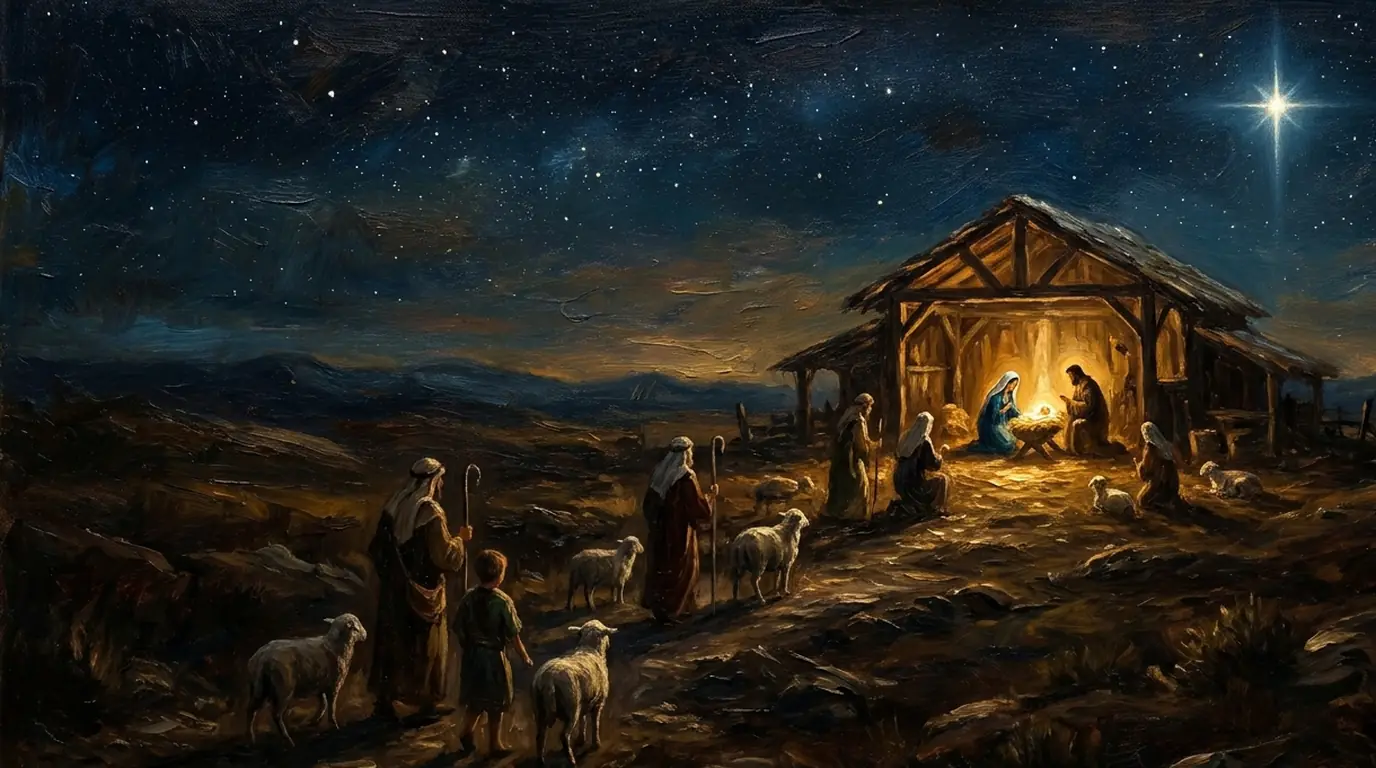
Most Nativity scenes put everyone in the same spot on the same night: Mary, Joseph, the shepherds, three kings, a stable full of animals. The Bible never puts them there together. The angel's announcement to the shepherds and the magi's visit are two separate events from two separate Gospels, probably separated by months. None of that makes the story less remarkable, if anything, reading it the way it was actually written gives it more shape than the flattened version on the card. Below are the twenty verses that carry the narrative, in the order it unfolds, each one followed by what it's actually saying.
The prophecies that came first
Centuries before any of it happened, three passages from the Hebrew prophets described pieces of what Christians would later read as this story: a child born of a virgin, a ruler from a small town, a name that carries titles no ordinary child could hold.
“Therefore the Lord Himself will give you a sign: Behold, the virgin will be with child and give birth to a son, and will call Him Immanuel.”
Isaiah spoke this to King Ahaz roughly seven centuries before Jesus, as a sign about a political crisis of that specific moment. Judah's fear of two invading kings. Matthew later reads it as pointing further out than Ahaz's own lifetime. The Hebrew word translated 'virgin' (almah) is debated among scholars as meaning simply 'young woman'; the Greek Old Testament Matthew was working from already rendered it as parthenos, a term that does specify virginity, which is the reading he builds on.
“But you, Bethlehem Ephrathah, who are small among the clans of Judah, out of you will come forth for Me One to be ruler over Israel — One whose origins are of old, from the days of eternity.”
Micah names the town seven centuries in advance, and names it precisely by pointing out how unlikely a choice it was, 'small among the clans of Judah,' not a capital, not a center of anything. Matthew 2:5-6 quotes this exact verse when Herod's own priests are asked where the Messiah would be born, which is why the magi go looking for Bethlehem in the first place.
“For unto us a child is born, unto us a son is given, and the government will be upon His shoulders. And He will be called Wonderful Counselor, Mighty God, Everlasting Father, Prince of Peace.”
This is the verse behind most of the titles sung in Christmas carols. In its own historical setting it was almost certainly first heard as a prophecy about a coming king in the line of David: a promise of relief after war. The titles stack up in a way that goes further than any ordinary monarch could claim, which is part of why later readers heard it pointing past any single king toward something more.
The angel visits Mary
Luke's Gospel opens the actual narrative with a young woman in Nazareth, likely a teenager by the customs of the time, receiving a visit that upends her life before she has agreed to anything.
“Do not be afraid, Mary, for you have found favor with God. Behold, you will conceive and give birth to a son, and you are to give Him the name Jesus. He will be great and will be called the Son of the Most High. The Lord God will give Him the throne of His father David, and He will reign over the house of Jacob forever. His kingdom will never end!”
The angel's first line answers the fear on her face before she has said a word. Everything that follows ties Jesus directly to the promise made centuries earlier to David: a throne, a kingdom, an end point that never arrives, which by itself would have told a first-century Jewish listener exactly what kind of announcement this was.
“"How can this be," Mary asked the angel, "since I am a virgin?" The angel replied, "The Holy Spirit will come upon you, and the power of the Most High will overshadow you. So the Holy One to be born will be called the Son of God."”
Mary's question is a practical one. She is engaged, not married, and the biology doesn't work yet. The angel's answer names the source and leaves the mechanism unexplained. Luke is careful here in a way that matters for how the rest of the story reads: the text describes something initiated by the Spirit from the start, with no ordinary conception and no divine blessing attached afterward.
“"I am the Lord's servant," Mary answered. "May it happen to me according to your word." Then the angel left her.”
This is the hinge of the whole story, and it's easy to read past it. A young, unmarried woman in a small town, told her pregnancy will be public and unexplainable to her neighbors, answers with consent rather than protest. Luke doesn't dwell on what it cost her socially (an engaged woman found pregnant by someone other than her fiancé faced real danger under the law and real shame in the town) but the cost is implied in everything that follows in Matthew's account of Joseph.
Joseph's dream
Matthew tells the same period from Joseph's side, and Joseph's first instinct is exactly what the law and custom of the time would have expected of him.
“But after he had pondered these things, an angel of the Lord appeared to him in a dream and said, "Joseph, son of David, do not be afraid to embrace Mary as your wife, for the One conceived in her is from the Holy Spirit. She will give birth to a Son, and you are to give Him the name Jesus, because He will save His people from their sins."”
Before this dream, Matthew 1:19 says Joseph had already decided to quietly end the engagement rather than expose Mary publicly: the legally gentler option, but still a real rejection. The angel's message reverses that decision and gives the child a name before birth, which in that culture was an act of legal claiming: naming a child was the father's prerogative, and doing it here settles Joseph's paternity in the eyes of the community regardless of biology.
“All this took place to fulfill what the Lord had said through the prophet: "Behold, the virgin will be with child and will give birth to a son, and they will call Him Immanuel" (which means, "God with us").”
Matthew quotes Isaiah 7:14 directly here, closing the loop from the first prophecy above. Worth noticing: nobody in the Gospel narrative actually calls the child Immanuel. Joseph is told to name him Jesus. Matthew is pointing at what the child means, not supplying an alternate legal name.
The census and the birth
Luke sets the timing of the birth against Roman imperial politics, which is part of what makes the story historically anchored rather than purely devotional.
“Now in those days a decree went out from Caesar Augustus that a census should be taken of the whole empire. This was the first census to take place while Quirinius was governor of Syria. And everyone went to his own town to register.”
Historians have long debated the exact dating of a census under Quirinius against what's known of Herod's reign, since Herod is generally dated as having died around 4 BC, before Quirinius's confirmed governorship. It's a genuine scholarly puzzle, not a detail invented for this article, and it hasn't been resolved with certainty. Luke may be referencing an earlier, less-documented registration, or working with a different dating tradition than modern historians reconstruct.
“So Joseph also went up from Nazareth in Galilee to Judea, to the city of David called Bethlehem, since he was from the house and line of David. He went there to register with Mary, who was pledged to him in marriage and was expecting a child.”
The trip from Nazareth to Bethlehem is roughly 90 miles through hill country. Luke doesn't describe the journey itself, so any detail about a donkey, the number of days, or the route is tradition filling a gap the text leaves open, not something the Gospel states.
“While they were there, the time came for her Child to be born. And she gave birth to her firstborn, a Son. She wrapped Him in swaddling cloths and laid Him in a manger, because there was no room for them in the inn.”
The Greek word usually translated 'inn' (kataluma) is the same word Luke uses elsewhere for a guest room, not a commercial inn: some scholars argue the more accurate picture is a private home whose guest space was already full, with the family staying in the lower level where animals were kept overnight, which is why a feeding trough was within reach. Either reading lands on the same core fact: no proper place was ready, and the baby went into a manger instead of a bed.
The shepherds
The first people told about the birth were shepherds, among the lowest-status workers of the time, out in the fields at night with the animals they were watching. No priests, officials, or family are among them.
“And there were shepherds residing in the fields nearby, keeping watch over their flocks by night. Just then an angel of the Lord stood before them, and the glory of the Lord shone around them, and they were terrified.”
“But the angel said to them, "Do not be afraid! For behold, I bring you good news of great joy that will be for all the people: Today in the city of David a Savior has been born to you. He is Christ the Lord! And this will be a sign to you: You will find a baby wrapped in swaddling cloths and lying in a manger."”
The sign the angel gives is ordinary and verifiable, with no miracle to prove the announcement: a baby, wrapped, in a feeding trough. Anyone could go check.
“And suddenly there appeared with the angel a great multitude of the heavenly host, praising God and saying: "Glory to God in the highest, and on earth peace to men on whom His favor rests!"”
“When the angels had left them and gone into heaven, the shepherds said to one another, "Let us go to Bethlehem and see this thing that has happened, which the Lord has made known to us." So they hurried off and found Mary and Joseph and the Baby, who was lying in the manger.”
“After they had seen the Child, they spread the message they had received about Him. And all who heard it were amazed at what the shepherds said to them. But Mary treasured up all these things and pondered them in her heart. The shepherds returned, glorifying and praising God for all they had heard and seen, which was just as the angel had told them.”
Luke gives Mary a distinct, quiet reaction: a kind of internal holding-onto. It's one of the small details that reads like testimony rather than legend: someone remembered, and remembered specifically, what she did with the news.
The magi arrive, later
This is the part most Nativity scenes get wrong by compression. The magi appear only in Matthew, in a separate scene that Luke never mentions, and the text gives real reasons to think it happened well after the night in the stable.
“After Jesus was born in Bethlehem in Judea, during the time of King Herod, Magi from the east arrived in Jerusalem, asking, "Where is the One who has been born King of the Jews? We saw His star in the east and have come to worship Him."”
Matthew gives no count of the magi: the number three comes from the three gifts named below. He also gives them no royal title; 'Magi' describes a class of scholars or astrologers, likely from Persia or the Arabian region, who studied the stars.
“After they had heard the king, they went on their way, and the star they had seen in the east went ahead of them until it stood over the place where the Child was. When they saw the star, they rejoiced with great delight. On coming to the house, they saw the Child with His mother Mary, and they fell down and worshiped Him. Then they opened their treasures and presented Him with gifts of gold and frankincense and myrrh.”
Matthew's own word choice makes the timing clear: the family is in a house, not a stable, and the Greek word used for Jesus at this point (paidion) means 'young child' rather than the word for a newborn infant used back in Luke's manger scene. A few verses later, Matthew records Herod ordering the deaths of boys in Bethlehem two years old and under, based on the timing the magi had reported, which is the strongest textual clue that real time, likely months, had passed between the shepherds' visit and this one.
What the story means
Two verses outside the narrative itself explain, in more abstract terms, what the Gospel writers believed had actually happened in that stable and that house.
“The Word became flesh and made His dwelling among us. We have seen His glory, the glory of the one and only Son from the Father, full of grace and truth.”
John narrates no birth scene: no shepherds, no manger, no magi. He opens his Gospel with this one compressed claim: whatever else the story is, John reads it as the eternal 'Word' entering ordinary human existence.
“But when the time had fully come, God sent His Son, born of a woman, born under the law, to redeem those under the law, that we might receive our adoption as sons.”
Paul, writing before either Gospel was composed, gives the earliest surviving Christian reflection on the birth, and he does it without a single narrative detail. No Bethlehem, no manger, no star. Just the claim that the timing mattered ('the fullness of time') and the purpose mattered more than the scene.
A note on December 25
None of the twenty verses above mention a date, a season, or even a year with precision. The date of December 25 appears nowhere in the Bible, and it became the fixed date for Christmas in the Western church by the 4th century, and historians still debate exactly how that date was chosen, theories range from an early calculation tied to the date of Jesus's death, to alignment with existing Roman winter festivals. The detail of shepherds keeping watch in the fields at night has led some readers to guess at a warmer season instead, but Judean shepherds are recorded grazing flocks through much of the winter too, so it isn't conclusive either way. None of this changes what the passages say. It just means the calendar date is a later church tradition, not a claim Scripture itself makes.
Ways to use these verses this season
- Christmas dinner reading: Luke 2:1-20 read aloud before the meal, straight through, works as a shared family moment that doesn't need commentary; the story carries itself.
- Cards and gift tags: Isaiah 9:6, Luke 2:11, and John 1:14 are short enough to hand-write, and each carries a different weight (promise, announcement, meaning).
- An Advent reading plan, spread the twenty passages above across the four weeks of Advent, roughly five per week, ending on Luke 2:1-20 on Christmas Eve or Christmas morning.
Where does each Christmas verse fit in the story?
The Christmas story is told across several chapters of Scripture. This table puts the scenes in order, so you can read the whole story in a few sittings.
| Scene | Passage | Key detail |
|---|---|---|
| The prophecies | Isaiah 7:14, Micah 5:2, Isaiah 9:6 | Centuries earlier, the prophets named a sign, a town and a child. |
| The angel and Mary | Luke 1:26-38 | Mary is told she will bear a son, and she says yes. |
| Joseph's dream | Matthew 1:18-25 | An angel tells Joseph to take Mary as his wife and name the child Jesus. |
| The census and the birth | Luke 2:1-7 | Mary and Joseph travel to Bethlehem, and Jesus is laid in a manger. |
| The shepherds | Luke 2:8-20 | Angels announce the birth to working shepherds, who go and see. |
| The magi | Matthew 2:1-11 | Wise men from the east follow a star and bring gifts. |
| The meaning | John 1:14 and Galatians 4:4-5 | The Word became flesh, in the fullness of time. |
Keeping the ones that hold
In Terra Gospel you can highlight any of these verses in four colors, add your own note, and keep them together under Favorites, free, alongside reading the whole Bible in English, Portuguese and Spanish and the verse of the day. Only the narrated audio Bible is part of the Premium subscription.
After the season, New Year Bible verses carries the same hope into January, short Bible verses has one-liners for cards, and Bible verses about peace goes further into the peace the angels announced.