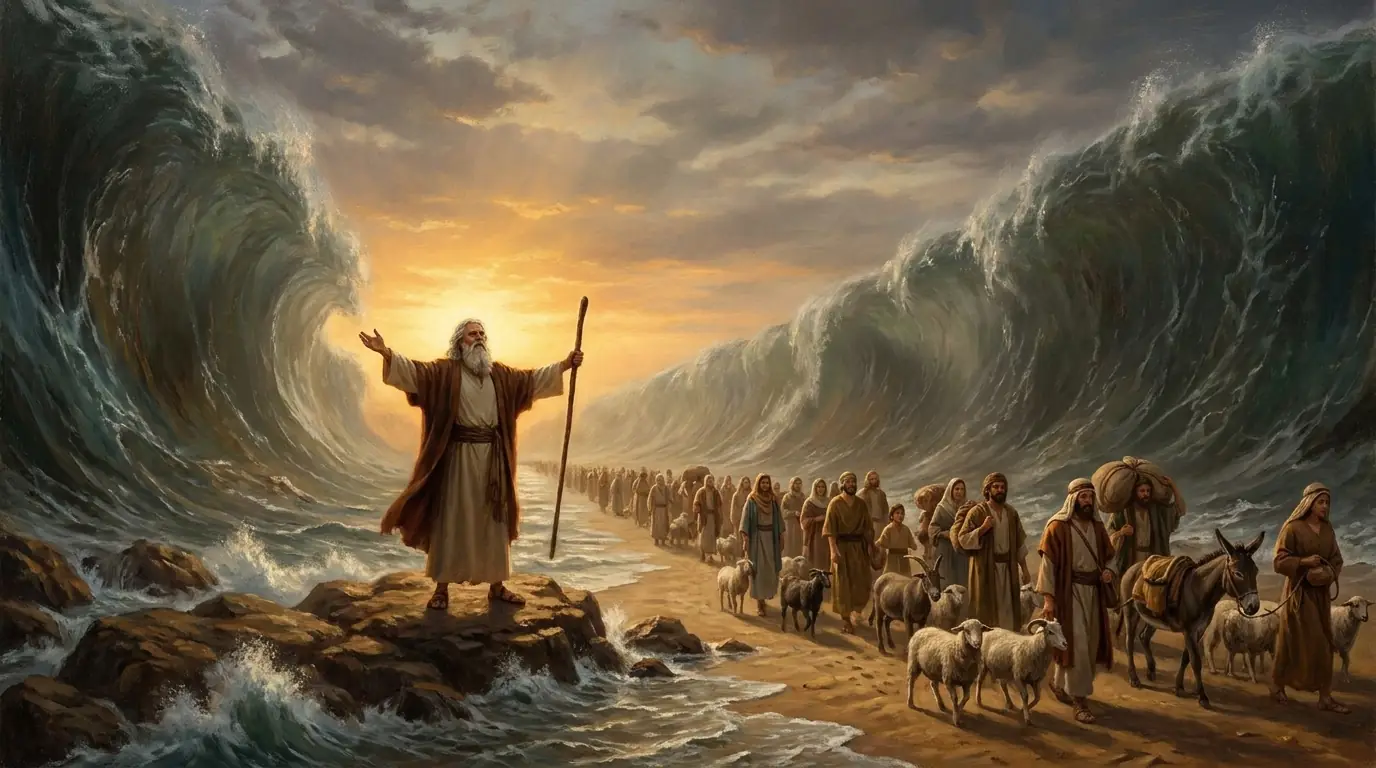
Moses is one of the central figures of the Bible, and for many people his is the story they first heard in Sunday school. It begins in Exodus 1 and ends in Deuteronomy 34, running through four books: Exodus, Leviticus, Numbers and Deuteronomy. He is born a Hebrew, raised as an Egyptian, lives forty years as a shepherd, and spends another forty leading a whole nation through the wilderness. To see how that nation ended up in Egypt, read the story of Joseph first. Here we go stage by stage, with the chapter references.
Who was Moses, and when does his story take place?
Moses was born in Egypt to a Hebrew family from the house of Levi, living in slavery (Exodus 2:1). The Bible presents him as the leader who brought Israel out of slavery, the mediator of the law at Mount Sinai, and the prophet who said farewell to the people. In the New Testament he appears with Jesus: “Moses and Elijah appeared before them, talking with Jesus” (Matthew 17:3).
Timeline: the life of Moses in 11 stages
The table shows each stage, where it is told, and how old Moses was when the Bible says.
| Stage | Where it is told | Age of Moses |
|---|---|---|
| Birth and the basket on the Nile | Exodus 1:1 to 2:10 | Newborn (2:2) |
| Raised in the palace | Exodus 2:10-15 | Until age 40 (Acts 7:23) |
| Flight to Midian, shepherd's life | Exodus 2:15 to 3:1 | From 40 to 80 (Acts 7:23, 7:30) |
| The burning bush | Exodus 3 and 4 | 80 (Exodus 7:7) |
| Before Pharaoh and the ten plagues | Exodus 5 to 11 | 80 (Exodus 7:7) |
| Passover and the departure from Egypt | Exodus 12 and 13 | The Bible does not give his age |
| Crossing the sea | Exodus 14 and 15 | The Bible does not give his age |
| Manna, water and Amalek | Exodus 16 to 18 | The Bible does not give his age |
| Sinai: commandments and tabernacle | Exodus 19 to 40; Leviticus; Numbers 1 to 10 | The Bible does not give his age |
| The spies and the wilderness years | Numbers 13 and 14; 20 and 21 | 40 years of wandering (Acts 7:36) |
| Farewell and Mount Nebo | Deuteronomy 31 to 34 | 120 (Deuteronomy 34:7) |
Added up, the three stages of 40 years fit the 120 years of Deuteronomy 34:7.
Birth and the basket on the Nile (Exodus 1 and 2)
Israel had grown large in Egypt, and a new king felt threatened by its numbers. His order was cruel: “Every son born to the Hebrews you must throw into the Nile” (Exodus 1:22). Moses is born into that world. His mother hides him for three months, and when she cannot any longer, she makes a papyrus basket, coats it with tar and pitch, and sets it among the reeds along the riverbank while his sister watches from a distance (Exodus 2:2-4).
Pharaoh's daughter comes down to bathe, finds the basket, and takes pity on the crying baby. His sister offers to find a Hebrew nurse, and so the child goes back into his own mother's arms, and she is even paid to raise him (Exodus 2:5-9). When he is older, the princess adopts him and gives him the name he will carry forever: “I drew him out of the water” (Exodus 2:10).
From the palace to Midian (Exodus 2:11-25)
As a grown man, Moses goes out to see his own people and watches an Egyptian beat a Hebrew. He kills the Egyptian and hides the body in the sand (Exodus 2:11-12). The next day he learns the matter is known. Pharaoh tries to have him killed, and Moses flees to the land of Midian. According to Acts 7:23, he was forty years old.
In Midian he ends up living with the priest Jethro, marries his daughter Zipporah, and has a son, Gershom (Exodus 2:21-22). For forty years, the man raised in a palace tends someone else's sheep. Back in Egypt, the people groan under slavery, and the text records a sentence that carries the whole story: “God heard their groaning” (Exodus 2:24).
The burning bush (Exodus 3 and 4)
According to Acts 7:30, after those forty years Moses leads the flock to Horeb, “the mountain of God.” There he sees a bush on fire that does not burn up. He walks over to look, and God calls him by name from the flames: “Moses, Moses!” (Exodus 3:4). He tells Moses to take off his sandals, because the ground is holy, and announces the mission: bring the people out of Egypt.
Moses answers with fear. He asks who he is for a task like this, asks what God's name is (the answer is the line below), and later admits that speaking is hard for him: “slow of speech and tongue” (Exodus 4:10). God offers his brother Aaron as a spokesman (Exodus 4:14-16).
“God said to Moses, “I AM WHO I AM. This is what you are to say to the Israelites: ‘I AM has sent me to you.’””
Pharaoh and the ten plagues (Exodus 5 to 11)
Moses and Aaron appear before Pharaoh. The text records their ages at that moment: “Moses was eighty years old and Aaron was eighty-three when they spoke to Pharaoh” (Exodus 7:7). Pharaoh refuses to let the people go, and his heart hardens again and again. Then the ten plagues arrive, told in Exodus 7:14 to 11:10 and 12:29-30 in this order:
- 01The river turns to blood.
- 02Frogs across the land.
- 03Gnats on people and animals.
- 04Swarms of flies.
- 05Death of the livestock.
- 06Boils on people and animals.
- 07Hail mixed with fire.
- 08Locusts covering the country.
- 09Darkness for three days.
- 10The death of the firstborn.
Passover: the last night in Egypt (Exodus 12 and 13)
Before the tenth plague, God gives Israel precise instructions. Each household is to prepare a lamb and mark the doorposts with its blood. That sign changes the fate of the house:
“The blood on the houses where you are staying will distinguish them; when I see the blood, I will pass over you. No plague will fall on you to destroy you when I strike the land of Egypt.”
At midnight every firstborn in Egypt dies, from Pharaoh's son to the prisoner's son in the dungeon (Exodus 12:29). Pharaoh summons Moses and Aaron that same night and tells them to leave. God asks the people to remember this day every year, “a permanent statute for the generations to come” (Exodus 12:14). That is where Passover comes from.
Crossing the sea (Exodus 13 to 15)
Israel leaves Egypt, but the road ends at a sea, with Pharaoh's army behind. The people panic, and Moses answers:
“But Moses told the people, “Do not be afraid. Stand firm and you will see the LORD’s salvation, which He will accomplish for you today; for the Egyptians you see today, you will never see again. The LORD will fight for you; you need only to be still.””
Then Moses stretches out his hand:
“Then Moses stretched out his hand over the sea, and all that night the LORD drove back the sea with a strong east wind that turned it into dry land. So the waters were divided, and the Israelites went through the sea on dry ground, with walls of water on their right and on their left.”
On the far shore, Moses and the people sing (Exodus 15:1), and Miriam, Aaron's sister, takes a tambourine while the women follow her with tambourines and dancing (Exodus 15:20).
Manna, water and Amalek: the road to Sinai (Exodus 15 to 18)
The first weeks of freedom bring thirst, hunger and complaints. God provides water and also manna, a food that arrives every morning. The text notes how long it lasted: “The Israelites ate manna forty years” (Exodus 16:35). At Rephidim, Israel fights Amalek. While Moses holds up his hands, Israel wins. When he lowers them from exhaustion, Israel loses. Aaron and Hur hold his arms up until sunset (Exodus 17:11-12).
Sinai: the Ten Commandments and the golden calf (Exodus 19 to 40)
In the third month after leaving Egypt, the people reach Mount Sinai. God speaks to Israel and proposes a covenant (Exodus 19:4-6). Moses climbs the mountain and comes down with the tablets of the law. The Ten Commandments begin by recalling who set the people free:
“And God spoke all these words: “I am the LORD your God, who brought you out of the land of Egypt, out of the house of slavery. You shall have no other gods before Me.”
The commandments that follow, according to Exodus 20:4-17, are these: make no idols, do not misuse God's name, keep the Sabbath, honor father and mother, do not murder, do not commit adultery, do not steal, do not bear false witness, and do not covet what belongs to others.
Moses stayed on the mountain forty days and forty nights (Exodus 24:18). Down below, the people make a golden calf, and when Moses sees it, he throws the tablets and shatters them at the foot of the mountain (Exodus 32:19). He climbs up again and receives new tablets. When he comes down, his face is radiant, though he does not know it (Exodus 34:29). The rest of Exodus, together with Leviticus, tells of the building of the tabernacle and the rules for worship. In Exodus 34:6, God describes himself to Moses as “compassionate and gracious, slow to anger.”
The forty years in the wilderness (Numbers 12 to 20)
Near the promised land, Moses sends out spies. Ten of the twelve come back afraid, and the people complain against Moses and Aaron and talk of returning to Egypt (Numbers 14:1-4). The result is written down: “Your children will be shepherds in the wilderness for forty years” (Numbers 14:33). A whole generation walks the wilderness before entering.
Amid all the complaining, the text says something surprising about Moses, given his stature: he was “a very humble man, more so than any man on the face of the earth” (Numbers 12:3). Even so, he stumbles too. In Numbers 20:8, God tells him to speak to the rock so it will give water. Moses strikes the rock twice. Water pours out, and the consequence follows:
“But the LORD said to Moses and Aaron, “Because you did not trust Me to show My holiness in the sight of the Israelites, you will not bring this assembly into the land that I have given them.””
Mount Nebo (Deuteronomy 31 to 34)
Deuteronomy gathers Moses' farewell speeches. He says himself: “I am now a hundred and twenty years old” (Deuteronomy 31:2). He reviews the law, blesses the tribes, and hands leadership to Joshua. Then he climbs Mount Nebo, and from the top of Pisgah God shows him the whole land.
“And the LORD said to him, “This is the land that I swore to give Abraham, Isaac, and Jacob when I said, ‘I will give it to your descendants.’ I have let you see it with your own eyes, but you will not cross into it.””
Moses died there at 120, in good health: “his eyes were not weak, and his vitality had not diminished” (Deuteronomy 34:7). Israel mourned him thirty days (34:8). The book closes with a short tribute: “no prophet has risen in Israel like Moses, whom the LORD knew face to face” (Deuteronomy 34:10). That closeness had shown up earlier: “face to face, as a man speaks to his friend” (Exodus 33:11).
Key verses from the story of Moses
- “I drew him out of the water” (Exodus 2:10). The origin of his name.
- “Who am I, that I should go to Pharaoh” (Exodus 3:11). The question many people recognize in themselves.
- “Do not be afraid. Stand firm and you will see the LORD’s salvation” (Exodus 14:13). Calm before the sea.
- “I am the LORD your God, who brought you out of the land of Egypt, out of the house of slavery” (Exodus 20:2). The opening of the Ten Commandments.
- “compassionate and gracious, slow to anger” (Exodus 34:6). How God describes himself to Moses.
- “his eyes were not weak, and his vitality had not diminished” (Deuteronomy 34:7). The end of his life.
Simple lessons from the life of Moses
- God calls people who feel small. Moses asked “Who am I?”, called himself “slow of speech and tongue,” and was sent anyway.
- Years that look wasted still count. Forty years of shepherding came before the mission.
- Remembering helps faith. Passover is celebrated every year.
- There are moments when the only thing to do is stand still and trust. At the sea, Moses said exactly that.
- Freedom comes first and the law second. The Ten Commandments open by saying: “who brought you out of the land of Egypt.”
- Great people fail too. Moses shattered the tablets and struck the rock, and the Bible still calls him “Moses the servant of the LORD” (Deuteronomy 34:5).
Psalm 90, the prayer of Moses
Psalm 90 is the psalm the Bible attributes to Moses in its title: “A prayer of Moses the man of God.” It speaks of a God who is a dwelling place through all generations and of how short life is. It mentions seventy or eighty years (Psalm 90:10), while Moses reached 120. One of its verses works as a prayer:
“So teach us to number our days, that we may present a heart of wisdom.”
The next psalm is Psalm 91, with a full verse-by-verse guide.
How to hear the story of Moses in audio
Exodus has 40 chapters. In the Berean Standard Bible they add up to about 29,300 words, or roughly 2 h 47 min at 175 words per minute. These are approximate times: the real length depends on the voice and the speed you choose. The table offers three routes.
| Route | Chapters | Approximate time at 175 words per minute |
|---|---|---|
| The essential Moses | Exodus 1 to 20, 24 and 32 to 34; Numbers 13, 14 and 20; Deuteronomy 34 | 1 h 54 min |
| The whole book of Exodus | Exodus 1 to 40 (40 chapters) | 2 h 47 min |
| The four books of Moses | Exodus, Leviticus, Numbers and Deuteronomy (137 chapters) | 10 h 6 min |
These four books are numbers 2 to 5 of the Bible's 66, as the guide on how many books are in the Bible explains. To listen instead of read, see how to listen to the Bible.
If you liked this story, the Bible holds others that read just as well: the story of David, the shepherd who became king, and the story of Esther, the young woman who saved her people.