Abraham is where the story of Israel begins, and the New Testament keeps coming back to his name. His account fills Genesis 12 to 25, and it opens with a short command: leave home. It is a story of roads, tents and a very long wait. To see what happens to his family afterward, read the story of Joseph, his great-grandson. Here we go stage by stage, with the chapter reference for each part.
Who was Abraham, and when does his story happen?
Abraham was born as Abram, son of Terah, in the region of Ur of the Chaldeans (Genesis 11:26, 11:31). God changed his name to Abraham when he was 99 (Genesis 17:5), and his wife Sarai became Sarah. He was the father of Isaac, the grandfather of Jacob and the first of the patriarchs of Israel. The Bible calls him “a friend of God” (James 2:23).
Timeline: the life of Abraham in 11 stages
The table shows each stage, where it is told and Abraham's age when the Bible gives it. Where the text is silent, the table says so.
| Stage | Where it is told | Abraham's age |
|---|---|---|
| Terah's family in Ur and Haran | Genesis 11:26-32 | Terah was 70 when Abram was born (11:26) |
| The call and the departure from Haran | Genesis 12:1-9 | 75 years (12:4) |
| Famine and the trip to Egypt | Genesis 12:10-20 | The Bible does not give his age |
| Parting from Lot and the rescue | Genesis 13 and 14 | The Bible does not give his age |
| The covenant and the stars | Genesis 15 | The Bible does not give his age |
| Hagar and the birth of Ishmael | Genesis 16 | 86 years (16:16) |
| The covenant, the new name and circumcision | Genesis 17 | 99 years (17:1, 17:24) |
| The three visitors and Sodom | Genesis 18 and 19 | The Bible does not give his age |
| Isaac is born; Hagar and Ishmael leave | Genesis 21:1-21 | 100 years (21:5) |
| Mount Moriah | Genesis 22 | The Bible does not give his age |
| Sarah dies and the cave is bought; Rebekah; Abraham dies | Genesis 23 to 25:11 | Sarah died at 127 (23:1); Abraham at 175 (25:7) |
Ur and Haran: Terah's family (Genesis 11:26-32)
Terah had three sons: Abram, Nahor and Haran. Haran died during his father's lifetime, and his son Lot later traveled with his uncle Abram. The text notes a sorrow in Abram's marriage right from the start: Sarai had no children (Genesis 11:30). Terah took Abram, Lot and Sarai and set out from Ur of the Chaldeans “for the land of Canaan” (Genesis 11:31). They got as far as Haran and settled there. Terah died in Haran at the age of 205 (Genesis 11:32).
The call: “Leave your country” (Genesis 12:1-9)
At 75, with a life already built, Abram receives a command that asks him to leave three things: his country, his kindred and his father's household. The destination comes without a map: “the land I will show you.” Behind the command comes a promise in three parts, and it holds up the whole story.
“Then the LORD said to Abram, “Leave your country, your kindred, and your father’s household, and go to the land I will show you. I will make you into a great nation, and I will bless you; I will make your name great, so that you will be a blessing. I will bless those who bless you and curse those who curse you; and all the families of the earth will be blessed through you.””
The text continues with a dry line: “Abram was seventy-five years old when he left Haran” (Genesis 12:4). He crosses Canaan to Shechem, and there God says, “I will give this land to your offspring” (Genesis 12:7). Abram builds an altar and calls on the name of the LORD (Genesis 12:8). That becomes his habit: wherever he pitches his tent, he builds an altar.
Famine and a mistake in Egypt (Genesis 12:10-20)
He has barely arrived when the promised land goes hungry, and Abram goes down to Egypt. Afraid of being killed because of his wife, he asks Sarai to say she is his sister (Genesis 12:11-13). Pharaoh takes her into his house, God sends plagues, and Pharaoh sends them away. The Bible tells the episode without dressing it up: the man of the promise also has moments of fear in which he acts wrongly.
Lot, the war and Melchizedek (Genesis 13 and 14)
Back in Canaan, the flocks of Abram and Lot grow so large that their herdsmen start to quarrel. Abram speaks to his nephew generously: “After all, we are brothers” (Genesis 13:8). He lets Lot choose first. Lot picks the Jordan valley, near Sodom, and Abram stays in Canaan.
In chapter 14, kings at war capture Lot. Abram musters 318 trained men born in his household, chases the raiders at night and recovers Lot with all his goods (Genesis 14:14-16). On his return he is blessed by Melchizedek, king of Salem and priest of God Most High, who brings bread and wine, and Abram gives him a tenth of everything (Genesis 14:18-20).
The covenant and the stars (Genesis 15)
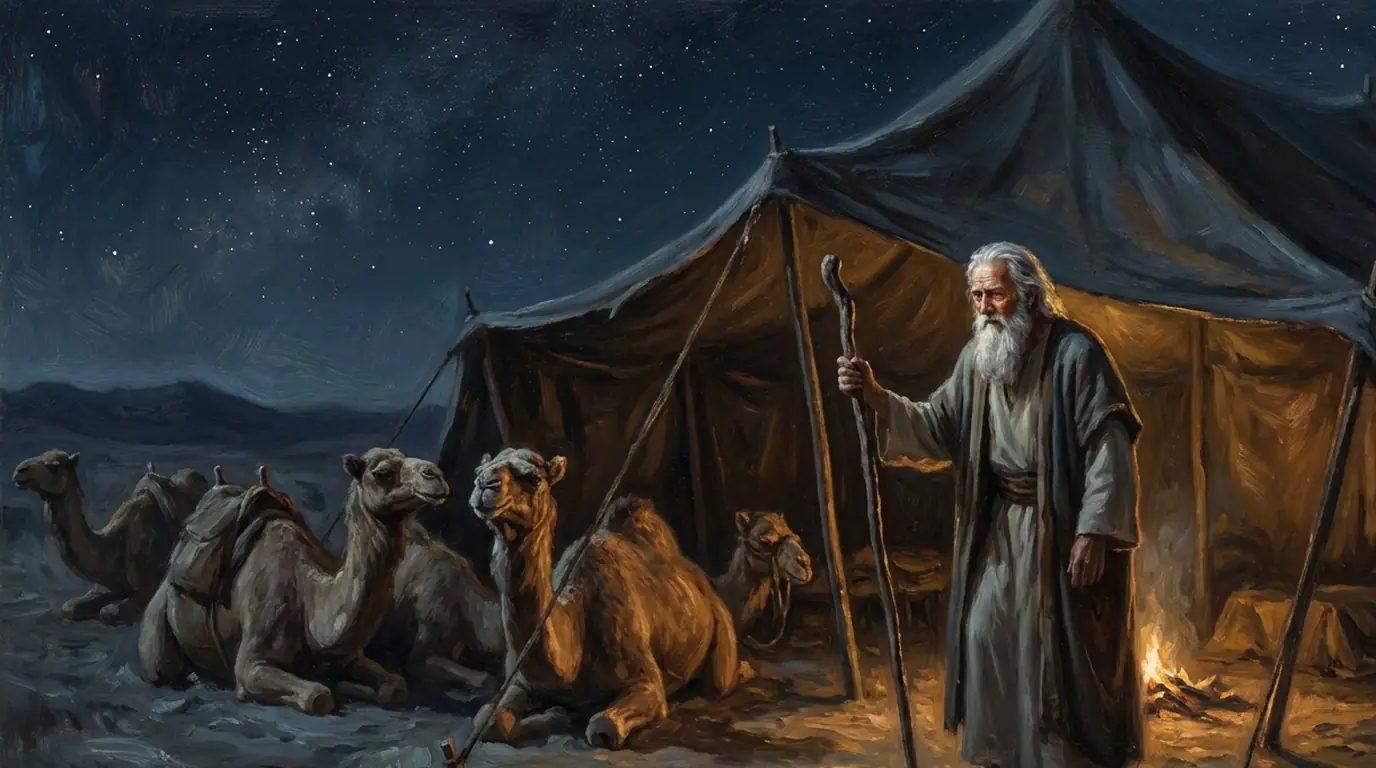
Years pass and the son does not come. God speaks to him in a vision: “Do not be afraid, Abram. I am your shield, your very great reward” (Genesis 15:1). Abram tells him the truth: I am childless, and my heir will be Eliezer of Damascus (Genesis 15:2-3). God answers that the heir will come from his own body, takes him outside the tent and asks him to look at the sky.
“And the LORD took him outside and said, “Now look to the heavens and count the stars, if you are able.” Then He told him, “So shall your offspring be.” Abram believed the LORD, and it was credited to him as righteousness.”
Verse 6 is the most quoted line of Abraham's whole life. Paul and James both pick it up in the New Testament. That same day God makes a covenant with him and warns that his descendants will be strangers in a land not their own for four hundred years (Genesis 15:13, 15:18).
Hagar and Ishmael (Genesis 16)
After ten years in Canaan, Sarai still has no children. She proposes that Abram have a child with her Egyptian servant, Hagar (Genesis 16:1-3). Hagar conceives, and the relationship between the two women breaks down. The Bible shows everyone's pain without naming villains. In the wilderness, the angel of the LORD tells Hagar she will bear a son, Ishmael, because the LORD has heard her cry of affliction (Genesis 16:11).
Hagar gives God a name, in one sentence: “You are the God who sees me” (Genesis 16:13). Abram was 86 when Ishmael was born (Genesis 16:16).
The covenant, the new name and the laughter (Genesis 17 and 18)
At 99, Abram receives a different kind of visit: “I am God Almighty. Walk before Me and be blameless” (Genesis 17:1). God changes his name to Abraham, which means father of many, and calls Sarai Sarah. He confirms that the land of Canaan will be an eternal possession for his descendants and that He will be their God (Genesis 17:8). As a sign he sets up circumcision, and Abraham carries it out that same day with Ishmael, who was 13, and every male in his household (Genesis 17:24-27).
God announces that Sarah will have a son, and Abraham laughs to himself: can a man of a hundred have a child, and Sarah at ninety (Genesis 17:17)? The boy will be named Isaac (Genesis 17:19), a name that means he laughs. In chapter 18, three visitors arrive at the tent, and Abraham runs to greet them. They repeat the promise, and this time Sarah laughs behind the door. They hear a much quoted question: “Is anything too difficult for the LORD?” (Genesis 18:14).
Sodom and Abraham's prayer (Genesis 18 and 19)
The visitors head toward Sodom, and Abraham walks along with them. He steps forward and asks: what if there are fifty righteous people in the city (Genesis 18:23-24)? He appeals to the justice of God: “Will not the Judge of all the earth do what is right?” (Genesis 18:25). He lowers the number step by step to ten (Genesis 18:32), and each time God grants what he asks.
Chapter 19 tells of the destruction of the cities of the plain. Lot comes out with his two daughters, and the narrator explains why: “He remembered Abraham” (Genesis 19:29). That prayer for others, even for people he did not know, is one of the most human scenes of his life.
Isaac, the son of the promise (Genesis 21:1-7)
The promise arrives on time: “Now the LORD attended to Sarah as He had said” (Genesis 21:1). Isaac is born when Abraham is a hundred (Genesis 21:5), twenty-five years after leaving Haran. There is laughter in the tent, this time from joy.
Hagar and Ishmael leave home (Genesis 21:8-21)
When Isaac grows, Sarah asks that Hagar and her son be sent away, and it grieves Abraham because of Ishmael. God tells him to listen to Sarah and promises to make a nation of Ishmael too (Genesis 21:12-13). Abraham gives Hagar bread and a skin of water and sends her off (Genesis 21:14). Lost in the wilderness of Beersheba, when the water runs out, this is what the passage wants us to remember: “God heard the voice of the boy” (Genesis 21:17). God opens Hagar's eyes, and she sees a well. It is a scene for anyone who has ever felt pushed out.
Mount Moriah (Genesis 22)
This is the hardest chapter of Abraham's life. It is worth reading slowly, with the text in front of you. It begins like this:
“Some time later God tested Abraham and said to him, “Abraham!” “Here I am,” he answered. “Take your son,” God said, “your only son Isaac, whom you love, and go to the land of Moriah. Offer him there as a burnt offering on one of the mountains, which I will show you.””
Abraham splits the wood and sets out with Isaac and two servants (Genesis 22:3). On the third day he sees the place from far away. Isaac asks where the lamb is, and his father answers: “God Himself will provide the lamb for the burnt offering, my son” (Genesis 22:8). At the place, Abraham builds the altar and binds Isaac on the wood (Genesis 22:9).
As he reaches out his hand for the knife, the angel of the LORD calls to him from heaven, twice by name: “Do not lay a hand on the boy” (Genesis 22:12). Abraham sees a ram caught in a thicket and offers it in place of his son (Genesis 22:13). He gives the place a name that sums up the scene.
“And Abraham called that place The LORD Will Provide. So to this day it is said, “On the mountain of the LORD it will be provided.””
After the test, God repeats the promise with an oath: He will multiply Abraham's descendants “like the stars in the sky and the sand on the seashore,” and through his offspring all nations of the earth will be blessed, “because you have obeyed My voice” (Genesis 22:17-18).
Sarah, Rebekah and the cave of Machpelah (Genesis 23 and 24)
Sarah died in Hebron at the age of 127, and Abraham came to mourn her (Genesis 23:1-2). In the promised land he did not own even a grave, and he says so plainly: “I am a foreigner and an outsider among you” (Genesis 23:4). He buys the cave of Machpelah, the first piece of Canaan he owns.
In chapter 24, Abraham's servant travels to find a wife for Isaac and comes back with Rebekah. Isaac brings her into his mother's tent, loves her and is comforted after Sarah's death (Genesis 24:67).
The death of Abraham (Genesis 25:1-11)
Abraham takes another wife, Keturah, and has more children (Genesis 25:1). When his hour comes, the text bids him farewell in quiet words:
“Abraham lived a total of 175 years. And at a ripe old age he breathed his last and died, old and contented, and was gathered to his people.”
His two sons, Isaac and Ishmael, buried him in the cave of Machpelah, beside Sarah (Genesis 25:9).
What did God promise Abraham? Land, descendants and blessing
God's promises to Abraham come in three kinds: a land, a great family and a blessing for all peoples. They repeat with new details, and the table puts them in order.
| Where | What God promises | Theme |
|---|---|---|
| Genesis 12:1-3 | A great nation, a great name and blessing for all the families of the earth | Descendants and blessing |
| Genesis 12:7 | “I will give this land to your offspring,” said at Shechem | Land |
| Genesis 15:5 | Offspring as many as the stars of heaven | Descendants |
| Genesis 15:18 | The land from the river of Egypt to the Euphrates | Land |
| Genesis 17:5-8 | Father of many nations; Canaan as an eternal possession; God will be their God | Descendants and land |
| Genesis 22:17-18 | Descendants like the stars and the sand, and blessing for all nations of the earth | Descendants and blessing |
Abraham died without seeing most of these promises fulfilled. He owned only a cave, and according to Hebrews 11:13-16 he lived and died believing. When Moses looks at the land from Mount Nebo, it is the land God had sworn to Abraham: you can read that scene in the story of Moses.
Key verses from the story of Abraham
- “Leave your country, your kindred, and your father’s household” (Genesis 12:1). The start of the road.
- “And all the families of the earth will be blessed through you” (Genesis 12:3). Blessing for every people.
- “Abram believed the LORD, and it was credited to him as righteousness” (Genesis 15:6). The line that sums up his faith.
- “Is anything too difficult for the LORD?” (Genesis 18:14). The question Sarah overheard.
- “God Himself will provide the lamb for the burnt offering, my son” (Genesis 22:8). The answer on the way up the mountain.
Abraham in the New Testament: Romans 4 and Hebrews 11
The New Testament returns to Abraham many times. These are the main passages, with what each one says.
| Passage | What it says about Abraham |
|---|---|
| Romans 4 | Paul quotes Genesis 15:6 and presents Abraham as the father of all who believe; his faith was credited to him as righteousness |
| Galatians 3:6-9 | Those who have faith are sons of Abraham, and the blessing promised in Genesis 12:3 reaches the nations |
| Hebrews 11:8-19 | Abraham obeyed and went without knowing where he was going, lived in tents and offered Isaac, reasoning that God could raise the dead |
| James 2:21-23 | His faith was working with his actions, and he was called a friend of God |
One verse in Romans sums up his attitude during the wait:
“being fully persuaded that God was able to do what He had promised.”
And Hebrews 11:8 says that Abraham, when called, “obeyed and went, without knowing where he was going.” If you like to see how another patriarch answered a hard call, read the story of Noah, who also obeyed before he saw the outcome.
Simple lessons from the life of Abraham
- You can start without seeing the destination. Abraham left at 75 with no map.
- Faith lives alongside failure. Abraham lied in Egypt, and the Bible still calls him a believer and a friend of God.
- God sees the ones who seem forgotten. He heard the voice of Ishmael in the wilderness.
- What God promises can take years. Twenty-five passed from Haran to the birth of Isaac.
If you want more verses for encouragement while you wait, see the Bible verses about faith and the Bible verses about trusting God.
How to listen to the story of Abraham as audio
In the Berean Standard Bible, Genesis chapters 12 to 24 plus the first 11 verses of chapter 25 come to about 8,600 words, roughly 49 minutes at 175 words per minute. These are approximate times, because the real length depends on the voice and the speed you choose. The table offers three routes.
| Route | Chapters | Approximate time at 175 words per minute |
|---|---|---|
| Mount Moriah | Genesis 22 | 3 min |
| The essential Abraham | Genesis 12, 13, 15 to 19, 21 to 23 and 25:1-11 | 34 min |
| The whole life of Abraham | Genesis 12 to 24 and 25:1-11 | 49 min |
Genesis is the first of the 66 books of the Bible, as the guide on how many books are in the Bible explains.