
Trusting God is easy to say and hard to live. The month arrives when the money runs short, the doctor calls, or a decision can no longer wait. In those moments you need a short line you can repeat slowly, and the Bible has plenty of them.
This page gathers 30 verses, sorted by situation and quoted word for word from the Berean Standard Bible. After each one there is a short note on where it comes from and when it helps. If you are looking for the big picture of belief, start with Bible verses about faith. If everyday worry is what weighs on you, read Bible verses about anxiety. The subject here is one thing: putting your weight down on God.
Which verse teaches us to trust God with all our heart?
“Trust in the LORD with all your heart, and lean not on your own understanding; in all your ways acknowledge Him, and He will make your paths straight.”
Proverbs 3:5-6 is the answer most people give. It packs three ideas into two verses: trust with all your heart, stop leaning on your own understanding as your only support, and acknowledge God in every road you take. The closing promise is that he makes your paths straight.
Notice the word “all.” The verse asks for complete trust. You can still study, plan and run the numbers, and hand over the outcome anyway. Your own thinking is a gift from God, and the verse asks it to share the place of support with him.
Which verse fits my situation?
| What you are facing | Verse to start with | Why it helps |
|---|---|---|
| Waiting for an answer | Psalm 27:14 | Gives the order to wait twice and adds courage for the heart. |
| Money running short | Philippians 4:19 | A promise of care written to people who shared what little they had. |
| Illness | Psalm 73:26 | Admits that the body fails and says God is still the strength of the heart. |
| A hard decision | James 1:5 | Gives you permission to ask for wisdom without fear of being scolded. |
| A loss | Psalm 34:18 | God is near to the brokenhearted. |
| An uncertain future | Psalm 31:14-15 | Hands the whole calendar over to God. |
What does it mean to trust God?
To trust God is to rest your weight on who he is and on what he promised. It works like sitting in a chair: you sit because you have tested it before. The Bible invites you to test God in small things until the trust grows.
The verses below show real people who trusted with fear, with doubt and with tears. None of them had life figured out. Their trust shows up in the middle of the problem, and that is where its value lies.
One reading tip: pick a single verse a day and say it quietly. One that stays in your memory keeps you company far longer than thirty read in a rush.
Which verses help when you have to wait?
Waiting is the hardest part of trusting, because time seems to stand still. These four verses are for anyone waiting on an answer, a job, a piece of news or a change.
“Wait patiently for the LORD; be strong and courageous. Wait patiently for the LORD!”
A psalm of David, written under threat. It repeats the call to wait twice, like someone talking to himself. Along with the advice comes courage: be strong and courageous.
“Be still before the LORD and wait patiently for Him; do not fret when men prosper in their ways, when they carry out wicked schemes.”
Some waits feel like everyone else is moving forward while you stand still. The verse asks for stillness before God and patience, without watching the person who moves faster.
“But those who wait upon the LORD will renew their strength; they will mount up with wings like eagles; they will run and not grow weary, they will walk and not faint.”
Isaiah speaks to an exhausted people, far from home. The promise has three steps: mount up, run and walk. The days of simply walking without fainting count as strength too.
“The LORD is good to those who wait for Him, to the soul who seeks Him. It is good to wait quietly for the salvation of the LORD.”
This book was born from the grief of a ruined city, and it still says the LORD is good to those who wait. It is a verse to read quietly when there is no news.
Which verses speak about trusting God with money?
Money worry is one of the biggest sleep thieves, from bills to payments to the last week of the month. These verses speak of care, contentment and knowing where your security is placed.
“Therefore do not worry, saying, ‘What shall we eat?’ or ‘What shall we drink?’ or ‘What shall we wear?’ For the Gentiles strive after all these things, and your heavenly Father knows that you need them. But seek first the kingdom of God and His righteousness, and all these things will be added unto you.”
Jesus speaks to ordinary people with a counted pantry. He gives a simple reason: your heavenly Father already knows what you need. Seeking his kingdom first puts everything else in order.
“And my God will supply all your needs according to His glorious riches in Christ Jesus.”
Paul wrote this to a church that had sent him help while he sat in prison. It is a promise of care, and it arrives alongside the generosity of those who supported him.
“I once was young and now am old, yet never have I seen the righteous abandoned or their children begging for bread.”
An older man looks back over a whole life and reports what he saw. It is a personal testimony, with the plainness of someone who has walked a long way.
“Keep your lives free from the love of money and be content with what you have, for God has said: “Never will I leave you, never will I forsake you.””
Contentment comes with trust. The verse joins two things: living free from the love of money and knowing that God stays. The bills are still there, and so is God’s company.
“Some trust in chariots and others in horses, but we trust in the name of the LORD our God.”
Chariots and horses were the military security of the day. Today they might be a savings account, a steady paycheck or a well-connected friend. The psalmist chooses to trust the name of the LORD.
Which verses help you trust God through illness?
Illness, your own or a loved one’s, tests any kind of trust. These verses keep you company through the process. Right below them is an important note about medical care.
“My flesh and my heart may fail, but God is the strength of my heart and my portion forever.”
Asaph admits that his flesh and heart may fail. In the same breath he says God is the strength of his heart. You can read it in a hospital waiting room.
“He heals the brokenhearted and binds up their wounds.”
A short and close verse. God tends the wounds of the heart and binds them up. It fits the pain that never shows up on an X-ray.
“Do not fear, for I am with you; do not be afraid, for I am your God. I will strengthen you; I will surely help you; I will uphold you with My right hand of righteousness.”
God speaks in the first person and commits himself with several verbs: to be with you, to strengthen, to help and to uphold. It is a promise of company, made for someone who is afraid.
“But He said to me, “My grace is sufficient for you, for My power is perfected in weakness.” Therefore I will boast all the more gladly in my weaknesses, so that the power of Christ may rest on me.”
Paul asked to be freed from a struggle and received this answer. Grace was enough to keep him going. It is an honest verse for anyone living with a long illness.
“Bless the LORD, O my soul, and do not forget all His kind deeds— He who forgives all your iniquities and heals all your diseases,”
David urges himself to remember God’s kind deeds one by one. It is a good practice for a hard day: list what you have already received, even in the middle of a sickness.
Which verses help when you have to make a decision?
A new job, a move, the end of a relationship or a return to school. Facing a big decision, trust takes the shape of asking for direction and moving ahead in peace. These five verses speak to that.
“I will instruct you and teach you the way you should go; I will give you counsel and watch over you.”
God promises to teach the way and keep watch over you. Before a big decision, it helps to read this slowly and ask for clarity.
“Commit your works to the LORD and your plans will be achieved.”
The verse includes your works: planning, studying, working. All of that is committed to the LORD, and with that commitment the plans are achieved.
“Commit your way to the LORD; trust in Him, and He will do it.”
Another verse with the verb commit, this time for your whole way. It ends with a short promise: he will do it.
“Now if any of you lacks wisdom, he should ask God, who gives generously to all without finding fault, and it will be given to him.”
James gives permission to ask for wisdom without fear of being scolded. God gives generously to all. It fits beautifully when you must choose between two good options.
“And whether you turn to the right or to the left, your ears will hear this command behind you: “This is the way. Walk in it.””
Isaiah speaks of a voice that guides from behind. Often the direction only makes sense looking back, once the road has been walked.
Which verses help you trust God after a loss?
After a death, a breakup or a dream that fell through, trusting can feel impossible. These verses leave room for the pain and show God close by. For more verses to walk with grief, see Bible verses about grief.
“The LORD is near to the brokenhearted; He saves the contrite in spirit.”
God comes near to the brokenhearted. He does not ask you to hurry and get up. It is a verse often read at funerals and goodbyes.
“When I am afraid, I put my trust in You. In God, whose word I praise— in God I trust. I will not be afraid. What can man do to me?”
David wrote this while afraid, and it shows: he says he trusts in exactly the moment he fears. Trust and fear fit inside the same verse.
“And we know that God works all things together for the good of those who love Him, who are called according to His purpose.”
It is quoted often and deserves a careful reading. Paul describes a God who works with all things, the painful ones too, toward a good that becomes visible over time.
““Do not let your hearts be troubled. You believe in God; believe in Me as well.”
Jesus said this the night before his death, to frightened friends. Trust is possible even in the middle of turmoil.
“For His anger is fleeting, but His favor lasts a lifetime. Weeping may stay the night, but joy comes in the morning.”
Sorrow has a schedule in this verse: a night, and then the morning. It helps anyone crossing a season of grief who needs to know weeping has an end.
Which verses help you trust God with the future?
Looking ahead and seeing nothing clear is a common source of dread. These five verses put the future in God’s hands. For more on confident waiting, read Bible verses about hope.
“For I know the plans I have for you, declares the LORD, plans to prosper you and not to harm you, to give you a future and a hope.”
Jeremiah wrote this letter to the exiles in Babylon. It was a message for a people with an uncertain future and many years of waiting ahead.
“But I trust in You, O LORD; I say, “You are my God.” My times are in Your hands; deliver me from my enemies and from those who pursue me.”
When the future looks blurry, this verse hands the calendar to God. The times of each person are in his hand.
“You will keep in perfect peace the steadfast of mind, because he trusts in You.”
Perfect peace is promised to the mind that stays fixed on God. It is a good verse for the night before an exam, a surgery or an interview.
“Those who know Your name trust in You, for You, O LORD, have not forsaken those who seek You.”
Those who know God’s name trust in him. Knowing comes first. Reading the Bible steadily is one way to get to know that name.
“The LORD is good, a stronghold in the day of distress; He cares for those who trust in Him.”
A short verse inside a hard book. God is a stronghold in the day of distress and cares for those who trust in him.
Who in the Bible trusted God?
The Bible shows trust in concrete people. Each one trusted in a different situation, and none had a clear road.
- Abraham left his homeland without knowing where he was going, because God called him (Genesis 12:1 and Hebrews 11:8). Years later, when his son asked about the lamb, he answered that God would provide it (Genesis 22:8).
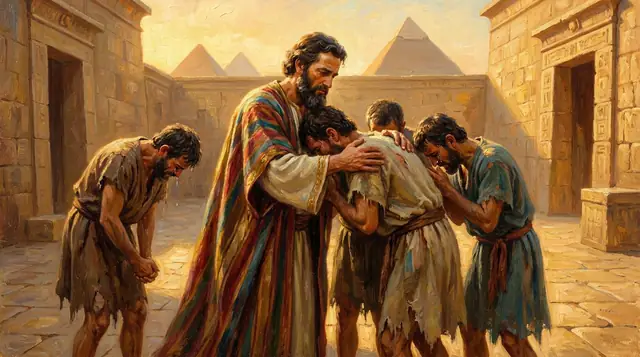
- Joseph went from being sold by his brothers to sitting in an Egyptian prison, and still recognized that God had turned it all toward good (Genesis 50:20). His whole life is told in the story of Joseph.
- David remembered how God rescued him from the lion and the bear, and with that memory he faced Goliath (1 Samuel 17:37). He also wrote Psalm 23, the most famous prayer of trust.
- Daniel spent the night in the lions’ den and came out without a wound, because he had trusted in his God (Daniel 6:23).
- Mary received the most unexpected news of her life and answered with a simple surrender: may it happen according to God’s word (Luke 1:38).
Does trusting God mean doing nothing?
Trusting God includes taking action. The Bible joins the two again and again: a person plans, works, asks for help and hands over the outcome. This table shows what healthy trust includes.
| Trust includes | What it looks like on an ordinary day | Where it appears in the Bible |
|---|---|---|
| Praying | Telling God what weighs on you, in plain words. | Psalm 62:8 |
| Working and planning | Doing today’s task well and handing over the result. | Proverbs 16:3 |
| Asking for wisdom | Asking God before deciding and listening to counsel. | James 1:5 |
| Waiting patiently | Keeping your routine while the answer is on its way. | Psalm 27:14 |
| Seeking practical help | Seeing a doctor, talking to a counselor or asking family for support. | Ecclesiastes 4:9-10 |
| Giving thanks | Writing down something received each day, however small. | Psalm 103:2 |
Look at each row: every one has an action from the person and a handing over to God. Biblical trust is active. Think of a farmer who plants, waters and waits for rain, knowing the rain is out of his hands.
How can you use these verses when trusting is hard?
A verse read slowly changes how you get through the day. These five ideas help the words stay with you.
- 01Choose a single verse for the week, the one closest to what you are living.
- 02Write it on a card and put it where you will see it: the mirror, the fridge or your planner.
- 03Say it quietly when you wake up and before you sleep.
- 04Share it with someone you trust who can pray with you.
- 05Write down what happened at the end of the week. Seeing the story on paper strengthens the next round of trust.
A short prayer for trusting God
Father, today I want to trust you. You know what worries me: the money, my health, the decision I still have to make. I place all of it in your hands. Give me calm to wait, wisdom to choose and strength for the next step. When believing gets hard, remind me that you are with me. In Jesus’ name, amen.
If this prayer helped, say it every morning for a week. To keep reading, begin with Bible verses about faith or stay with Psalm 23, which sums up in a few lines everything on this page.