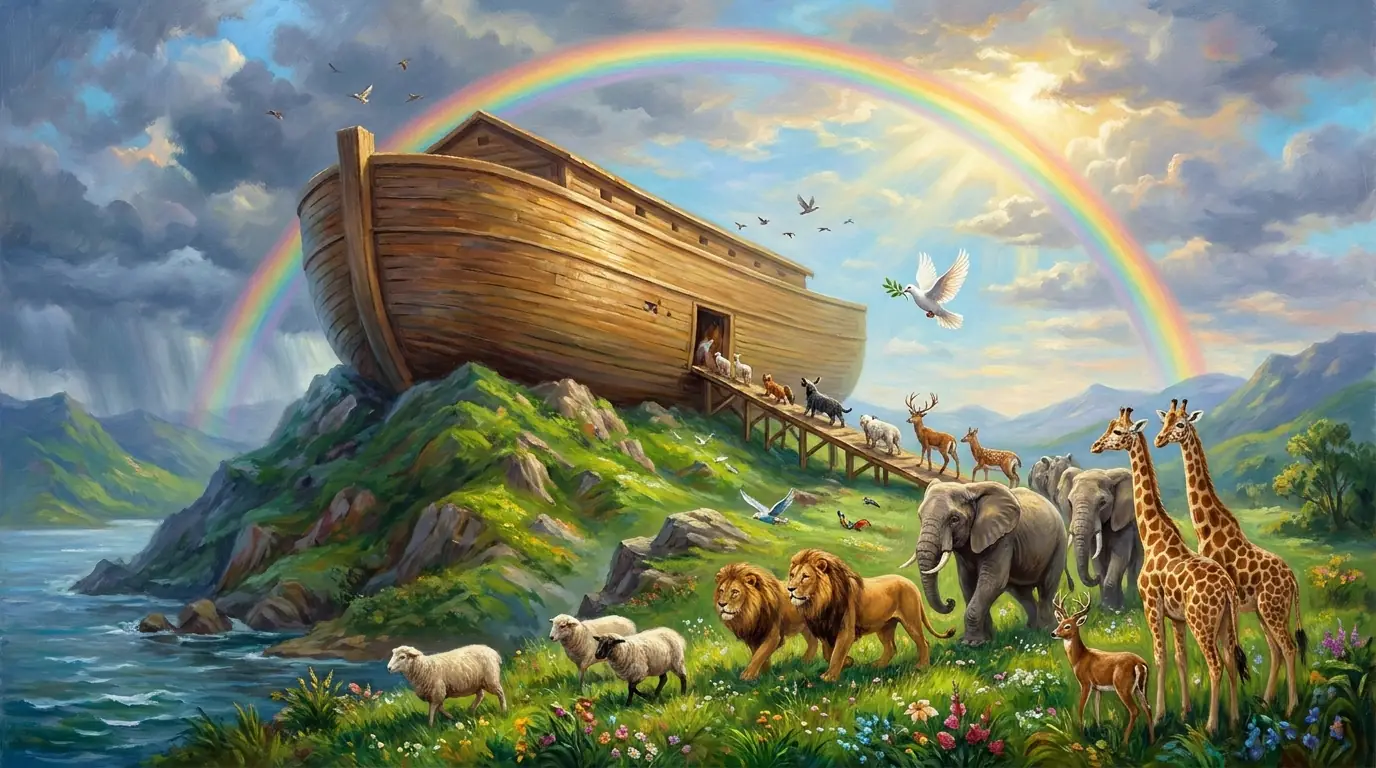
The story of Noah fits into four chapters, Genesis 6, 7, 8 and 9, and takes about twelve minutes to read. It is one of the best-known accounts in the Bible and one of the most often told to children, with a boat full of animals and a rainbow at the end. Here we walk through it scene by scene, staying with what the text actually says: the numbers, the dates, the measurements and the words of God. To keep following the Bible's storyline, the next figure is Abraham, so see the story of Abraham, and later the story of Moses.
Who was Noah and where is his story?
Noah is the man God chose to save his family and the animals when the flood came. His account begins in Genesis 6:9 with the words “This is the account of Noah” and ends in Genesis 9:29 with his death at 950 years old. He had three sons: Shem, Ham and Japheth (Genesis 6:10).
The text describes him in very few words, and every one of them counts:
“This is the account of Noah. Noah was a righteous man, blameless in his generation; Noah walked with God.”
Why did God send the flood? (Genesis 6:1-13)
Chapter 6 opens with a world that grows and decays. The Bible sums it up: “the LORD saw that the wickedness of man was great upon the earth, and that every inclination of the thoughts of his heart was altogether evil all the time” (Genesis 6:5). Then it adds something people rarely mention: “the LORD regretted that He had made man on the earth, and He was grieved in His heart” (Genesis 6:6). God does not watch this scene coldly. It hurts him.
In the middle of that darkness comes a short sentence, one of the brightest in the chapter:
“Noah, however, found favor in the eyes of the LORD.”
The reason for the judgment is written plainly: the earth was “full of violence” (Genesis 6:11). God tells Noah his decision and, in the same conversation, hands him the plan to save his family. Before he destroys, God warns and offers a way through. That detail runs through the whole story.
How big was Noah's ark? Measurements and materials
God gives Noah very concrete instructions: “Make for yourself an ark of gopher wood; make rooms in the ark and coat it with pitch inside and out” (Genesis 6:14). Gopher is a kind of wood nobody can identify with certainty today. Then come the measurements, in cubits. A cubit was the length from the elbow to the tip of the fingers and is usually figured at about 18 inches (roughly 45 centimeters). That is why the feet and meters in the table are approximate.
| Part of the ark | What the text says | Approximate equivalent |
|---|---|---|
| Length | 300 cubits (Genesis 6:15) | About 450 feet, about 137 meters |
| Width | 50 cubits (Genesis 6:15) | About 75 feet, about 23 meters |
| Height | 30 cubits (Genesis 6:15) | About 45 feet, about 13.7 meters |
| Decks | Lower, middle and upper decks (Genesis 6:16) | Three levels |
| Window | A cubit from the top (Genesis 6:16) | About 18 inches, about 45 centimeters |
| Door | In the side (Genesis 6:16) | One door, on the side |
| Material | Gopher wood, pitch inside and out (Genesis 6:14) | Resinous wood, sealed against water |
| Water above the mountaintops | Fifteen cubits (Genesis 7:20) | About 22.5 feet, about 6.9 meters |
To picture the size, 450 feet is longer than an American football field, end zones included, which measures 360 feet. It had three decks with rooms, meaning compartments. God gave one more order: “You are also to take for yourself every kind of food that is eaten and gather it as food for yourselves and for the animals” (Genesis 6:21). Noah had to plan meals for his whole family and for the animals. The chapter closes with a plain line of obedience:
“So Noah did everything precisely as God had commanded him.”
The New Testament looks back on this moment in Hebrews 11:7, where building the ark is described as an act of Noah's faith in something not yet seen.
Going into the ark: seven days of waiting (Genesis 7:1-16)
In chapter 7, God speaks again: “Go into the ark, you and all your family, because I have found you righteous in this generation” (Genesis 7:1). He gives instructions about the animals. Seven pairs of every kind of clean animal, and one pair of every kind of unclean animal (Genesis 7:2). Seven pairs of birds too (Genesis 7:3). And he sets a deadline: “For seven days from now I will send rain on the earth for forty days and forty nights” (Genesis 7:4).
Noah complies: “And Noah did all that the LORD had commanded him” (Genesis 7:5). Into the ark go Noah, his wife, his three sons Shem, Ham and Japheth, and the three wives of his sons (Genesis 7:13). That makes eight people, plus the animals the text describes as coming “two by two” (Genesis 7:9). And there is one small sentence many readers underline:
“And they entered, the male and female of every living thing, as God had commanded Noah. Then the LORD shut him in.”
The one who shuts the door is God. Inside the ark, the family is kept safe by a hand bigger than their own.
Timeline of the flood: the numbers in the text
Genesis 7 and 8 record dates and durations with unusual care. The table gathers only what the text says, in order. Months are counted the way the text names them: the second month, the seventh month and so on.
| Moment | What the text says | Where |
|---|---|---|
| Noah's age when the flood came | 600 years | Genesis 7:6 |
| God's warning | Seven days before the rain begins | Genesis 7:4 and 7:10 |
| The flood begins | Noah's 600th year, second month, day 17 | Genesis 7:11 |
| How long it rained | 40 days and 40 nights | Genesis 7:12 and 7:17 |
| How long the waters prevailed | 150 days | Genesis 7:24 |
| The ark comes to rest | Seventh month, day 17, on the mountains of Ararat | Genesis 8:4 |
| Mountaintops become visible | Tenth month, day 1 | Genesis 8:5 |
| Noah opens the window and sends a raven | Forty days later | Genesis 8:6-7 |
| First dove | Finds no place to rest and returns | Genesis 8:8-9 |
| Second dove | Seven more days; returns in the evening with an olive leaf | Genesis 8:10-11 |
| Third dove | Seven more days; does not return | Genesis 8:12 |
| The waters dry up | Noah's 601st year, first month, day 1 | Genesis 8:13 |
| The earth is fully dry | Second month, day 27 | Genesis 8:14 |
| Noah's life after the flood | 350 years | Genesis 9:28 |
| Total of his days | 950 years | Genesis 9:29 |
These dates allow a simple calculation. From the seventeenth day of the second month to the seventeenth day of the seventh month is five months, which matches the 150 days in the text. And from the seventeenth day of the second month in year 600 to the twenty-seventh day of the second month in year 601 is a little over a year. That sum is ours, worked out from the dates in the book, and the text does not state it in those words.
The waters rise (Genesis 7:17-24)
The account slows down and describes the flood with verbs of rising water: “the waters rose and lifted the ark high above the earth” (Genesis 7:17). Then: “the ark floated on the surface of the waters” (Genesis 7:18). The ark floats. It has no sail and no rudder, and the account mentions no direction. It is a boat that can only wait.
The text is direct about what happened on the earth: everything that lived on dry land died, and “only Noah and those with him in the ark remained” (Genesis 7:23). It is a sober passage, and the Bible does not soften it. That is why it matters to read what comes next.
“God remembered Noah”: the raven and the dove (Genesis 8:1-14)
Chapter 8 opens with the turning point of the whole story:
“But God remembered Noah and all the animals and livestock that were with him in the ark. And God sent a wind over the earth, and the waters began to subside.”
After 150 days of water, God remembers. In the Bible, that verb means God moves into action on someone's behalf. He sends a wind, the springs of the deep and the floodgates of the heavens are closed, and the waters slowly go down (Genesis 8:2-3). The ark comes to rest on the mountains of Ararat, in the seventh month, on day 17 (Genesis 8:4).
Noah does not leave right away. He waits forty more days, opens the window and sends out a raven first, which flies back and forth “until the waters had dried up from the earth” (Genesis 8:7). Then he sends a dove. The first time, she finds “no place to rest her foot” and comes back; Noah reaches out his hand and brings her into the ark (Genesis 8:9). He waits seven days and sends her again:
“And behold, the dove returned to him in the evening with a freshly plucked olive leaf in her beak. So Noah knew that the waters had receded from the earth.”
The olive leaf became, from then on, a symbol of peace in many cultures. Noah waits seven more days and sends the dove a third time. This time she does not come back (Genesis 8:12). Even so, Noah does not step out on his own. He removes the covering and sees that the ground is dry (Genesis 8:13), and he still waits until God speaks: “Come out of the ark, you and your wife, along with your sons and their wives” (Genesis 8:16). He went in when God said go in, and he comes out when God says come out.
The altar and God's promise (Genesis 8:18-22)
The first thing Noah does on solid ground is build an altar: “Then Noah built an altar to the LORD” (Genesis 8:20). He offers burnt offerings from the clean animals, and God answers with a promise. He says “in His heart” that he will never again curse the ground because of man or destroy all living creatures as he has done (Genesis 8:21). And he adds a guarantee any farmer understands:
“As long as the earth endures, seedtime and harvest, cold and heat, summer and winter, day and night shall never cease.”
The rainbow and the covenant (Genesis 9:1-17)
Chapter 9 begins with a blessing: “And God blessed Noah and his sons and said to them, ‘Be fruitful and multiply and fill the earth’” (Genesis 9:1). Then God speaks of his covenant, already announced in Genesis 6:18, and this time extends it to every living creature. The promise is clear:
“And I establish My covenant with you: Never again will all life be cut off by the waters of a flood; never again will there be a flood to destroy the earth.”
And God gives a visible sign, so nobody has to guess whether the promise still stands:
“I have set My rainbow in the clouds, and it will be a sign of the covenant between Me and the earth.”
Notice who does the remembering. God says: “I will remember My covenant between Me and you and every living creature of every kind” (Genesis 9:15), and “I will see it and remember the everlasting covenant” (Genesis 9:16). The rainbow is a sign God looks at. The covenant reaches “every living creature,” including the animals that came out of the ark (Genesis 9:10-12). The next time you see a rainbow after the rain, you are looking at the sign Genesis 9 describes.
After the flood: the vineyard and Noah's last years (Genesis 9:18-29)
The Bible does not present its characters as perfect. Noah plants a vineyard, drinks some of its wine and becomes drunk (Genesis 9:20-21). His son Ham sees him uncovered and tells his brothers, while Shem and Japheth cover him with a garment, walking backward so they will not look (Genesis 9:22-23). When Noah wakes, he speaks a curse over Canaan, Ham's son, and a blessing over Shem and Japheth (Genesis 9:25-27). It is a hard scene, and the text leaves it without decoration.
The account closes with two numbers: “After the flood, Noah lived 350 years. So Noah lived a total of 950 years, and then he died” (Genesis 9:28-29).
Key verses from the story of Noah
- “Noah, however, found favor in the eyes of the LORD” (Genesis 6:8). The sentence that opens the hope.
- “Noah walked with God” (Genesis 6:9). How the Bible describes his life.
- “So Noah did everything precisely as God had commanded him” (Genesis 6:22). Simple obedience.
- “Then the LORD shut him in” (Genesis 7:16). God protects his own.
- “But God remembered Noah” (Genesis 8:1). The turning point of the account.
- “I have set My rainbow in the clouds” (Genesis 9:13). The sign of the covenant.
- “I will remember My covenant” (Genesis 9:15). The promise God commits himself to remember.
If you are looking for more verses for hard seasons, see the guides to Bible verses about hope and Bible verses about protection.
Simple lessons from the story of Noah
- You can walk with God when nearly everyone goes another way. Noah lived like that in a world the Bible describes as full of violence.
- God warns. Before the flood there was a plan of rescue and a deadline of seven days.
- Obeying a big instruction takes daily work. Noah built, gathered food and waited.
- God shuts the doors we cannot shut. Genesis 7:16 says it simply.
- Waiting is work too. Noah stayed a little over a year inside the ark and left only when God said so.
- God remembers us even when time feels long. One hundred fifty days of water ended with “God remembered Noah.”
- God's promises come with signs. Every rainbow recalls Genesis 9.
- Good people stumble too. After the flood, Noah fell in the vineyard scene, and the account tells it without hiding it.
How do you tell the story of Noah to kids?
The story of Noah works well with little ones, as long as it is told calmly and without details that frighten them. It suits Sunday school, bedtime or a family circle at the table. Here is a short version you can read aloud in two minutes:
- 01Long ago, people were doing very bad things, and God was sad.
- 02But there was a good man named Noah, who walked with God.
- 03God asked him to build an ark, a very big boat. Noah listened.
- 04God asked him to bring his family and the animals, two by two, and God himself shut the door.
- 05Rain fell for forty days and forty nights. Noah and his family stayed safe inside the ark.
- 06When the water went down, Noah sent out a dove. She came back with an olive leaf, and Noah knew the ground was dry.
- 07God told them they could come out of the ark. Noah thanked God.
- 08God put a rainbow in the sky and promised there would never again be a flood to destroy the earth.
Afterward you can ask: Which animal would you like to take care of on the ark? Why did Noah wait so long? What does the rainbow remind you of? With the youngest, drawing the boat, the dove and the colors of the rainbow helps. With older kids, look up the numbers in the text together: 40 days, 150 days and 600 years.
How long does it take to read or listen to Genesis 6 to 9?
In the Berean Standard Bible, the four chapters come to about 2,100 words. At 175 words per minute, a relaxed narration pace, reading the whole story takes about 12 minutes. These are approximate times, because the real length depends on the voice and the speed.
| Section | Chapters | Approximate time |
|---|---|---|
| The warning and the ark | Genesis 6 | 3 minutes |
| The flood | Genesis 7 | 3 minutes |
| The raven, the dove and leaving the ark | Genesis 8 | 3 minutes |
| The covenant and the rainbow | Genesis 9 | 3 and a half minutes |
| The whole story of Noah | Genesis 6 to 9 | 12 minutes |
Genesis is the first of the 66 books of the Bible, as the guide on how many books are in the Bible explains. To hear the text instead of reading it, see how to listen to the Bible.
To keep going through the Bible's stories, read the story of Abraham, the story of Joseph and the story of Moses.