After one hundred and forty-nine psalms full of complaints, questions, confessions, escapes, victories and long silences, the book ends with a party. Psalm 150 does not argue and does not ask for anything. It has six verses, and in them the word 'praise' keeps landing like a kick drum that never stops. Plenty of people learned it in Sunday school, others hear it at praise team rehearsal, and some read it alone at the kitchen table when the day went well and they want to thank someone. It is printed in full below, in the Berean Standard Bible, followed by a verse-by-verse explanation, a table of the instruments and a guide for using it in different settings.
Psalm 150 in full
“Hallelujah! Praise God in His sanctuary. Praise Him in His mighty heavens. Praise Him for His mighty acts; praise Him for His excellent greatness.”
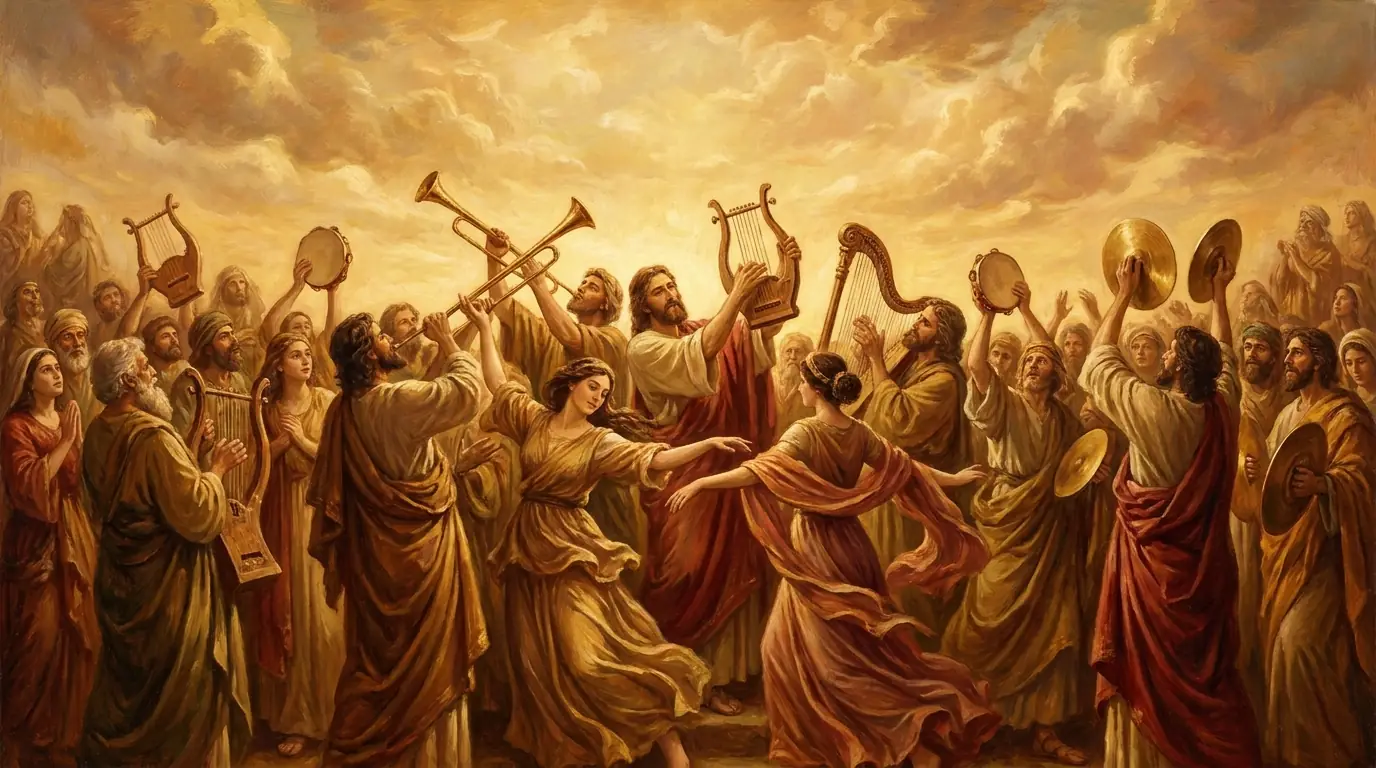
“Praise Him with the sound of the horn; praise Him with the harp and lyre. Praise Him with tambourine and dancing; praise Him with strings and flute. Praise Him with clashing cymbals; praise Him with resounding cymbals.”
“Let everything that has breath praise the LORD! Hallelujah!”
Why does Psalm 150 close the book of Psalms?
The book of Psalms is arranged in five parts, and each part ends with a line blessing God. It is as if the editor placed a musical period at the end of each section. Psalm 150 does that job for the fifth part and for the whole collection. That is why many people call it the grand finale. After the last psalm there is no other prayer. The book ends in music.
| Part of the book | Psalms | How that part ends |
|---|---|---|
| Book 1 | 1 to 41 | Psalm 41:13, a blessing to God |
| Book 2 | 42 to 72 | Psalm 72:18-19, a blessing to God |
| Book 3 | 73 to 89 | Psalm 89:52, a blessing to God |
| Book 4 | 90 to 106 | Psalm 106:48, a blessing to God and an 'Amen' from the people |
| Book 5 | 107 to 150 | Psalms 146 to 150, five hallelujah psalms, with 150 as the end of everything |
The last five psalms, 146 to 150, share a trait you can see when you read them in a row: each begins and ends with 'Hallelujah'. They form a choir that keeps rising. Psalm 146 praises God for as long as there is life, 147 praises him for caring for the brokenhearted, 148 calls on all creation, 149 praises with song and dance, and 150 gathers everything into one shout. If you want to know what 'hallelujah' means, see the meaning of amen, hallelujah and hosanna. According to the Berean Standard Bible footnote, the word is Hebrew for 'Praise the LORD'.
From Psalm 1 to Psalm 150: the arc of a book
It helps to look at both ends of the book together. Psalm 1 opens with a picture of a happy person who delights in God's law and is like a tree planted by streams of water. It is a calm start, almost classroom style, with two roads to choose from. Psalm 150 ends with a whole crowd at full volume. In between you find everything: David on the run, an exile weeping by a river, a person full of regret, a nation giving thanks.
Read that way, the whole book is a school of prayer. It starts by teaching you to choose God's road, goes on to teach you to bring him everything you feel, even the darkest parts, and ends by showing that the place you arrive at is praise. People who pray the psalms for years often notice this movement in their own lives: the complaints slowly give up ground and the thank-yous take up more room.
Two psalms sit very close to this one. Psalm 118 is a song of thanks sung at Israel's festivals, and Psalm 100 invites everyone to come in with joy. The three can be read in a single sitting as a small trilogy of gladness.
Who wrote Psalm 150?
The psalm carries no title and no author's name. Many other psalms say 'of David' or name a music leader, and this one begins straight away with 'Hallelujah'. That is why it is considered anonymous. Israel's custom was to sing it at the temple in Jerusalem, and the Church has kept it in its liturgy and hymnals for centuries. Having no known author makes it belong to everyone even more.
Psalm 150 explained verse by verse
Verse 1: where to praise God
The psalm opens with 'Hallelujah' and quickly marks two places: 'in His sanctuary' and 'in His mighty heavens'. The sanctuary is the meeting place, the physical spot where the people gathered to worship. The mighty heavens are the sky, that enormous space you can see from anywhere. A Berean Standard Bible footnote offers two other ways to translate that phrase, 'the expanse of his might' and 'the firmament of his might', and connects it to Genesis 1:6-8, where God stretches out the firmament.
There is something lovely about that pair: the small place and the immense place. You praise God in the neighborhood church with its folding chairs and the microphone that sometimes squeals, and you praise him under the open sky, in a field, at the beach, on the back porch. No corner is left out.
Verse 2: why praise him
Here comes the reason, and there are two: 'for His mighty acts' and 'for His excellent greatness'. The mighty acts are what God did, like bringing Israel out of Egypt or caring for each person in their own story. The greatness is who God is. You praise him for what he does and for who he is. The greatness is called 'excellent', and since God's greatness has no end, the reason to praise never runs out.
This is a good question to ask out loud before praying with the psalm: which mighty acts of God do I know firsthand? It might be a healing, a job that came just in time, a child who came home, a hard night that finally ended. Remembering those acts makes the verse personal.
Verses 3 and 4: how to praise him, part one
Now the orchestra starts. First 'the sound of the horn', a wind instrument blown with force, which in the biblical world was used to call the people together and announce festivals. Then 'the harp and lyre', two stringed instruments. Next 'tambourine and dancing', a hand drum and movement. And finally 'strings and flute'. The list goes from loudest to softest, from what you strike to what you blow to what you pluck.
The Berean Standard Bible reads 'tambourine and dancing' in verse 4, while other translations name only a drum or a pipe, so translators do not fully agree here. In every case the message is that praise involves movement. You can dance a little awkwardly and still have your whole body take part.
Verse 5: how to praise him, part two
Verse 5 names the same instrument twice: 'clashing cymbals' and 'resounding cymbals'. Cymbals are two metal plates struck against each other, making a bright sound that carries far. Their appearing twice suggests the psalm has reached its loudest point. It is the moment the conductor waves for the whole orchestra to play at full strength.
Verse 6: who praises him
The ending is the best-known line of the psalm: 'Let everything that has breath praise the LORD!' There is no guest list. Anything with breath is invited: the elderly person who breathes with difficulty, the newborn baby, the one who sings off key, the one who can only whisper. It has also been read as an invitation to every living creature. The psalm ends the way it began, with 'Hallelujah', and the circle closes. The Berean Standard Bible footnote explains that 'Hallelu YAH' means 'Praise the LORD'.
A simple idea comes out of this verse. As long as a person is breathing, they have something to praise with. The air moving in and out is already a way of saying thank you to the one who gives it. Many people who are sick, older or worn out find comfort in that, because it does not depend on strength or on a good singing voice.
Which instruments does Psalm 150 name, and what were they?
Every translation picks slightly different words for the instruments, and it can be hard to imagine what actually sounded. The table below uses the words of the Berean Standard Bible and explains each one in plain language, sticking to what scholars broadly agree on.
| Word in the Berean Standard Bible | What it was, in plain words | How it sounded and what it was for |
|---|---|---|
| Horn | A wind instrument made from an animal horn, known in the biblical world as the shofar | A loud, deep sound used to call people together and announce festivals |
| Harp | A stringed instrument, usually larger, played with the hands | A sweet, wide sound, traditionally linked with the music of King David |
| Lyre | A smaller stringed instrument with a wooden sound box, played with the fingers | A gentle sound, closely tied to accompanying singing |
| Tambourine | A hand drum, a simple frame drum rather than the jingling kind found in modern bands | Kept the beat at festivals, often together with dancing |
| Strings | A general name for several stringed instruments | Varied sounds, played with the fingers |
| Flute | A wind instrument made from reed or another light material | A clear melody, used at celebrations and with singing |
| Clashing cymbals | Two metal plates struck together | A bright, strong sound |
| Resounding cymbals | The same instrument, now in its most festive form | A sound that marks the high point of the praise |
One detail helps you read the psalm with freedom: there is no rule about which one to play. The instruments listed were the ones available back then, and today the same spirit can be expressed with an acoustic guitar, a keyboard, a drum kit, a cajon, clapping hands or a voice with no accompaniment at all. The words 'everything that has breath' make clear that what counts is the breath of the one praising.
Summary table: where, why, how and who
The psalm answers four simple questions in order. This table puts each one next to its verse and an idea to take with you.
| Question | The psalm's answer | Verse | Idea for today |
|---|---|---|---|
| Where? | In His sanctuary and in His mighty heavens | 1 | In church and outside it, under the sky, at home, on the road |
| Why? | For His mighty acts and His excellent greatness | 2 | Write a list of what God has done for you and your family |
| How? | With horn, harp, lyre, tambourine, strings, flute and cymbals | 3 to 5 | With music, clapping, movement and whatever voice you have |
| Who? | Everything that has breath | 6 | Young and old, with or without a voice, healthy or worn out |
How can you use Psalm 150 in worship, in a praise team and in personal prayer?
In a church service
Because it works like a call and response, the psalm makes a strong opening or closing for a service. The leader can read verses 1 to 5 and the congregation answer together with verse 6. Another way is to split the room into two halves: one side reads 'Praise Him' and the other finishes the line. Churches with a band or orchestra can bring each instrument in when its name appears in the text. In a small chapel with no instruments, clapping and the voices in the room are enough.
- 01Before starting, invite everyone to take one deep breath with verse 6 in mind.
- 02The leader reads verses 1 and 2 in a clear voice, without rushing.
- 03Each instrument comes in when the text names it. With no instruments, use clapping.
- 04Everyone says verse 6 together and ends with a strong 'Hallelujah'.
- 05Leave one minute of silence for quiet thanks.
In a praise team or choir
Musicians find a perfect rehearsal in this psalm. Each person can pick a verse and prepare to play it. To rehearse, it helps for the group to read the whole text first and talk about why each instrument appears where it does. Then you can build a simple arrangement: start soft, add instruments verse by verse and reach the peak on the cymbals. It also helps to remember that the psalm puts all the focus on God. Before stepping up to play, many teams read verses 1 and 2 to remind themselves who they are playing for.
- Short rehearsal: read the whole psalm out loud before playing the first note.
- Layered arrangement: one instrument per verse, everyone together at the end.
- Room for everyone: people who do not play can clap or lead the 'Hallelujah' chorus.
- Closing in silence: after the last chord, a brief moment of stillness.
In personal prayer
For praying alone, read the psalm slowly, pausing after each verse. At the first verse, think about where you are right now and give thanks for the place. At the second, name one concrete thing God did for you this week. At the next ones, put on a favorite song, clap or hum quietly. At the last, take three deep breaths and say 'Hallelujah' out loud. Nothing more is needed. It takes about five minutes and changes the tone of the day.
A short prayer of praise with Psalm 150
For anyone who likes to have the words at hand, this short prayer follows the order of the psalm. You can say it in the morning, after a service or before bed:
How does Psalm 150 connect to gratitude?
Praise and thanks are two sides of one coin. When you give thanks, you look at what you received. When you praise, you look at the one who gave it. Psalm 150 turns the eyes toward God and his greatness, which makes it a natural finish for anyone who has been collecting reasons to be thankful. If you want a list of texts for different situations, the Bible verses about gratitude gather short lines for thanking God at different moments, and they can help prepare your heart before praying Psalm 150.
A useful habit is to end the day with three reasons to be thankful and then read the psalm. Within a week you start to notice your mind learning to look for what is good.
What should you read after Psalm 150?
After the last page you can go back to the first. Read Psalm 1 again and see how the first and the last answer each other. You can also browse the most popular psalms to see which ones sit in the middle of this journey, or stay a while longer with the gratitude of Psalm 118 and the joyful entrance of Psalm 100.