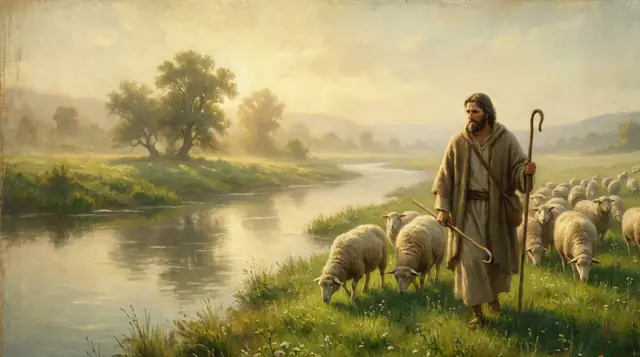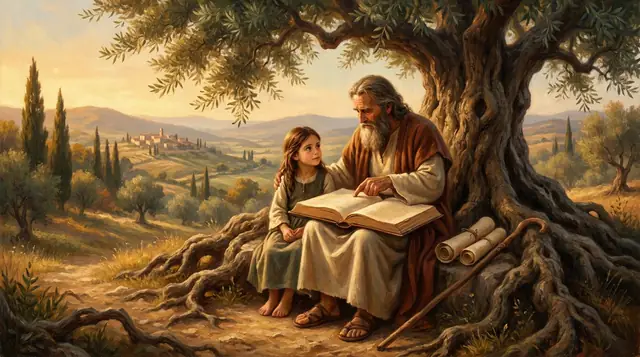
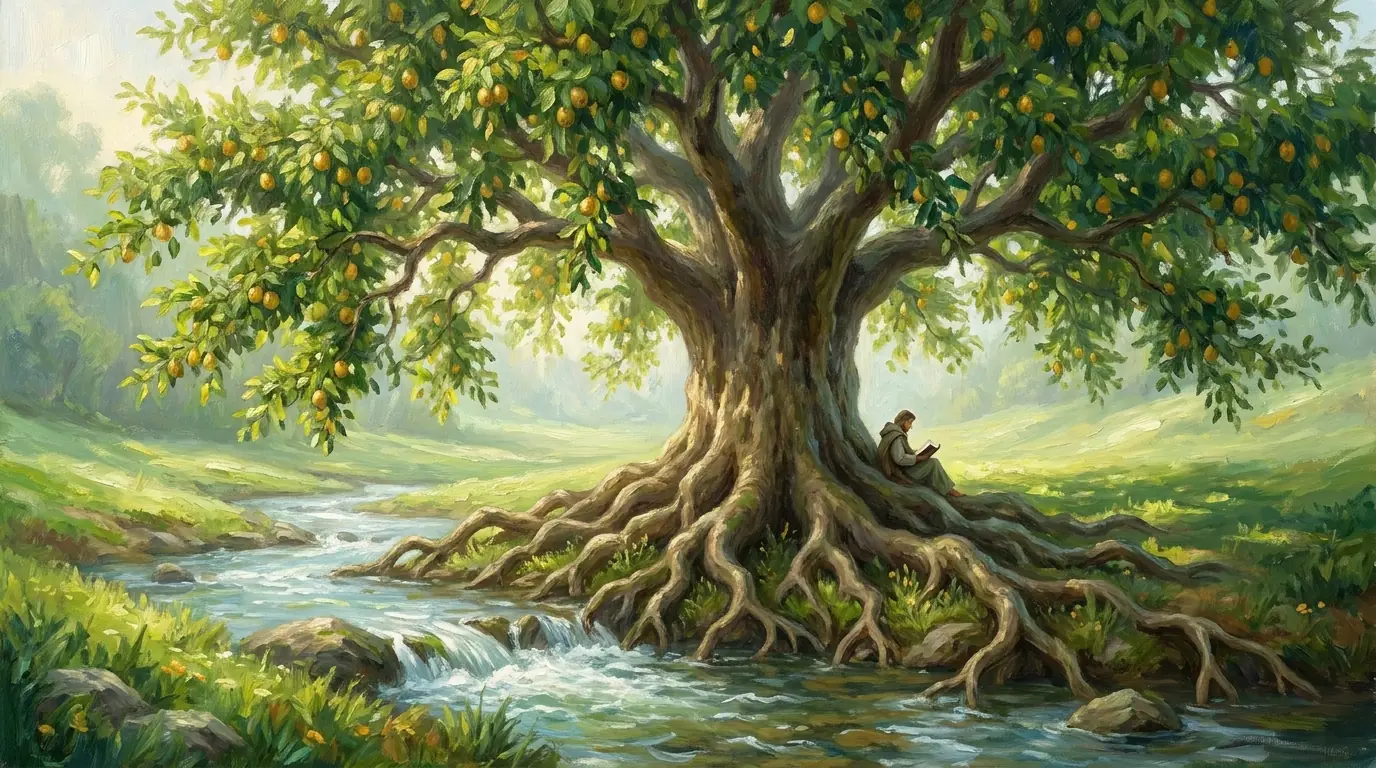
Many people start reading the Psalms with the most famous one, Psalm 23. Others open the book at the beginning and land on Psalm 1. It is short, only six verses, and it holds one of the best-loved pictures in the whole Bible: a tree planted by streams of water, with leaves that do not wither and fruit in its season. It is the psalm that ends up framed in a hallway, written on the first page of a journal, or set as the wallpaper on a phone. Below it appears in full, in the Berean Standard Bible, followed by a verse-by-verse explanation in everyday words, with tables that show at a glance the two paths the psalm describes.
Psalm 1 in full
“Blessed is the man who does not walk in the counsel of the wicked, or set foot on the path of sinners, or sit in the seat of mockers. But his delight is in the Law of the LORD, and on His law he meditates day and night. He is like a tree planted by streams of water, yielding its fruit in season, whose leaf does not wither, and who prospers in all he does.”
“Not so the wicked! For they are like chaff driven off by the wind. Therefore the wicked will not stand in the judgment, nor sinners in the assembly of the righteous. For the LORD guards the path of the righteous, but the way of the wicked will perish.”
Why does Psalm 1 open the book of Psalms?
The book of Psalms gathers 150 songs and prayers, written over many centuries by several authors, David among them. Someone arranged them, and chose this one to go first. It shows. Almost every psalm that follows is a cry, a lament, a victory song, or a plea for help. Psalm 1 speaks to the reader. It works like the sign at the entrance of a national park: before you start walking, check which trail you are on.
Many scholars treat it as the front door of the whole book, which is why it is often read together with Psalm 2. The idea is simple. The Psalms are going to talk about good days and bad days, enemies and friends, doubt and joy. For all of that, Psalm 1 gives a starting point: there is a way of living planted by the water, and there is another way that has no roots. The rest of the book can be read as the walk of someone trying to live in the first one.
One more detail. This psalm carries no title and no author's name. Many of the ones after it say 'A Psalm of David' or name an instrument. This one starts straight in with a single word, 'Blessed,' which can also be understood as 'happy.' The Berean Standard Bible puts the heading 'The Two Paths' above it, and that label sums up the content well.
If you want to see how the book continues after this front door, take a look at the most popular psalms, a short list with the theme of each one.
Psalm 1 explained verse by verse
Verse 1: three steps downhill
The psalm opens with a blessing: 'Blessed is the man who does not walk in the counsel of the wicked.' The Hebrew word behind 'man' was used in the sense of 'person,' and today it applies to men and women alike. The first thing said about the happy person is what they avoid. And it comes in three verbs that go down like stairs: 'walk,' 'set foot,' and 'sit.'
First a person walks in the counsel of the wicked, meaning they listen to what those people say and follow their opinion. Then they set foot on their path, meaning they slow down and share the direction. In the end they sit in the seat of mockers, the scoffers, the ones who laugh at everything that has value. Nobody lands in that seat overnight. You get there step by step, and the psalm warns you in the very first line. Further down there is a table with the three actions in plain language.
Verse 2: where the delight is
Verse 2 shows the other side: 'But his delight is in the Law of the LORD, and on His law he meditates day and night.' The happy person has a place where they love to be. 'Delight' means pleasure, enjoyment, gladness. The psalmist enjoys the Law, and that changes everything: a duty done through clenched teeth is heavy, and a delight is something you go looking for on your own.
The 'Law' of the LORD, in ancient Hebrew, is the 'Torah,' a word that means teaching or instruction. For whoever wrote the psalm, that was the first books of the Bible and everything God had said to His people. For us today it is the Word of God. And 'meditates' has a curious sense in Hebrew: the word can describe the murmur of someone repeating something under their breath, chewing it over. From that comes the habit of reading slowly, repeating a line, and letting it stay.
Verse 3: the planted tree
Here is the picture that made the psalm famous: 'He is like a tree planted by streams of water, yielding its fruit in season, whose leaf does not wither, and who prospers in all he does.' It is worth looking at each part, because each one says something.
First, the tree is 'planted.' Nobody dropped it there by chance. Someone put it beside the water, and that speaks of a life that has a place and someone caring for it. Second, the 'streams of water,' in a dry land like Israel, made the difference between a tree that lives and one that dries out. With water nearby, the roots do not worry about summer. Third, it yields fruit 'in season,' in the season that belongs to it. Fourth, its 'leaf does not wither,' so it stays green even when the heat presses in. And fifth, it 'prospers in all he does.'
That last phrase calls for care. Some people read it as a promise of wealth or of a life without problems. With the whole book of Psalms in view, it reads better as a promise about the deep down: the life of the person beside the water has meaning, bears fruit, and does not dry out inside, even through hard seasons. The same book holds many psalms written by people who were suffering, and none of them claims that suffering takes the fruit from the tree. The prophet Jeremiah uses a nearly identical picture in Jeremiah 17:7-8, and there it is clear that the tree by the water does not fear when the heat comes.
Verse 4: the chaff
Verse 4 changes the scene suddenly: 'Not so the wicked! For they are like chaff driven off by the wind.' Chaff is the light husk around a grain of wheat. When wheat was threshed, everything was tossed into the air, and the wind carried the husk away while the heavy grain fell to the ground. Chaff has no weight and no root. It does not stay anywhere.
The picture is almost harsh in how clear it is. Next to the firm tree, planted, green, and bearing fruit, there is a dry husk that flies off at any breath. Both are part of the harvest, but one stays and the other goes. Notice that the psalm sketches the wicked with a single word about weight: they have none, and no list of crimes is needed. They live without a root, and any wind moves them.
Verse 5: the judgment
Verse 5 looks ahead: 'Therefore the wicked will not stand in the judgment, nor sinners in the assembly of the righteous.' 'Will not stand' can be taken as 'will not hold up on their feet.' When the moment comes that everything is weighed, what had no root will not be able to hold. It is a promise of justice for anyone who sees that evil sometimes seems to win. That same theme, the wicked who seem to prosper, has its own long psalm in Psalm 37.
Verse 6: God knows the way
The close is a line that embraces: 'For the LORD guards the path of the righteous, but the way of the wicked will perish.' In the Hebrew behind this verse the word can be read as 'knows,' and older translations, including the Reina-Valera in Spanish, put it that way. In the Bible, to 'know' someone often carries the sense of caring for, accompanying, and staying close. God watches over the path of the righteous the way a guide knows the trail he leads his group along. The way of the wicked 'will perish': it ends, it is erased, it leads nowhere.
It is a reassuring ending. The psalm began with what we do: walk, stand, sit, meditate. It ends with what God does: guard. The righteous person does not walk alone. Someone is watching over that path.
The three actions of verse 1: walk, stand, and sit
This table explains in plain words the three steps the psalm begins with. It helps you recognize, without guilt and without drama, where you are standing on each topic in your life.
| Action in verse 1 | What it means in plain words | How it looks today |
|---|---|---|
| Walk in the counsel of the wicked | Listen to and follow the ideas of people who live without God, without thinking much about it | Copying an important decision from someone just because it worked for them, without asking whether it is right |
| Set foot on the path of sinners | Stop and stay on other people's route, sharing their habits | Spending every weekend in a setting you know pulls you away from what you believe |
| Sit in the seat of mockers | Get comfortable and join the ridicule, with no resistance left | Laughing at other people's faith, at honesty, or at someone trying to do things right |
Look at what the table shows: each step is slower and more still than the one before. You start out walking, you go on standing, and you end up sitting. Talking with people who think differently is part of life. What the psalm points to is a slope, and it is worth spotting early. And for anyone who already feels seated, the good news is that a seat can always be left.
The two paths of Psalm 1 in one table
The whole psalm is a comparison. To see it all at once, this table puts together what it says about the righteous and the wicked in three questions: what they do, what they look like, and how it ends.
| The righteous | The wicked | |
|---|---|---|
| What they do | Delight in the Law of the LORD and meditate on it day and night (verse 2) | Walk in the counsel of the wicked, set foot on the path of sinners, and sit with the mockers (verse 1) |
| What they look like | A tree planted by streams of water, with a leaf that does not wither and fruit in season (verse 3) | Chaff, the light husk the wind drives away (verse 4) |
| How it ends | The LORD guards their path (verse 6) | They do not stand in the judgment or among the righteous, and their way perishes (verses 5 and 6) |
One more thing to notice. The psalm points to where the source is, with no list of rules for earning the title of righteous: in delighting in the Word and meditating on it. The rest flows from there, the way fruit flows from a tree that has water. That idea fits with what the Bible verses about wisdom say, where the book of Proverbs keeps repeating that the path of the wise is tended and learned every day.
What does it mean to meditate on God's law day and night?
It is probably the line that raises the most questions. Do you have to read the Bible twenty-four hours a day? No. Nobody can live that way, and the psalmist himself had work, family, and a need for sleep. The phrase 'day and night' points to a steady habit, something that becomes part of a person's rhythm: at the start of the day, at some point in the middle, and at the end, before bed.
And 'meditate' in the Bible looks like chewing the cud, the way a cow works over grass: read a line, come back to it, repeat it, ask what it says and how it fits what I am living through. It is slow reading, with few words and a lot of attention. That is why a single line well meditated on can stay with someone all day.
How to meditate on Psalm 1 in 5 minutes a day
A simple way to put verse 2 into practice. It works for the morning, for the commute, or for the evening. Try it for one week.
- 01Minute 1: take a deep breath and read all of Psalm 1 quietly, once. If you prefer, listen to it.
- 02Minute 2: pick one line that caught your attention. It might be 'a tree planted,' 'whose leaf does not wither,' or 'the LORD guards the path.' Repeat it three times, slowly.
- 03Minute 3: ask yourself where you are today: walking, standing, or sitting with those who scoff. No guilt, just looking.
- 04Minute 4: think about which water you have been drinking from. It could be the Word, prayer, a talk with a friend of faith, or a stretch of quiet. Choose one concrete thing for today.
- 05Minute 5: tell God in your own words what you saw, and ask Him to plant you by the water. Jot the line in the notes app on your phone so you can come back to it during the day.
Many readers find it most useful to carry a single line with them. If you like to get the verse of the day on your phone, you can use one from Psalm 1 as an anchor for the whole week. For anyone just starting to read the Bible, a Bible reading plan for beginners helps you know what to open each morning and saves you from staring at the page without knowing where to enter.
Does Psalm 1 promise that everything will go well for the righteous?
It is an honest question, and it deserves an honest answer. The line 'prospers in all he does' sounds like a guarantee. At the same time, anyone who has lived a while knows people of faith who lost a job, fell ill, or buried someone they loved. The Bible does not hide that. Other psalms speak bluntly about righteous people who weep, and the whole book of Job deals with that subject.
One way to read it without losing either hope or honesty: the psalm speaks of life seen from a distance, as a whole. Watch the tree for decades and you will see it still green, with roots that reach the water even in drought years. There will be dry years, and that tree knows where the water is. That is the promise many Christians see in the psalm: a life with nourishment on the inside, even in the middle of what happens on the outside.
A short prayer to begin with Psalm 1
For anyone who wants to pray with the psalm and cannot find the words, here are a few, in everyday language. Feel free to swap them for your own.
Lord, I want to be like a tree planted by the water. Today I choose to listen to Your voice before other voices. Teach me to delight in Your Word and to carry it with me all day. When I feel myself drying out, draw me close to You. And thank You, because You watch over my path. Amen.
What to read after Psalm 1
If Psalm 1 spoke to you, the natural next step is Psalm 23, where God cares for you like a shepherd, and Psalm 37, which digs deeper into the righteous and the wicked. To keep a list of each psalm's theme within reach, the most popular psalms serve as a map. And if you want a short line for each morning, try the Bible verses about wisdom.