Some psalms are read in a whisper, and some ask you to open the windows. Psalm 118 is the second kind. It starts with thanks, moves through a great danger God brought the singer out of, passes a gate, a stone, and a festival procession, and ends with the same words it began with. It has 29 verses. Here it is in full, in the Berean Standard Bible, followed by an explanation section by section, the verses the New Testament quotes, a simple way to use verse 24 each morning, and a short prayer.
Psalm 118 in full
“Give thanks to the LORD, for He is good; His loving devotion endures forever. Let Israel say, “His loving devotion endures forever.” Let the house of Aaron say, “His loving devotion endures forever.” Let those who fear the LORD say, “His loving devotion endures forever.””
“In my distress I called to the LORD, and He answered and set me free. The LORD is on my side; I will not be afraid. What can man do to me? The LORD is on my side; He is my helper. Therefore I will look in triumph on those who hate me. It is better to take refuge in the LORD than to trust in man. It is better to take refuge in the LORD than to trust in princes.”
“All the nations surrounded me, but in the name of the LORD I cut them off. They surrounded me on every side, but in the name of the LORD I cut them off. They swarmed around me like bees, but they were extinguished like burning thorns; in the name of the LORD I cut them off. I was pushed so hard I was falling, but the LORD helped me. The LORD is my strength and my song, and He has become my salvation.”
“Shouts of joy and salvation resound in the tents of the righteous: “The right hand of the LORD performs with valor! The right hand of the LORD is exalted! The right hand of the LORD performs with valor!” I will not die, but I will live and proclaim what the LORD has done. The LORD disciplined me severely, but He has not given me over to death. Open to me the gates of righteousness, that I may enter and give thanks to the LORD. This is the gate of the LORD; the righteous shall enter through it. I will give You thanks, for You have answered me, and You have become my salvation.”
“The stone the builders rejected has become the cornerstone. This is from the LORD, and it is marvelous in our eyes. This is the day that the LORD has made; we will rejoice and be glad in it.”
“O LORD, save us, we pray. We beseech You, O LORD, cause us to prosper! Blessed is he who comes in the name of the LORD. From the house of the LORD we bless you. The LORD is God; He has made His light to shine upon us. Bind the festal sacrifice with cords to the horns of the altar. You are my God, and I will give You thanks. You are my God, and I will exalt You. Give thanks to the LORD, for He is good; His loving devotion endures forever.”
What is Psalm 118 and who wrote it?
Psalm 118 is a psalm of thanksgiving. Someone who was in trouble and came out alive returns to the temple to give thanks in front of everyone. The text does not name an author, and the honest answer is that we do not know who wrote it. What you can see is one person speaking ('In my distress I called to the LORD') and a crowd answering in chorus. That is why many readers treat it as a liturgy, with a singer telling the story and a congregation joining in.
What is the Hallel, and where does Psalm 118 fit?
Psalms 113 through 118 form a group that Jewish tradition calls the Hallel, a word tied to 'praise' (the same root as 'hallelujah'). These are the psalms of praise sung at Israel's great festivals, especially Passover. Psalm 118 is the last in the series, the one that closes the song with a burst of gratitude.
That detail helps with a scene in the Gospels. After the Last Supper, which was a Passover meal, Matthew says that 'when they had sung a hymn, they went out to the Mount of Olives' (Matthew 26:30). Many scholars understand that hymn to be the Hallel, with Psalm 118 at the end. If so, some of the last words Jesus sang with his disciples before the cross would have been these. Matthew says only 'hymn'; the link to the Hallel is the most widely accepted explanation. To see where this psalm sits among the others, look at the most popular psalms.
Verses 1-4: give thanks, because God is good
The psalm opens with a happy command: 'Give thanks to the LORD, for He is good; His loving devotion endures forever.' The phrase 'loving devotion' translates a rich Hebrew word for loyal love, the kind that does not walk away when things get hard. Then three groups follow one another: Israel, the house of Aaron, and those who fear the LORD. All three repeat the same line. Nobody leaves without hearing that this love lasts forever.
Verses 5-9: God answered and set me free
Now the singer tells his story: 'In my distress I called to the LORD, and He answered and set me free.' The word for distress comes from a root that suggests a narrow place with no way out. Being set free is the opposite, an open field where you can breathe.
Out of that experience comes a line of courage: 'The LORD is on my side; I will not be afraid. What can man do to me?' The letter to the Hebrews repeats it to encourage its readers (Hebrews 13:6). Verses 8 and 9 close the section with a clear saying: 'It is better to take refuge in the LORD than to trust in man.' Leaning on God is safer than leaning on any person, whether a neighbor, a boss, or a politician.
Verses 10-14: surrounded, pushed, and held up
This section describes war or persecution, told with a force you can almost hear. 'All the nations surrounded me,' says verse 10, and verse 12 adds a vivid picture: 'They swarmed around me like bees, but they were extinguished like burning thorns.' A fire of thorns burns out fast, like a bonfire of dry brush. Three times the singer repeats that it was 'in the name of the LORD' that he won. The victory is credited to God.
In verse 13 he admits his own weakness: 'I was pushed so hard I was falling, but the LORD helped me.' He nearly went down, and that word 'but' is the turn of the whole passage. Verse 14 is a gem: 'The LORD is my strength and my song, and He has become my salvation.' These are almost the same words as the song Israel sang after crossing the Red Sea, in Exodus 15:2. The psalmist takes an ancient song of rescue and makes it his own.
Verses 15-18: living to tell it
The news runs through the people: 'Shouts of joy and salvation resound in the tents of the righteous.' And the song repeats twice that 'the right hand of the LORD performs with valor.' The right hand was the hand of strength, the one raised to defend.
Then comes verse 17, one of the best loved: 'I will not die, but I will live and proclaim what the LORD has done.' It is the vow of someone who came close to the end and came back, and the purpose is plain: tell what God did. Gratitude like this gets told to children and neighbors.
Verse 18 adds an honest note: 'The LORD disciplined me severely, but He has not given me over to death.' The singer admits he went through hard correction and admits, too, that God did not abandon him. It is one person's story, told with humility.
Verses 19-21: the gates of righteousness
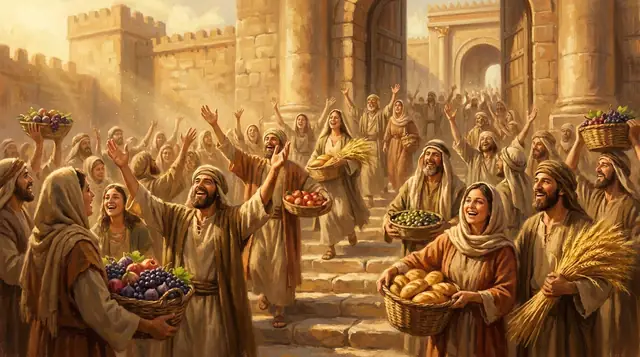
The scene changes: a procession reaches the temple. The singer asks, 'Open to me the gates of righteousness, that I may enter and give thanks to the LORD.' And someone from inside answers, 'This is the gate of the LORD; the righteous shall enter through it.' Many readers see a dialogue between the arriving worshiper and those who guard the entrance. Verse 21 sums it up in a few words: 'I will give You thanks, for You have answered me, and You have become my salvation.'
Verses 22-23: the stone the builders rejected
Here is the heart of the psalm and the passage most quoted in the rest of the Bible: 'The stone the builders rejected has become the cornerstone. This is from the LORD, and it is marvelous in our eyes.'
The picture comes from construction. Builders toss aside a stone that looks crooked. Later it turns out to be the one that holds the corner where two walls meet. The psalm does not say whom it is talking about. In its own day it could be heard as the nation of Israel, looked down on by the nations and held up by God, or as a king who was rejected and then recognized. What the text makes clear is that the change comes 'from the LORD' and causes wonder: 'it is marvelous in our eyes.' Anyone who has felt passed over at school, at work, or in a family will find comfort here.
Verse 24: the day the LORD has made
“This is the day that the LORD has made; we will rejoice and be glad in it.”
This is the best-known verse of the psalm, widely known and often sung in churches. It helps to read it in its place. It comes right after the rejected stone and the wonder, in the middle of a festival. 'This is the day' points to the day of celebration, when the people came into the temple to give thanks. Over time people took it for any day, because the invitation is unchanged: receive the day as something God made, and be glad in it.
Verses 25-29: save us now, blessed is he who comes
The psalm reaches its last part with a very short prayer: 'O LORD, save us, we pray.' The Hebrew for 'save, we pray' is 'hosanna.' The word began as a cry for help and, over the centuries, became a shout of joy. If you want the story of that word, see the meaning of amen, hallelujah, and hosanna.
Next comes the greeting of verse 26: 'Blessed is he who comes in the name of the LORD. From the house of the LORD we bless you.' It is the blessing of those inside the temple for those arriving. Verse 27 ends with 'Bind the festal sacrifice with cords to the horns of the altar,' a line translators read in different ways; a note in the Berean Standard Bible offers another possible reading, joining the festal procession with boughs in hand. The psalm closes with two declarations of love: 'You are my God, and I will give You thanks. You are my God, and I will exalt You.' Verse 29 repeats the words of verse 1. The circle closes: it began with thanks and ends with thanks.
Psalm 118 summary: section, theme, and key verse
| Section | Theme | Key verse |
|---|---|---|
| Verses 1-4 | Thanks, because God's love lasts forever | Verse 1: 'Give thanks to the LORD, for He is good' |
| Verses 5-9 | God answers in distress and gives courage | Verse 6: 'The LORD is on my side' |
| Verses 10-14 | Surrounded and pushed, yet helped by God | Verse 13: 'but the LORD helped me' |
| Verses 15-18 | Living to tell what God did | Verse 17: 'I will not die, but I will live' |
| Verses 19-21 | The gates of righteousness and thanks in the temple | Verse 19: 'Open to me the gates of righteousness' |
| Verses 22-24 | The rejected stone and the day of joy | Verse 22: 'The stone the builders rejected' |
| Verses 25-29 | A prayer for salvation, a blessing, and a closing of thanks | Verse 26: 'Blessed is he who comes in the name of the LORD' |
Which verses of Psalm 118 does the New Testament quote?
Psalm 118 is one of the most quoted psalms in the New Testament. The notes in the Berean Standard Bible list the places, and the table below gathers them, with references so you can look them up in your own Bible.
| Psalm verse | Where it is quoted | Scene |
|---|---|---|
| 6 ('The LORD is on my side') | Hebrews 13:6 | Encouragement not to fear what man can do |
| 22-23 (the rejected stone) | Matthew 21:42, Mark 12:10-11, Luke 20:17, Acts 4:11, 1 Peter 2:7 | Jesus applies it to himself before the leaders; the apostles repeat it |
| 25 ('save us', hosanna) | Matthew 21:9 and 21:15, Mark 11:9, John 12:13 | The crowd shouts 'hosanna' at the entry into Jerusalem |
| 26 ('Blessed is he who comes') | Matthew 21:9 and 23:39, Mark 11:9, Luke 13:35 and 19:38, John 12:13 | The entry into Jerusalem and Jesus' words about his return |
Verses 22-23 in Matthew 21:42
In Matthew 21, Jesus tells a parable to the religious leaders and asks, 'Have you never read in the Scriptures: ‘The stone the builders rejected has become the cornerstone. This is from the Lord, and it is marvelous in our eyes’?' With that question he places himself in the picture of the stone. Acts 4:11 and 1 Peter 2:7 pick up the psalm's words to speak about Jesus.
Verse 26 at the entry into Jerusalem
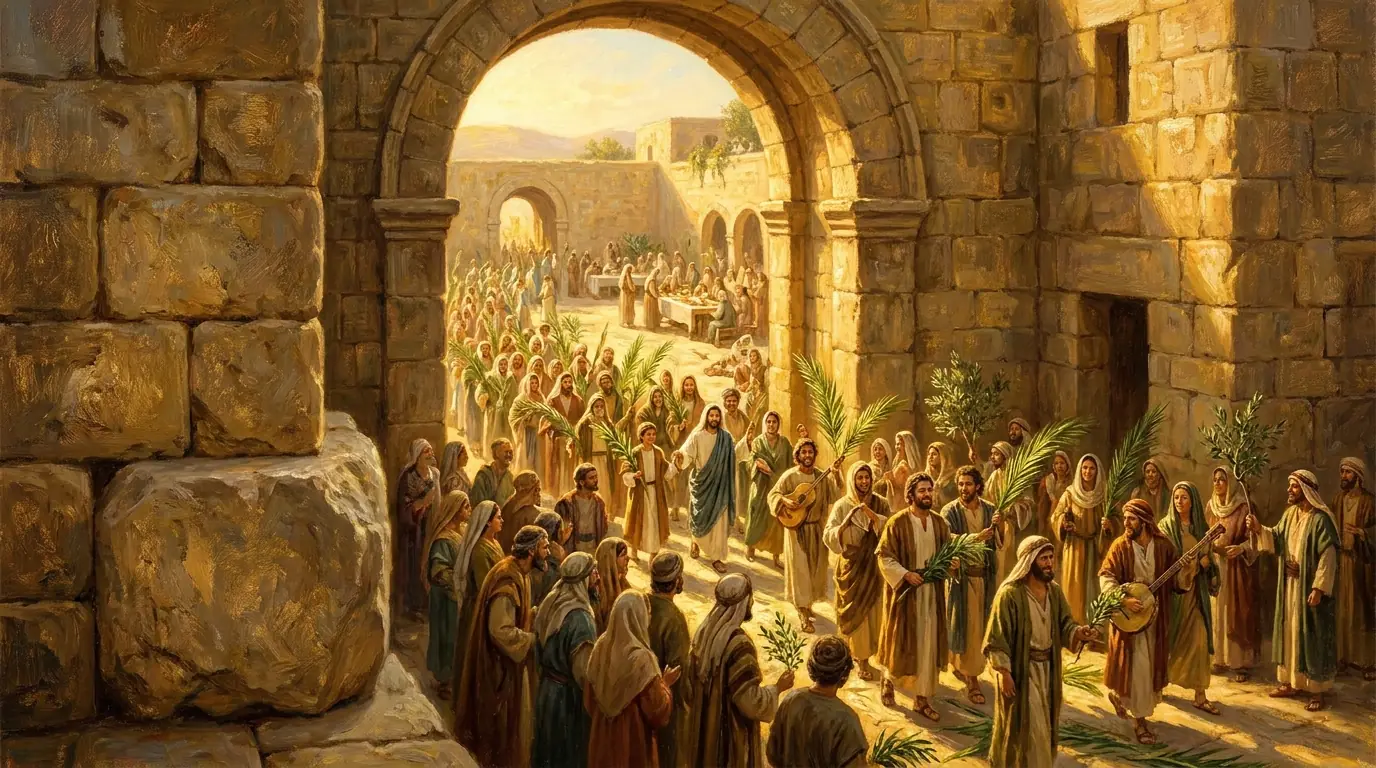
All four Gospels tell of Jesus arriving in Jerusalem while the people shout words from Psalm 118. Matthew 21:9 says: 'The crowds that went ahead of Him and those that followed were shouting: “Hosanna to the Son of David!” “Blessed is He who comes in the name of the Lord!” “Hosanna in the highest!”' You can hear the psalm's two phrases. Christians remember this scene every year on Palm Sunday, the start of Holy Week. If you want to live that week reading a little each day, the Lent Bible reading plan runs all the way to that Sunday and on to Easter.
How do you use verse 24 every morning?
Verse 24 fits in one breath and can be memorized in a minute. That makes it perfect for starting the day. A simple way, in five steps, taking under five minutes:
- 01Before you pick up your phone, say the verse quietly: 'This is the day that the LORD has made; we will rejoice and be glad in it.' Once slowly, once more calmly.
- 02Give thanks for three concrete things about today. They can be small: the coffee, the roof, the fact that morning came.
- 03Name the weight of the day. An exam, an appointment, a hard meeting. Saying it out loud to God already helps.
- 04Ask the way the psalm does: 'save us, we pray.' One short sentence is enough.
- 05Choose one possible joy for today. Call someone, sing a song on the drive to work, eat lunch without rushing.
Some mornings, saying 'we will rejoice' is hard. That is normal: the psalm goes through distress and shoving before it reaches the festival day. It invites you to receive the day as a gift even when it comes with weight. To round out the habit, read the morning Bible verses, and for more reasons to give thanks, the Bible verses about gratitude.
How do you pray with Psalm 118?
The psalm works as a borrowed prayer, especially when you have just come out of a tight spot and cannot find words to say thanks. You can follow its order: first give thanks, then tell what happened, then step into God's house and end with a blessing. It fits well after a health scare that ended well, when a job comes through after months of searching, or on the first day of a year or a week.
A short prayer to start with, in everyday language: 'Lord, thank You, because You are good and Your love lasts forever. When I was in a tight place, You set me free. Today I want to receive this day as Yours, be glad in it, and tell what You have done for me. Hold me up when I feel pushed, and help me trust You more than any person. Save us, Lord, and bless those who come in Your name. Amen.'
What to read after Psalm 118
If Psalm 118 spoke to you, go on to Psalm 100, a short psalm of praise, and to the Bible verses about gratitude, which gather texts for giving thanks in every situation. To start your mornings well, the morning Bible verses offer simple words.