Some psalms are long, full of battles and tears, and some fit in a single breath. Psalm 100 is one of the second kind. It has five verses, takes under a minute to read, and has been sung in churches, schools and around dinner tables for centuries. Its title says exactly what it is: a psalm of thanksgiving. It is printed below in full, in the Berean Standard Bible, followed by a verse-by-verse explanation in everyday language.
Psalm 100 in full
“A Psalm of thanksgiving. Make a joyful noise to the LORD, all the earth. Serve the LORD with gladness; come into His presence with joyful songs. Know that the LORD is God. It is He who made us, and we are His; we are His people, and the sheep of His pasture. Enter His gates with thanksgiving and His courts with praise; give thanks to Him and bless His name. For the LORD is good, and His loving devotion endures forever; His faithfulness continues to all generations.”
What is Psalm 100 and what is it about?
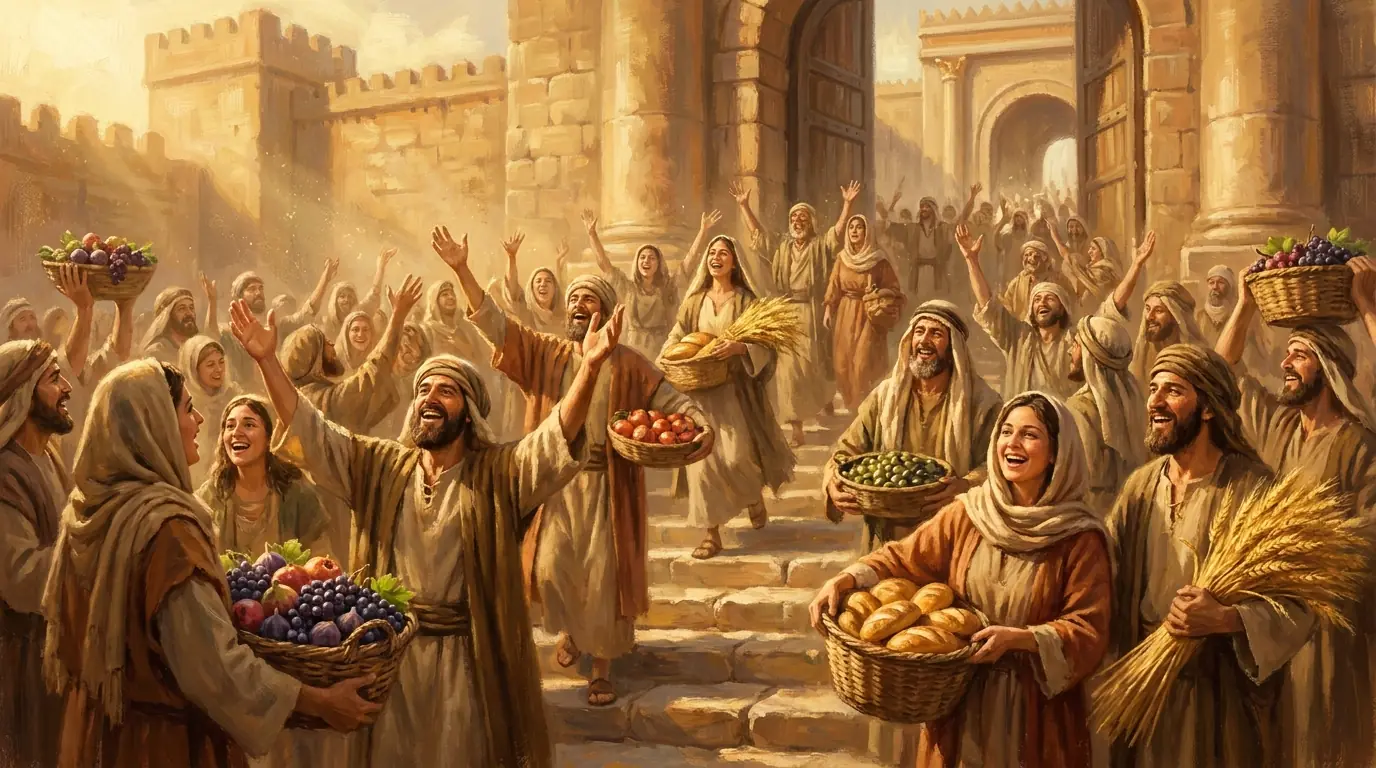
Psalm 100 is a short hymn of joy. Its title in the Berean Standard Bible reads 'A Psalm of thanksgiving.' The Hebrew word behind it, 'todah,' means thanks. In ancient Israel, a 'todah' was also a thank offering that a person brought to the temple after God had helped them, and the meal was shared with others (Leviticus 7:12-15). This psalm may well have been sung at that very moment, as someone arrived at the temple gates with a gift of gratitude.
The psalm names no author. Many psalm titles mention David, Asaph or the sons of Korah, and this one mentions nobody. That makes it feel closer to ordinary life: a song without an owner, written for anyone to sing. It closes a group of psalms, 93 through 99, that keep saying the Lord reigns. Psalm 100 works like an open door. After declaring that God is king, the invitation is to walk in.
Notice who it speaks to. It addresses 'all the earth,' without sorting people by country, language or age. It can be sung in Texas, in Ontario or in a small town in Kenya, and the invitation reaches each one the same way.
Verse 1: 'Make a joyful noise to the LORD, all the earth'
“Make a joyful noise to the LORD, all the earth.”
The psalm opens with an order that sounds like a party. The Hebrew word behind 'joyful noise' was used for the shout of a people celebrating, like a crowd greeting its king. Other versions say 'shout for joy' or 'raise a shout.' Nobody asks for a choir voice here. Praise starts with whatever voice a person has, in tune or not.
Look at the last three words, 'all the earth.' The door is open to everyone. Someone reading in a kitchen, someone singing in a packed sanctuary and someone murmuring on the bus all belong to the same crowd.
Verse 2: serve with gladness and come with songs
“Serve the LORD with gladness; come into His presence with joyful songs.”
Verse 2 adds two new verbs. The first is 'serve.' In the ancient world, serving God meant working for Him in the temple, but the Bible shows service reaching across all of life: caring for a sick neighbor, teaching a child, treating a customer honestly. The psalm asks for that service to come with a smile. Work done gladly shows.
The second verb is 'come.' To come 'into His presence' means to stand before someone with respect. The psalm says God welcomes the one who arrives, and that arriving with songs pleases Him. Anyone who has waited for a child or a friend at the airport knows that mood. Nobody walks up to a meeting they have looked forward to with a face of duty.
Verse 3: who is God, and who are we?
“Know that the LORD is God. It is He who made us, and we are His; we are His people, and the sheep of His pasture.”
This is the center of the psalm. It gathers three simple truths. The first: the LORD is God. 'Know' is a verb that can also be translated 'acknowledge' or 'recognize.' It speaks of knowledge that is lived, like that of a child who knows who her father is and trusts him.
The second truth: God made us. Life is a gift received. Nobody picked their birthday, their family or the first breath they took. Thinking this way changes the mood. If life comes from God's hands, the natural first reaction is thanks. A small note for curious readers: the Berean Standard Bible has a footnote at this verse, because the Hebrew text can be read as 'and not we ourselves' or as 'and we are His.' The traditional Hebrew reading and the alternative both point to the same idea, that everything starts with God.
The third truth is the tenderest: 'we are His people, and the sheep of His pasture.' A sheep depends on its shepherd for water, grass and protection. It is the same picture as in Psalm 23, which says 'The LORD is my shepherd.' Here the voice speaks in the plural, 'we,' and the emphasis shifts: the shepherd looks after the whole flock. Nobody arrives at the pasture alone.
Verse 4: entering the gates with thanksgiving
“Enter His gates with thanksgiving and His courts with praise; give thanks to Him and bless His name.”
The temple in Jerusalem had gates and courts, the open yards around the inner sanctuary. Pilgrims came through the gates, crossed the court and reached the altar. The psalm puts a different word at each stretch of the road. At the gate, 'thanksgiving.' In the court, 'praise.' It is a journey: you enter thanking and move forward praising.
Then come two short verbs: 'give thanks to Him' and 'bless His name.' To give thanks is to say 'thank you' while looking at the giver. To bless is to speak well of someone. In the Bible a 'name' is the whole person, character included. To bless God's name is to say out loud what you know about who He is. Today there are no stone gates in front of our houses, and the road can be walked the same way in the car, at work or in the living room.
Verse 5: the three reasons to give thanks
“For the LORD is good, and His loving devotion endures forever; His faithfulness continues to all generations.”
The key word is 'for.' After four verses of commands, the psalm finally gives the reason, and it gives three. First, 'the LORD is good.' That is a statement about God's character, and it does not depend on how this week went. Second, 'His loving devotion endures forever.' The Hebrew word is 'chesed,' the faithful love that does not walk away. Third, 'His faithfulness continues to all generations.' God keeps what He promises, and He keeps it with grandparents, parents and grandchildren alike.
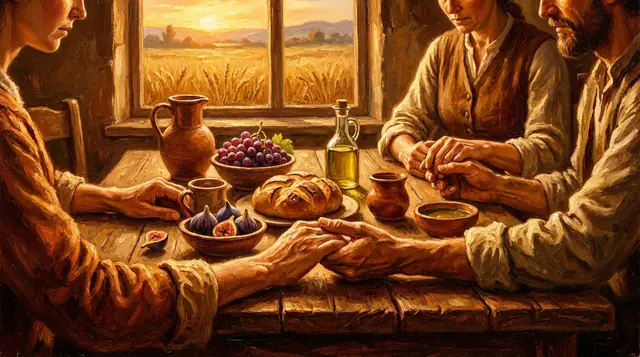
That third reason carries special weight in families. A grandmother who prays this psalm with her grandchildren is passing along, hand to hand, the same trust she received. And every generation can give thanks in its own way, without pretending everything is fine. Acknowledging that God is still good is enough.
Psalm 100 verse by verse: invitation and reason
| Verse | The invitation | The reason |
|---|---|---|
| 1 | Make a joyful noise, all the earth | God deserves the joy of every people |
| 2 | Serve with gladness and come with songs | God welcomes the one who arrives in His presence |
| 3 | Know that the LORD is God | He made us, we are His people and the sheep of His pasture |
| 4 | Enter with thanksgiving and praise, bless His name | A road is open all the way to His presence |
| 5 | (Closing of the psalm, giving the reason behind all of the above) | God is good, His devotion endures forever and His faithfulness reaches every generation |
What are the 7 verbs of Psalm 100?
Psalm 100 can be read as a list of seven actions to take today. In the Berean Standard Bible they appear in this order:
| Verb | Verse | What you can do today |
|---|---|---|
| Make a joyful noise | 1 | Put on a worship song in the car, at home or at work |
| Serve | 2 | Do one task today gladly, without complaining |
| Come | 2 | Set aside five unhurried minutes to be with God |
| Know | 3 | Say out loud that God made life and cares for it |
| Enter | 4 | Walk through the 'gate' of your day with a word of thanks |
| Give thanks | 4 | Tell God what you admire about Him |
| Bless | 4 | Speak well of God in front of another person |
These are verbs of movement and voice. Almost all of them use the body: sing, serve, come, enter. The psalm invites a person to set out on the road, with no need to work out every detail first. That makes it a good psalm for days when concentration is hard, because the verbs already say what to do with hands, feet and mouth.
How can you use Psalm 100 on Thanksgiving Day?
In 2026, Thanksgiving falls on Thursday, November 26. Psalm 100 fits that table well because it is short and can be read around the room. A few practical ways to use it:
- 01Read it before the meal. One person reads verses 1 to 4, and the whole table answers with verse 5.
- 02Go around the table. After the reading, everyone names one thing they are thankful for. Verse 3 sets the tone, since it reminds us that life is a gift.
- 03Make it a thank offering. Ancient Israel brought a gift of thanks to the temple. Today that can be a bag of groceries for a food pantry or a meal delivered to a neighbor who lives alone.
- 04Let the children pick a verb. Each child chooses one verb from the table above, and the family tries to do it before the day ends.
- 05Close with verse 5. Say it together, slowly, as the blessing before the meal.
How can a church use Psalm 100 in a thanksgiving service?
Many congregations hold a Thanksgiving Eve or Sunday service, and the psalm is a natural opening. A few ideas:
- Responsive reading. The leader reads verses 1 through 4, and the congregation responds with verse 5.
- Entrance song. While people come in, invite them to sing and to whisper one personal reason for gratitude as they pass through 'His gates.'
- Short testimonies. Three people share in one minute why they are thankful, with verse 3 as the frame.
- Closing blessing. Repeat verse 5 together, slowly.
For many families, the Thanksgiving meal is also the one time in the year when three generations sit at the same table. That is the setting verse 5 describes, with its promise that God's faithfulness continues to all generations. Children pick up the psalm quickly, because it has a joyful rhythm and few words.
How do you pray Psalm 100 as a family?
A simple way to pray the psalm at home, with children and adults, uses the verbs as a guide. It takes five minutes, at the table or before bed:
- 01Read the whole psalm aloud, one verse per person.
- 02Each person names one thing they are thankful for today. It can be small: breakfast, a text from a friend, the afternoon sun.
- 03Choose one verb from the psalm for the week. For 'serve,' each person does one chore at home with a smile.
- 04Say verse 5 together to close.
- 05Repeat the next day with a different verb.
With little ones, it can become a game: 'make a joyful noise' means singing a song, and 'enter' means walking through the bedroom door saying a word of thanks. Children remember what they do with their bodies.
A short prayer using Psalm 100
For anyone who wants the words ready, this prayer gathers the seven verbs in everyday language: 'Lord, today I come to You with joy. I sing because You gave me life. I want to serve You in what I do today. I know that You are God, that You made me and that You care for me like a shepherd cares for his sheep. I enter Your presence with thanks. I praise You for Your goodness and bless Your name. Your devotion lasts forever, and Your faithfulness reaches my family and those who are still to come. Amen.'
What if it is hard to give thanks today?
Some days the psalm feels far away. A loss, a debt, an illness at home or a long stretch of exhaustion can put out the wish to sing. Psalm 100 leaves room for slow joy. The verbs can be done one at a time. Many people begin with the simplest one: read verse 5 and sit in silence. A small, honest thank-you is worth more than forced enthusiasm.
What should you read after Psalm 100?
If Psalm 100 spoke to you, go on to Psalm 23, which deepens the picture of the shepherd and the sheep, and to Psalm 51, David's prayer for a clean heart. For more words of gratitude, see the Bible verses about gratitude. To see where this psalm sits among the rest, visit the most popular psalms. And to start the day with a word of thanks, try these morning Bible verses.