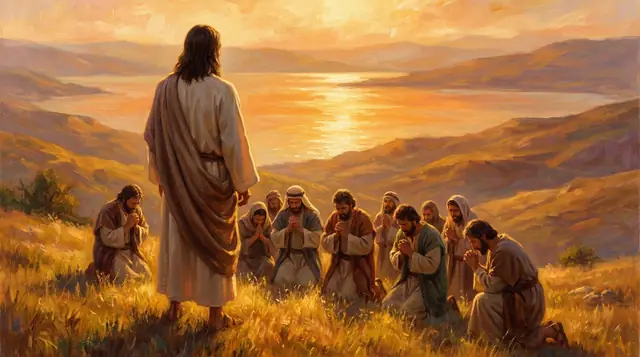

Lent is the six-week walk from Ash Wednesday to Easter. In 2027 it begins on Wednesday, February 10, and Easter falls on Sunday, March 28. This page gives you a Bible reading plan for each of those 47 days: one short reading a day, with the reference only, that takes five to ten minutes.
Below you will find the exact dates, the plan week by week (from Ash Wednesday through Holy Week, day by day), the theme of each week, a simple way to read, and fasting and prayer tips in plain words. The plan works for Catholics and Protestants. It sits next to Mass or Sunday worship as a quiet, personal reading at home with whatever Bible you already own.
When does Lent start and end in 2027?
Lent 2027 starts on Wednesday, February 10, which is Ash Wednesday, and ends on Saturday, March 27, the day before Easter. Easter is the feast where Christians celebrate the resurrection of Jesus, and in 2027 it falls on Sunday, March 28.
People talk about the forty days of Lent, yet 46 days pass between February 10 and March 27. The math works like this: six Sundays fall in that stretch, and 46 minus 6 is 40, the same number of days Jesus spent in the wilderness in the Gospels. Sundays are feast days, a small Easter every week, so the fast takes a break.
| Date | Day | What it remembers |
|---|---|---|
| February 10 | Ash Wednesday | Lent begins |
| February 14 | 1st Sunday of Lent | Jesus in the wilderness |
| February 21 | 2nd Sunday | Learning to pray |
| February 28 | 3rd Sunday | The fast God wants |
| March 7 | 4th Sunday | The father who forgives |
| March 14 | 5th Sunday | Living water and light |
| March 21 | Palm Sunday | Holy Week begins |
| March 25 | Holy Thursday | The Last Supper |
| March 26 | Good Friday | The cross |
| March 27 | Holy Saturday | Lent ends |
| March 28 | Easter Sunday | The resurrection of Jesus |
These dates follow the calendar of the Catholic Church and of many historic Protestant churches, such as the Episcopal, Lutheran and Methodist churches. Catholics and Protestants share the same Easter date. The day before Ash Wednesday, February 9, is Fat Tuesday, so the plan fits well as a fresh start right after the party.
How does this Lent reading plan work?
The plan has three parts. First come the four days that begin with Ash Wednesday. Then come five full weeks, Sunday to Saturday, each with one theme. Last is Holy Week, from Palm Sunday to Holy Saturday, and Easter Sunday closes the walk. That makes 47 readings in all.
Each reading is short. Some are six verses and some are a whole chapter, and all of them read aloud in two to five minutes. The plan lists references only, so it works with any Bible translation, on paper, on your phone or in audio.
| Week | Dates | Theme | Question to carry |
|---|---|---|---|
| Ash Wednesday | Feb 10 to 13 | Turning back to God | What do I need to let go of? |
| 1 | Feb 14 to 20 | The wilderness | Where am I tempted to give up? |
| 2 | Feb 21 to 27 | Prayer | How do I talk to God? |
| 3 | Feb 28 to Mar 6 | Fasting and giving | What can I share this week? |
| 4 | Mar 7 to 13 | Forgiveness | Who do I need to forgive, or ask to forgive me? |
| 5 | Mar 14 to 20 | Water, light and life | What gives my faith life? |
| Holy Week | Mar 21 to 28 | The cross and the resurrection | What does Jesus' story say to me today? |
Ash Wednesday and the next three days (February 10 to 13)
Lent opens with an invitation to return. The first four days describe a heart that comes close to God honestly. We start with Psalm 51, the prayer of a king who admits his failure and asks for a fresh start. If you want to read it slowly, verse by verse, we walk through it in our article on the meaning of Psalm 51.
“Create in me a clean heart, O God, and renew a right spirit within me. Cast me not away from Your presence; take not Your Holy Spirit from me. Restore to me the joy of Your salvation, and sustain me with a willing spirit.”
| Day | Date | Reading | What to notice |
|---|---|---|---|
| 1 | Wed, Feb 10 | Psalm 51:1-17 | A king asks for forgiveness and a clean heart |
| 2 | Thu, Feb 11 | Joel 2:12-17 | God invites his people to return with all their heart |
| 3 | Fri, Feb 12 | Matthew 6:1-6 | Giving and praying without looking for applause |
| 4 | Sat, Feb 13 | Matthew 6:16-21 | How to fast in secret and where to put your treasure |
Week 1: the wilderness (February 14 to 20)
The first Sunday of Lent always circles the wilderness. Jesus spends forty days there, gets hungry and faces three temptations. Every answer he gives comes from Scripture, and that is the best advice for the week: fill your mind with good words so you have something to say when doubt shows up. This week also passes through Psalm 91, a song of trust that many families pray in hard times.
| Day | Date | Reading | What to notice |
|---|---|---|---|
| 5 | Sun, Feb 14 | Matthew 4:1-11 | Jesus in the wilderness, tempted and steady |
| 6 | Mon, Feb 15 | Genesis 3:1-13 | The first temptation and what came after |
| 7 | Tue, Feb 16 | Deuteronomy 8:1-6 | Forty years in the desert and bread from every word |
| 8 | Wed, Feb 17 | Luke 4:1-13 | The same wilderness told by Luke |
| 9 | Thu, Feb 18 | Psalm 91:1-13 | A shelter for those who trust in God |
| 10 | Fri, Feb 19 | Hebrews 4:14-16 | A high priest who understands our weakness |
| 11 | Sat, Feb 20 | James 1:12-18 | The crown for the one who endures testing |
Week 2: prayer (February 21 to 27)
The second week is about talking with God. It starts on Sunday with the Lord's Prayer, the prayer Jesus taught his disciples, and moves through asking, through psalms of thirst and waiting, and through the parable of two men who prayed very differently in the temple. To understand each line of the Lord's Prayer, read the meaning of the Lord's Prayer first.
| Day | Date | Reading | What to notice |
|---|---|---|---|
| 12 | Sun, Feb 21 | Matthew 6:5-15 | The Lord's Prayer, line by line |
| 13 | Mon, Feb 22 | Luke 11:1-13 | The disciples ask Jesus to teach them to pray |
| 14 | Tue, Feb 23 | Psalm 63:1-8 | Thirst for God in a dry land |
| 15 | Wed, Feb 24 | Luke 18:9-14 | Two men in the temple and a prayer of few words |
| 16 | Thu, Feb 25 | Matthew 7:7-12 | Ask, seek and knock |
| 17 | Fri, Feb 26 | Philippians 4:4-9 | Joy, peace and good thoughts |
| 18 | Sat, Feb 27 | Psalm 130 | Out of the depths, waiting for the Lord |
Week 3: fasting and giving (February 28 to March 6)
The third week asks about fasting. The prophet Isaiah tells the people which fast God is looking for: setting people free, sharing bread, opening the door of your home. The following readings pass through Jesus and the poor, a rich man who filled his barns, Zacchaeus and the joy of giving. It is a good week to pack a bag for the food pantry or call a neighbor who lives alone.
“Isn’t it to share your bread with the hungry, to bring the poor and homeless into your home, to clothe the naked when you see him, and not to turn away from your own flesh and blood?”
| Day | Date | Reading | What to notice |
|---|---|---|---|
| 19 | Sun, Feb 28 | Isaiah 58:1-9 | The fast that pleases God |
| 20 | Mon, Mar 1 | Isaiah 58:9-14 | Light that rises when someone helps |
| 21 | Tue, Mar 2 | Matthew 25:31-40 | What was done for the least of these |
| 22 | Wed, Mar 3 | Luke 12:13-21 | The man who filled his barns |
| 23 | Thu, Mar 4 | Luke 19:1-10 | Zacchaeus gives back what he took |
| 24 | Fri, Mar 5 | Mark 10:17-27 | A rich young man walks away thinking |
| 25 | Sat, Mar 6 | 2 Corinthians 9:6-15 | Giving with joy |
Week 4: forgiveness (March 7 to 13)
The fourth week brings the best-loved parable of Jesus: a father who runs to hug the son who comes home. Alongside it come a lost sheep and a lost coin, a psalm of joy for forgiveness received and letters that talk about forgiving others. It is a good week to make peace with someone, with one phone call or one text.
| Day | Date | Reading | What to notice |
|---|---|---|---|
| 26 | Sun, Mar 7 | Luke 15:11-32 | The father who runs to hug the son coming home |
| 27 | Mon, Mar 8 | Luke 15:1-10 | The lost sheep and the lost coin |
| 28 | Tue, Mar 9 | Psalm 32 | The joy of feeling forgiven |
| 29 | Wed, Mar 10 | Matthew 18:21-35 | Forgiving again and again |
| 30 | Thu, Mar 11 | Colossians 3:12-17 | Clothing yourself in compassion, kindness and patience |
| 31 | Fri, Mar 12 | Ephesians 4:25-32 | Words that build up and forgiveness like God's |
| 32 | Sat, Mar 13 | Psalm 103:1-14 | A God slow to anger and rich in love |
Week 5: water, light and life (March 14 to 20)
The fifth week follows three encounters in John's Gospel: a woman who talks with Jesus at a well, a man born blind who receives his sight, and a family in Bethany mourning their brother Lazarus. In all three, Jesus arrives with a promise (living water, light, life). The week ends with a letter from Paul about the Spirit who gives life, so you enter Holy Week with a lighter heart.
| Day | Date | Reading | What to notice |
|---|---|---|---|
| 33 | Sun, Mar 14 | John 4:5-26 | The woman at the well and the living water |
| 34 | Mon, Mar 15 | John 4:27-42 | She runs to tell the whole town |
| 35 | Tue, Mar 16 | John 9:1-12 | A man born blind receives his sight |
| 36 | Wed, Mar 17 | John 9:24-41 | The healed man answers those who doubt |
| 37 | Thu, Mar 18 | John 11:1-27 | Martha and the promise of resurrection |
| 38 | Fri, Mar 19 | John 11:28-44 | Jesus weeps and calls Lazarus out |
| 39 | Sat, Mar 20 | Romans 8:1-11 | The Spirit who gives life |
Holy Week day by day (March 21 to 28)
The last week follows the steps of Jesus from the entry into Jerusalem to the empty tomb. The readings run longer on the days of the supper and the cross. If time runs short, read the first half and finish the next day. For Good Friday, one reading and a few minutes of silence are enough.
| Day | Date | Reading | What to notice |
|---|---|---|---|
| 40 | Sun, Mar 21 (Palm Sunday) | Luke 19:28-40 | Jesus enters Jerusalem to shouts of praise |
| 41 | Mon, Mar 22 | John 12:1-11 | Mary's perfume at Bethany |
| 42 | Tue, Mar 23 | John 12:20-33 | The grain of wheat that falls into the ground |
| 43 | Wed, Mar 24 | Matthew 26:14-25 | Thirty pieces of silver and a supper being prepared |
| 44 | Thu, Mar 25 (Holy Thursday) | John 13:1-15 | Jesus washes his disciples' feet |
| 45 | Fri, Mar 26 (Good Friday) | Luke 23:32-49 | The cross and the last words of Jesus |
| 46 | Sat, Mar 27 (Holy Saturday) | Matthew 27:57-66 | The sealed tomb and a day of silence |
| 47 | Sun, Mar 28 (Easter) | Luke 24:1-12 | The empty tomb and the news that spreads |
On Easter Sunday the plan ends with the question the angels ask the women at the tomb.
“Why do you look for the living among the dead?”
How can you read in 5 to 10 minutes a day?
The plan works best when it is small enough to survive a hard week. Pick a moment that already exists in your day: the morning coffee, the commute on the train or the bus, your lunch break or bedtime. Put the reading there and keep everything short.
- 01Breathe and ask God for help in one sentence. Ten seconds is enough: "Lord, open my heart to your word."
- 02Read the passage of the day aloud or in silence. Two to four minutes.
- 03Pick one phrase that caught your attention and read it again, slowly. One minute.
- 04Answer the question of the week (see the themes table) with one line in a notebook or a phone note. One to two minutes.
- 05Close with a short prayer. Thirty seconds to one minute.
That is the ten-minute version. The five-minute version keeps only the reading, the chosen phrase and the prayer. Some days only five minutes fit, and that counts just the same. If you like to start the day with something already written, our morning Bible verses give you a short one.
To read as a family, one person reads while the others listen, or everyone reads a verse. With kids, the most visual stories work well (the wilderness, Zacchaeus in the tree, the running father). With teenagers, one question a day works.
How do you fast during Lent without making it complicated?
A biblical fast means giving something up, usually food, for a time, so you can pray with more attention. In the Sermon on the Mount Jesus speaks about fasting as something his listeners already practiced, and he asks them to do it simply, in secret.
“But when you fast, anoint your head and wash your face, … And your Father, who sees what is done in secret, will reward you.”
The Catholic Church asks for fasting and abstinence from meat on Ash Wednesday and Good Friday, and abstinence from meat on the other Fridays of Lent (which is why many American parishes hold Friday fish fries). Each parish explains the details about age and exceptions. Many Protestant churches have no fixed rule, and each believer decides with their pastor how to fast before Easter. In both cases the fast is a personal decision before God.
- Light fast: give up dessert, soda or fast food for all of Lent.
- Screen fast: take social media off your phone for one hour a day and use that time to read the plan.
- One-meal fast: skip one meal on Ash Wednesday and Good Friday, if your health allows, and give that money to someone in need.
How do you pray during Lent in simple words?
Lenten prayer needs no hard words. Talk the way you would talk to a parent: tell how the day went, ask forgiveness for what went wrong, thank God for one thing and ask for help tomorrow. Week 2 of the plan is built for exactly this. If you say the Lord's Prayer from memory without thinking, read it slowly once a week, line by line.
Can you listen to the Lent plan instead of reading it?
Yes. Listening suits people who commute a lot, have tired eyes or spend the day with busy hands. Many readings in this plan are whole chapters or very short passages, and they fit the drive to work, the time you spend cooking or the minutes before sleep. Our guide on how to listen to the Bible covers the basics, from choosing a voice to setting a comfortable speed.
In Terra Gospel, the complete narrated Bible in English, Spanish and Portuguese is part of Premium. It has speed from 0.75x to 2x, optional background music, a sleep timer from 15 to 60 minutes and it moves on to the next chapter by itself. The audio streams, so it needs an internet connection. The app has no audio download for offline listening. Reading the text is free and ad-free, with a daily reminder at the hour you choose so the plan does not slip your mind.
What if I miss a day or fall behind?
What should you do after Easter?
After 47 days of reading you already have a habit, and it is worth keeping. If the pace felt comfortable, go on with a Bible reading plan for beginners, a gentle next step. If the goal is to reach the end of the Bible, the plan to read the Bible in a year fits, and you can start any day.
And if you followed the Advent Bible reading plan in December, Lent is the other season of waiting in the Christian year. In Advent you wait for the birth of Jesus. In Lent you walk toward his resurrection. Doing both, year after year, gives the year a rhythm.