Few sentences get repeated by as many different people, in as many different rooms, as the Lord's Prayer. It closes Catholic Mass, it opens Protestant services, it's the prayer said before bed by people who haven't set foot in a church as an adult, and it's the childhood memory of people who no longer practice any faith at all. That much repetition tends to flatten meaning: most people reciting the Lord's Prayer are not pausing to think about what each line is actually asking for. Below is the prayer in full, the way Matthew recorded it, read it straight through, or listen to it narrated while you follow along, and after that, line by line, what each part means, including the ending most people have never had explained to them.
The Lord's Prayer, in full
“Our Father in heaven, hallowed be Your name. Your kingdom come, Your will be done, on earth as it is in heaven. Give us this day our daily bread. And forgive us our debts, as we also have forgiven our debtors. And lead us not into temptation, but deliver us from the evil one.”
The text above follows the Berean Standard Bible (BSB), an open-license English translation. Most English Bibles print an additional closing line here, "for Thine is the kingdom, and the power, and the glory, forever, Amen", a line this article covers in detail below, because its absence here is not an accident of this particular translation.
Where this prayer comes from, and why Jesus taught it
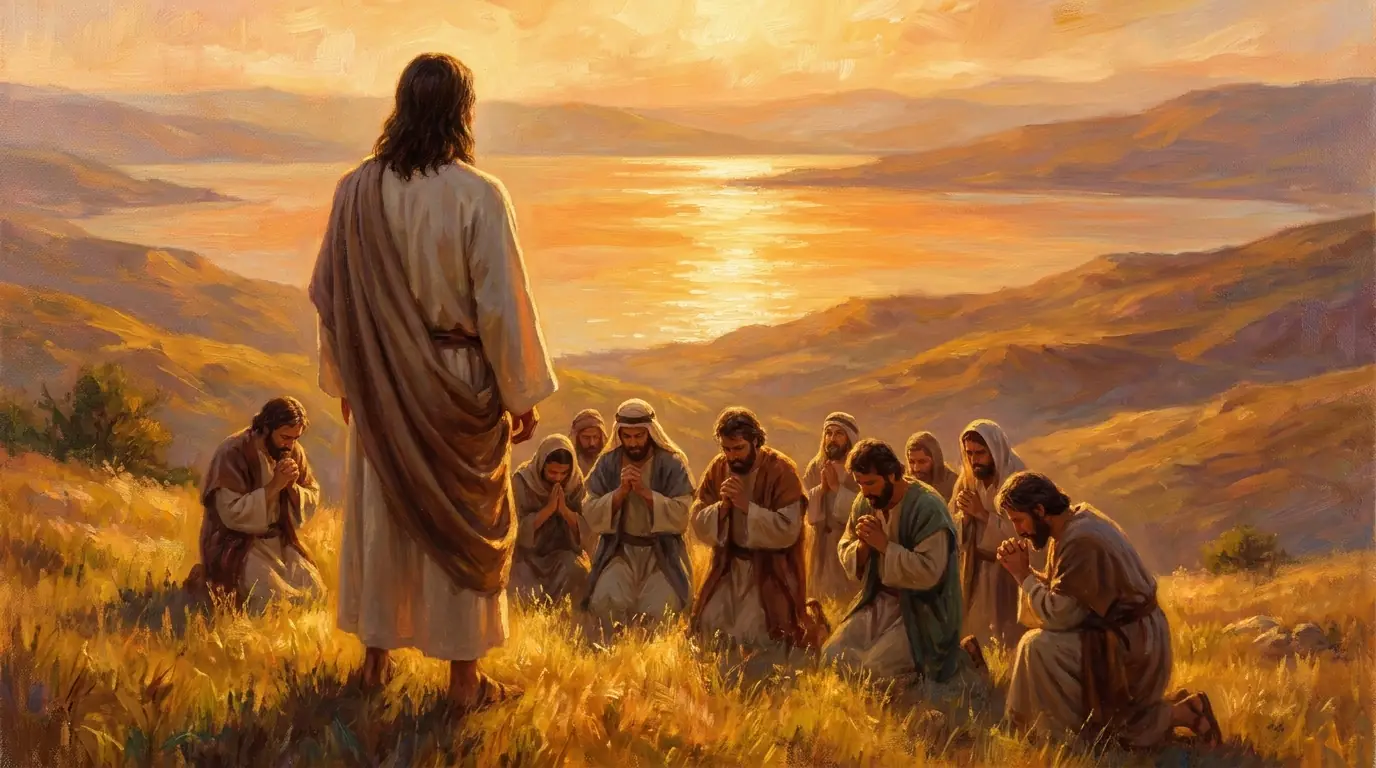
The Lord's Prayer sits in the middle of the Sermon on the Mount, the longest single block of Jesus's teaching recorded anywhere in the Gospels, spanning Matthew chapters 5 through 7. Right before the prayer, Jesus has been talking about giving, praying and fasting done in private, in contrast to people who do all three to be seen, and it's inside that same teaching that he arrives at prayer itself, warning against praying "like the pagans, who think they will be heard because of their many words" (Matthew 6:7). The Lord's Prayer follows immediately, introduced as a model: "This, then, is how you should pray", a pattern to follow with no fixed formula to recite word for word.
In Luke 11, the same prayer shows up in a different setting: as a direct answer to a request, outside any larger teaching. One of the disciples watches Jesus praying and says, "Lord, teach us to pray, just as John taught his disciples" (Luke 11:1), and Jesus answers with essentially the same prayer. That double origin, a sermon and a direct request, is part of why scholars read the Lord's Prayer as something Jesus taught more than once, in slightly different wording each time, because what mattered was the shape of the prayer, with no exact script to memorize on the spot.
Worth stating honestly: Luke's version is shorter in a good number of the oldest surviving Greek manuscripts. In those manuscripts, Luke's text lacks the line "Your will be done, on earth as it is in heaven" and ends at "lead us not into temptation," without the closing "but deliver us from evil", leaving a prayer close to "Father, hallowed be Your name. Your kingdom come. Give us each day our daily bread. And forgive us our sins, for we also forgive everyone who sins against us. And lead us not into temptation." Bibles that translate those older Luke manuscripts more literally print that shorter version; other translations follow a textual tradition that had already harmonized Luke's wording with Matthew's fuller version. Neither choice is an invention. It's the same kind of textual difference that shows up at several points across the New Testament, and it will come up again below, when this guide reaches the final line of the prayer.
"Our Father in heaven": the strangeness of calling God Father
In first-century Judaism, God was already addressed as Father in some texts, but almost always collectively and at a distance. Father of Israel as a nation, and never of any one person specifically. What stands out in the Gospels is how Jesus addresses God in his own prayers: with the Aramaic word Abba, a term of family address, closer to how a child would speak to their own father than to a formal religious title. Teaching the disciples to open their prayer by calling God "our Father", and skipping "Lord of the universe" and "King of kings," even though both titles appear elsewhere in Scripture, invites the person praying directly into that same closeness. The word "our," right after, keeps the prayer from becoming purely private: it's a request made in the plural, alongside others, even when prayed alone.
"In heaven" completes the line without undercutting that closeness. It points to authority, with no suggestion of being far away or hard to reach: a Father close enough to be addressed that way, and at the same time great enough to govern everything. Both ideas, nearness and rule, open the prayer together, and the rest of the text builds on that combination.
"Hallowed be Your name"
The prayer's first request asks that God's own name be treated as holy, recognized for what it is, rather than worn down into something ordinary. In biblical culture, a person's name carries their identity and character, not just a label; asking that God's name be "hallowed" is asking that how people speak of God, and live in front of him, actually matches who he is. It's a request about reverence before it's a request about need: the first ask in the prayer looks toward God, not toward the one praying.
"Your kingdom come"
The "kingdom of God" is the central theme of Jesus's preaching across the Gospels, and here it enters the prayer as a request: that God's rule be established in fact. The next line, "Your will be done, on earth as it is in heaven," works almost like an explanation of what that kingdom means in practice, a state of affairs where what God wants happens down here the same way it already happens, without obstruction, in heaven, and no territory or calendar date is in view. It's a request carrying two layers of time inside it: Christian tradition reads the kingdom of God as something that already began with Jesus's coming, and at the same time as something still to arrive in full, "come" asks for both at once, without choosing between them.
"Our daily bread": a word nobody is fully certain about
After three requests aimed at God, the prayer changes direction and starts asking for concrete human needs, beginning with the most basic one, food. But verse 11 hides one of the toughest translation puzzles in the entire New Testament: the Greek word rendered "daily," epiousios, is so rare that it barely appears in any other surviving Greek text outside these two passages, Matthew 6:11 and Luke 11:3. There's no dictionary from that period a translator can simply check, scholars had to reconstruct the meaning from the word's own roots, and they arrived at more than one answer.
The more traditional reading, the one behind most English Bibles, takes epiousios as something close to "necessary for existence" or simply "daily": a request for basic provision, day after day, without stockpiling beyond what's needed. A second reading takes the word as built from a root tied to "what is coming" or "the next day," which would produce something closer to "tomorrow's bread": a request made in advance for the provision of the day that hasn't arrived yet. The clearest evidence of that uncertainty sits inside the history of Bible translation itself: Jerome, translating the New Testament into Latin in the 4th century, rendered the very same Greek word two different ways across the two Gospels, supersubstantialem in Matthew, suggesting something beyond ordinary bread, and quotidianum, "daily" bread, in Luke. If the greatest Bible translator of antiquity couldn't settle on one meaning within his own work, that's a strong sign the word genuinely supports more than one honest reading, and there's no way to close that gap without manufacturing a certainty the history of translation itself doesn't have.
"Forgive us... as we forgive": the only request with a condition attached
This is the only one of the prayer's seven requests that comes tied to an explicit condition: forgiveness received in the same measure as forgiveness given. And Jesus keeps that detail in the light: right after finishing the prayer, he circles back to this one point alone, in Matthew 6:14-15, saying that whoever forgives others will be forgiven by the heavenly Father, and whoever doesn't, won't be. It's the only line in the Lord's Prayer that earns its own follow-up comment, in the same chapter, which suggests Jesus expected this to be the part people would recite by rote and skip past. Forgiveness on its own is a big enough subject to carry an entire piece. Terra Gospel has a full article on Bible verses about forgiveness for anyone who's at exactly this point, still working on letting go of something that still hurts.
"Lead us not into temptation": a translation that unsettles people, for good reason
Few lines in the Lord's Prayer generate as much second-guessing as this one. Read flatly, it seems to suggest God could lead someone into temptation: an idea that runs against another New Testament passage, the letter of James, which states directly that God tempts no one toward evil (James 1:13). Different English translations resolve that tension in different ways: some keep the traditional "lead us not into temptation"; others render it "do not bring us to the time of trial" or "save us from the time of trial," shifting the weight from God's action toward protection from the moment of testing. None of these choices is wrong: the underlying Greek verb, eisenenkēs, is ambiguous enough to support more than one translation, and the Vatican itself officially revised the Italian wording of this line in 2019, changing "do not induce us into temptation" to "do not abandon us to temptation," specifically to make clearer that the protection being asked for is against giving in to temptation, not an accusation that God causes it. The more balanced reading treats this line as a request for protection against weakness in the face of temptation, not a statement about where temptation comes from.
The closing line: "for Thine is the kingdom, the power, and the glory"
This is the part that calls for precision rather than drama. The prayer's closing line, the way most people have learned to recite it, "for Thine is the kingdom, and the power, and the glory, forever, Amen", is not present in the oldest and most reliable surviving Greek manuscripts of Matthew, two of which date to the 4th century. Because of that, the more recent critical editions of the Greek New Testament, the ones most modern English Bible translations are built on, treat this line as a later addition to the text rather than as Matthew's own words, which is why the BSB text quoted at the top of this article ends at "deliver us from the evil one," without it.
That doesn't mean the line was invented out of nowhere, or that it's some kind of fraud. A very early Christian text, the Didache (a church instruction manual dated to around the end of the first century or the start of the second, close to the time of the Gospels themselves) already closes the Lord's Prayer with a short doxology of its own: "for thine is the power and the glory forever." That shows closing this prayer with a line of praise was a Christian worship habit almost as old as the apostles, even though that line wasn't part of the text Matthew originally wrote. Over time, that liturgical habit of ending the prayer this way found its way into the biblical text itself through some copyists, which is how it ended up printed in translations built on manuscripts produced after that insertion happened.
Why the prayer sounds a little different between Catholics and Protestants
That same doxology question explains most of the difference people notice between how Catholics and Protestants pray the Lord's Prayer. In the Catholic Mass, the prayer as recited stops at "deliver us from evil," without moving straight into "for Thine is the kingdom." After that line, the priest prays a separate request alone, called the embolism, asking that the community be kept free from all evil and granted peace; only after that does the congregation respond together with the doxology, "For the kingdom, the power, and the glory are yours, now and forever", as a separate response, not as the direct continuation of the same sentence. In most Protestant churches, the prayer is recited straight through from start to finish, with the doxology built directly into the sequence, no pause or inserted prayer in between. The result is the same prayer, in practice split across slightly different spots in the service, not a different text, just a different way of fitting it into each tradition's worship.
What are you asking in each line of the Lord's Prayer?
The Lord's Prayer is short, and each line has a clear request. The table turns each line into a simple way to pray it today.
| Line of the prayer | What you are asking | A simple way to pray it |
|---|---|---|
| Our Father in heaven | To speak to God as a caring Father | Father, I come to You as Your child. |
| Hallowed be Your name | That God is honored | Help me treat You as holy today. |
| Your kingdom come | That God's rule spreads | Let Your goodness show up in my home and work. |
| Your will be done | To trust God's plan | Show me what You want, and help me follow. |
| Give us this day our daily bread | For what we need today | Give me enough for today, and help me share. |
| Forgive us as we forgive | For mercy, and the courage to give it | Forgive me, and help me forgive the person I am angry with. |
| Lead us not into temptation, and deliver us from evil | For protection and a way out | Keep me from what would harm me, and rescue me. |
How to use the Lord's Prayer: model or recitation, both are valid
The two introductions the Gospels give this prayer already point toward the two ways it's used today. In Matthew, Jesus says "this is how you should pray", pointing toward a pattern, a structure for praying in one's own words. In Luke, he says "when you pray, say", pointing toward these exact words being repeated. Christian tradition has never settled on just one of those two readings, and it doesn't have to: reciting the Lord's Prayer word for word, as part of a service, a rosary or a daily prayer routine, is a valid practice with close to two thousand years of history behind it; using the prayer's structure, praise, surrender, request for provision, request for forgiveness, request for protection, as a template for praying in one's own words is also a legitimate use, one the text of Matthew itself points toward. There's no single correct way this prayer has to be used.
In Terra Gospel you can highlight any part of the Lord's Prayer in one of four colors, write your own note, and keep it all under Favorites. Reading, highlights, notes, favorites and the verse of the day are free in English, Portuguese and Spanish; the narrated audio Bible, including the full Gospel of Matthew read aloud, with background music and adjustable speed, is part of Premium.
Two themes from the prayer have their own guides: Bible verses about forgiveness and morning Bible verses, which shows how to open a day with prayer. The word that closes the prayer is explained in the meaning of Amen, Hallelujah and Hosanna.