Amen, hallelujah, and hosanna show up in nearly every prayer, hymn, or church service, said so often that they turn into sound before they turn into sense. Most people who say them know, vaguely, that they are old religious words. Fewer know which language they came from, what they literally meant before entering Christian vocabulary, or why one of them, specifically, changed meaning partway through the biblical story itself.
All three come from biblical Hebrew, not from Greek or Latin, and all three can be traced with precision back to a specific verbal root. None of them started life as an empty interjection. Each one began as a fuller phrase, too long to fit into a single breath of singing, and got worn down over the centuries into the one-word fragment that survived.
The three words, at a glance
| Word | Hebrew original | Literal meaning | First appearance cited here |
|---|---|---|---|
| Amen | אָמֵן (amen), from the root אָמַן (aman) | to be firm, reliable, true | Revelation 3:14 (as a title for Jesus) |
| Hallelujah | הַלְלוּיָהּ (hallelu-Yah) | praise Yah | Psalm 146:1 |
| Hosanna | הוֹשִׁיעָה נָּא (hoshia-na) | save, we pray / save now, we beg you | Psalm 118:25 |
Amen: the word that seals a commitment
Amen comes from the Hebrew אָמֵן (amen), tied to the verbal root אָמַן (aman), which Strong's Concordance (H539) defines as to confirm, support, believe, be faithful. The core of the meaning is firmness, the quality of something that holds its weight and can be relied on. It shares a root with emunah, the Hebrew word for faith, and with other terms describing something a person can lean their full weight on, like a supporting pillar or a steady hand. To say amen, at its root, is closer to 'this is solid, this can be trusted' than to 'I agree.'
The common gloss 'so be it' is a useful approximation and falls short of a literal translation. It describes the effect of saying amen, a wish that something come true, but it loses the original sense of declaring something already firm and true. Amen states that what was just said is already reliable, a confidence that sits at the end of every request.
Jesus uses the word in a way no other biblical figure does: doubled, at the start of a sentence rather than the end. In the Greek text of John's Gospel, this construction appears 25 times, always right before an important statement:
“Jesus replied, 'Truly, truly, I tell you, no one can see the kingdom of God unless he is born again.'”
'Truly, truly' translates the Hebrew amen amen, rendered 'verily, verily' in older English translations. Opening a sentence with amen instead of closing it is a way of saying 'what I am about to tell you, I vouch for on my own authority, not because I heard it from someone else.' No other character in Scripture speaks this way. It is a speech pattern unique to Jesus across all four Gospels.
The word's most direct use, though, appears in Revelation, where it stops being a response from the listener and becomes a title for Jesus instead:
“To the angel of the church in Laodicea write: These are the words of the Amen, the faithful and true Witness, the Originator of God's creation.”
Calling Jesus 'the Amen' pulls both edges of the word's meaning into a single name: he is described as the one who is firm, faithful, and true: the final guarantee that everything God promised holds up. It applies the root sense of aman as an identity: the one who is firm, reliable, and true.
Hallelujah: a direct call to praise Yah
Hallelujah is two words in the original Hebrew, fused together into one. Hallelu is the imperative plural form of the verb halal, to praise, to boast, to sing loudly in celebration; Yah is the shortened form of God's personal name, YHWH, the same short form found in names like Elijah (Eli-Yah) and Isaiah (Yesha'ya-Yah). Put the two pieces together and the literal meaning is a direct command: 'praise Yah.' It works as an explicit, imperative call addressed to whoever is listening, inviting each person to join in.
The word appears 24 times in the Old Testament, always inside the book of Psalms, spread across roughly 15 different psalms between chapters 104 and 150: almost always opening or closing the poem. The heaviest concentration sits in the final five psalms of the Psalter, 146 through 150, known as the final Hallel: each one opens and closes with the word.
“Hallelujah! Praise the LORD, O my soul.”
In the New Testament, the word appears exactly once, in Revelation, sung by the multitude in heaven: four times in rapid succession, across the first six verses of chapter 19. Outside of that, the word is carried over directly from Hebrew, untranslated, in both Psalms and Revelation, which is why it sounds nearly identical in practically every language with a Christian tradition. Every tradition chose to keep the original sound rather than translate the meaning.
Hosanna: from a cry for help to a shout of praise
Hosanna is the Greek transliteration of the Hebrew הוֹשִׁיעָה נָּא (hoshia-na): a request, not a compliment. Hoshia is the imperative form of the verb yasha, to save, to deliver, to bring victory; na is a particle of urgent entreaty, something like 'please' or 'now, we beg you.' The root yasha is the same root behind the name Joshua (Yehoshua, 'the LORD saves') and, in its shortened Aramaic form, behind the name Jesus itself (Yeshua). Hosanna began, then, as a cry for rescue directed at God. Nothing close to a celebration.
Its source is Psalm 118, one of the central texts in the Jewish liturgy for the Feast of Tabernacles:
“O LORD, save us, we pray. We beseech You, O LORD, cause us to prosper!”
Over the following centuries, as this psalm became a fixed part of the festival's annual celebration, the emotional center of the word shifted. Sung year after year inside a liturgy built around joy and gratitude, hosanna came to function as both plea and praise at once: a request for salvation that, through sheer repetition in a festive setting, also became an expression of celebration. By the time of Jesus, the word already carried both loads simultaneously.
That double sense is exactly what explains the scene at Jesus's entry into Jerusalem: the crowd was quoting a liturgical formula already loaded with messianic expectation, aimed at someone they recognized as the 'Son of David,' the title of the promised king.
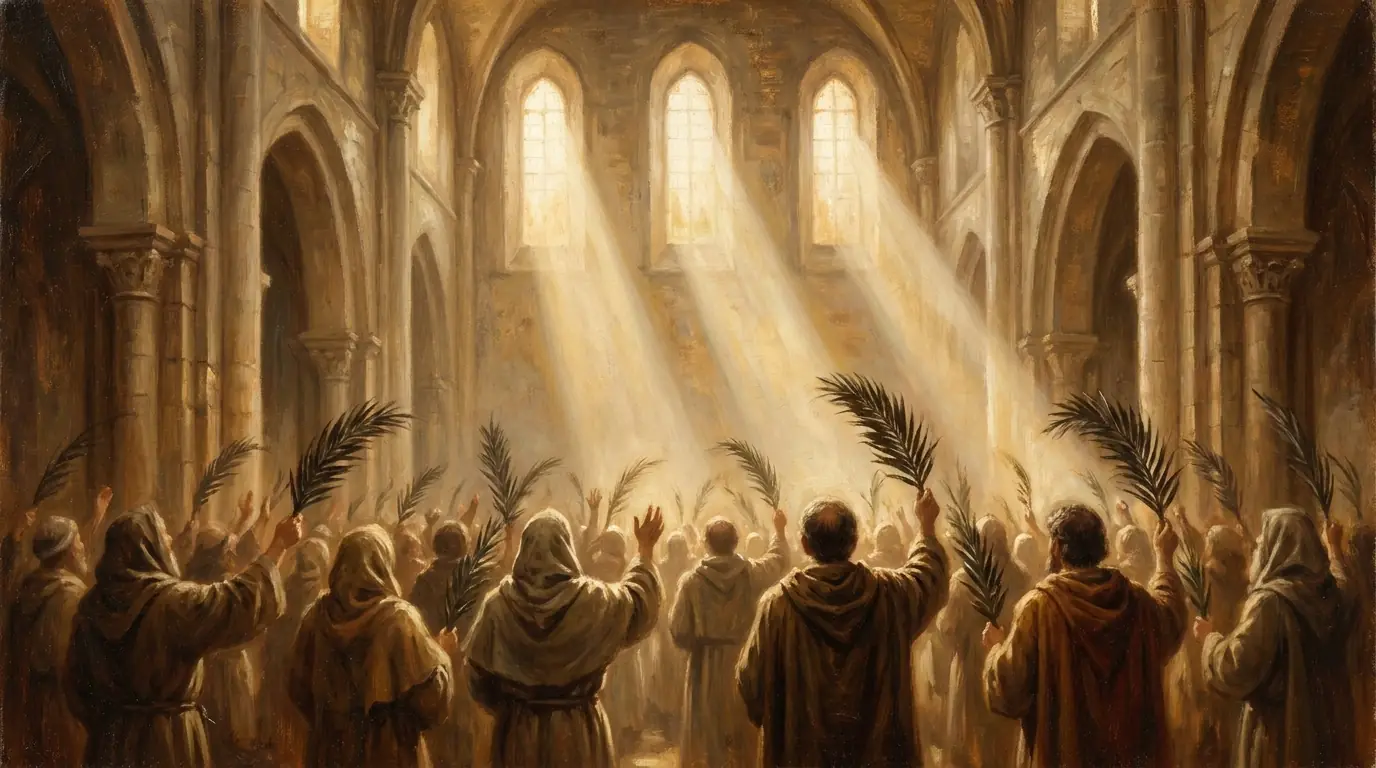
“The crowds that went ahead of Him and those that followed were shouting: 'Hosanna to the Son of David!' 'Blessed is He who comes in the name of the Lord!' 'Hosanna in the highest!'”
The precise shift is this: hosanna was born as a plea ('save us, O LORD') and arrived at Matthew's Gospel as an acclamation ('blessed is he who comes'), without ever losing the original plea underneath it. The crowd kept both meanings alive at once, using the same word to beg for salvation and celebrate the one it hoped would bring it, at the same time, because that is exactly what the word had already been doing inside the festival's liturgy for centuries.
Two bonus words that show up alongside them: maranatha and selah
Maranatha is Aramaic, not Hebrew: the one Aramaic expression Paul leaves untranslated in the middle of a letter written in Greek, which suggests it was already a fixed formula among the earliest Aramaic-speaking Christians, repeated as-is, needing no explanation. The most widely accepted split is marana tha, 'Lord, come': a plea for Jesus's return. In the translation used on this site, the verse appears translated into English rather than transliterated:
“If anyone does not love the Lord, let him be under a curse. Come, O Lord!”
'Come, O Lord' is exactly what maranatha means, just already rendered into English here, rather than kept in Aramaic the way some other Bible versions print it.
Selah is different from the other four words on this list for a simple reason: nobody knows, with certainty, what it means. It appears more than 70 times in the Psalms, always at the end of a line, and most scholars agree it is some kind of instruction, musical, liturgical, or a pause, but there is no consensus on which. The most discussed proposals include a marker for a pause or reflection, a cue to raise the voice or the instruments, and a purely literary term flagging a turn inside the poem. The honest answer here is simple: it is uncertain, and most Bible translations leave the word exactly as it is rather than attempt to translate it.
“Many say of me, 'God will not deliver him.' Selah”
Which other worship words should you know?
Once you know these three, a few more words in the Bible open up. Each was left in its original language in the text, which means the writers thought it carried something the translation could lose.
| Word | Language | Meaning | Where you meet it |
|---|---|---|---|
| Abba | Aramaic | Father, a warm and close word | Mark 14:36 and Romans 8:15 |
| Immanuel | Hebrew | God with us | Matthew 1:23 |
| Shalom | Hebrew | Peace, wholeness, things being well | Numbers 6:26 and many greetings |
| Maranatha | Aramaic | Come, O Lord | 1 Corinthians 16:22 |
| Selah | Hebrew, of uncertain meaning | Probably a pause or musical mark | Psalm 3 and many others |
““Abba, Father,” He said, “all things are possible for You. Take this cup from Me. Yet not what I will, but what You will.””
Jesus uses a home word in the hardest moment of his life. That is a good sign of what kind of relationship prayer is meant to hold.
How can you use these words when you pray?
- Say amen slowly at the end of a prayer and let it mean this is firm, and I stand behind it.
- Use hallelujah on a good day. It is a short, direct way to praise, and it needs no long sentences.
- Whisper hosanna when you need help. It began as a cry for rescue.
- Pray maranatha in a hard season, as a way of saying come, Lord, and set things right.
Why every prayer on this site ends in 'Amen'
With the meaning of amen in view, closing a prayer with that word stops being a matter of form and becomes part of the content. Saying amen at the end of a prayer declares that what was just requested, thanked for, or confessed is firm, something the one praying is willing to put their weight behind, the same way the word's root describes a pillar that holds or a hand that does not shake. That is why every prayer published on Terra Gospel ends in amen: the word is the signature that closes the request as something serious, and the reader is invited to sign it too.
Amen, hallelujah, and hosanna are still in use today exactly as they appeared in the original texts, untranslated, carried over from Hebrew into practically every language with a Christian tradition. Reading the verse of the day, following the psalms that use these words the most, and listening to each of them narrated in audio are free features on Terra Gospel, in English, Portuguese, and Spanish.
The same vocabulary of worship runs through the Lord's Prayer explained line by line, which ends with a doxology, and through the most popular psalms, many of which open with a call to praise. For a short daily dose of the same spirit, try Bible verses about gratitude.