Some books of the Bible you read with a lump in your throat, and others with a smile. Jonah has a bit of both. It tells about a prophet to whom God gives an assignment and who decides to do exactly the opposite. It has four chapters and takes about seven minutes to read.
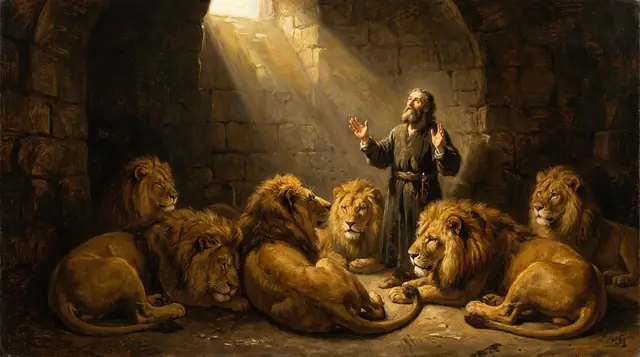
Here we walk through the four chapters one by one, with a table of scenes and verses, the prayer Jonah says inside the fish, the whale question, the open ending of chapter 4 and the sign of Jonah that Jesus mentions in Matthew 12. If you like stories of courage, read about Daniel in the lions' den too, and for another story of water, an ark and a second chance, the story of Noah.
Who was Jonah and when does the story happen?
The book introduces him in a few words: “Now the word of the LORD came to Jonah son of Amittai” (Jonah 1:1). A prophet with the same name appears in 2 Kings 14:25, in the time of King Jeroboam, in the northern kingdom of Israel. The book gives no date and does not say how Jonah became a prophet. It goes straight to the order and the escape.
Nineveh, the city God sends him to, lay far from his homeland, to the east. For readers of that time it was the great city of a foreign and feared people.
The four chapters of Jonah at a glance
This table sums up each chapter with its main scene and a verse that stands for it. Quotes are from the Berean Standard Bible.
| Chapter | Scene | Key verse |
|---|---|---|
| Jonah 1 | God sends Jonah to Nineveh; he flees by ship to Tarshish; storm, lots and the sea that goes calm | “Get up! Go to the great city of Nineveh and preach against it” (1:2) |
| Jonah 2 | Three days and three nights in the belly of the great fish; Jonah's prayer; the fish puts him on dry land | “Salvation is from the LORD!” (2:9) |
| Jonah 3 | Second call, trip to Nineveh, the whole city fasts and the king repents | “He relented from the disaster He had threatened to bring upon them” (3:10) |
| Jonah 4 | Jonah's anger, the shelter to the east, the vine, the worm and God's final question | “So should I not care about the great city of Nineveh” (4:11) |
Jonah 1: the escape, the storm and the calm sea
God gives Jonah a clear order: “Get up! Go to the great city of Nineveh and preach against it, because its wickedness has come up before Me” (1:2). Jonah's answer is just as clear, though he says not a word: “Jonah, however, got up to flee to Tarshish, away from the presence of the LORD” (1:3). He goes down to the port of Joppa, finds a ship, pays the fare and climbs aboard. The text repeats that he was running from the presence of the LORD, so nobody can doubt what he was after.
Then God hurls a great wind upon the sea. The storm is so violent that the ship is about to break apart. The sailors, who were not from Israel, are afraid, each one cries out to his own god, and they throw the cargo overboard to lighten the load. And Jonah? “But Jonah had gone down to the lowest part of the vessel, where he lay down and fell into a deep sleep” (1:5).
The captain wakes him with a question that would sound the same today: “How can you sleep? Get up and call upon your God” (1:6). The sailors cast lots to find out who caused the storm, and the lot falls on Jonah. They ask who he is, where he comes from and what his people are. He answers: “I am a Hebrew,” and “I worship the LORD, the God of the heavens, who made the sea and the dry land” (1:9). He says this while running from that very God, and the sailors catch on at once: “What have you done?” (1:10).
The storm keeps growing and they ask what to do. Jonah offers a hard way out: “cast me into the sea, so it may quiet down for you. For I know that I am to blame for this violent storm that has come upon you” (1:12). The sailors refuse. They row with all their strength to reach land and cannot (1:13). In the end they pray to the LORD: “Do not charge us with innocent blood!” (1:14). They lift Jonah and throw him into the sea, and “the raging sea grew calm” (1:15). The sailors, who started by shouting to their own gods, end up fearing the LORD, offering a sacrifice and making vows (1:16).
That detail is worth noticing. The sailors, who did not know God, care about a stranger's life, hesitate before throwing a man overboard and pray. From the start the book shows God reaching people nobody would expect.
Was it a whale or a great fish?
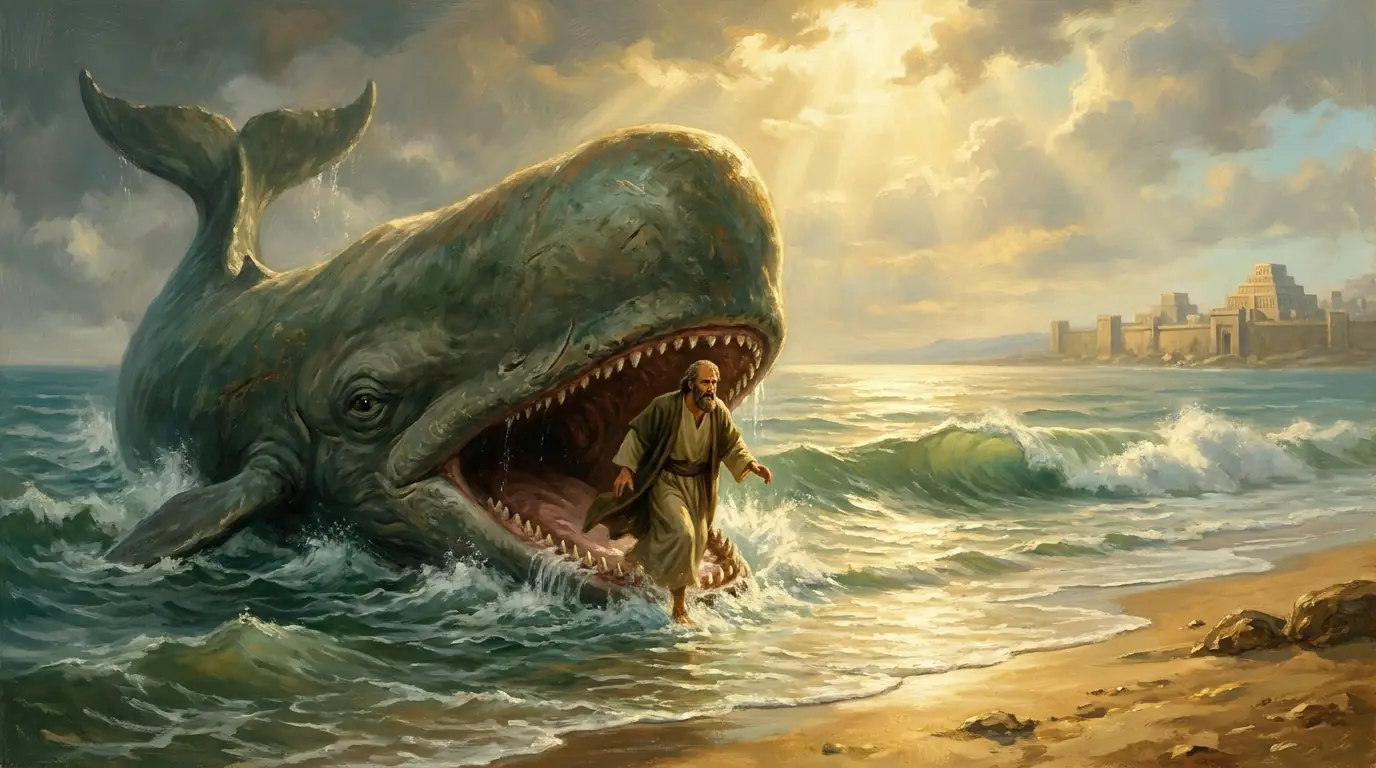
Almost everyone says “Jonah and the whale.” The text of Jonah says something else. Jonah 1:17 reads: “the LORD had appointed a great fish to swallow Jonah.” It never mentions a whale, gives no size or species and does not describe the inside. It says only that God prepared that animal and that Jonah stayed in it “three days and three nights.”
So where does the whale come from? From popular tradition, children's drawings and a word in Matthew 12:40. Some older English Bibles, such as the King James Version, use “whale” there, because the Greek word Matthew uses (kētos) names a large sea creature. Other translations, including the BSB, say “great fish.” It is best to read Jonah as written: a great fish prepared by God.
| Detail | What the text says | What popular tradition adds |
|---|---|---|
| The animal | “a great fish” (Jonah 1:17) | A whale, almost always drawn with its mouth open |
| Who sent it | The LORD “had appointed” it, meaning He arranged it | Many children's versions present it as a chance event at sea |
| How long | “three days and three nights” (Jonah 1:17) | Matches, almost always told the same way |
| How it ends | “the LORD commanded the fish, and it vomited Jonah onto dry land” (Jonah 2:10) | Matches, with a little comic exaggeration |
Jonah 2: the prayer inside the fish
Chapter 2 has one scene: Jonah prays. The whole chapter is the words of a man who finally talks to God again. “From inside the fish, Jonah prayed to the LORD his God” (2:1). The prayer begins by telling what happened:
“In my distress I called to the LORD, and He answered me. From the belly of Sheol I called for help, and You heard my voice. For You cast me into the deep, into the heart of the seas, and the current swirled about me; all Your breakers and waves swept over me.”
Jonah says God cast him into the deep. He recognizes that the hand that dropped him was God's. The prayer goes on past complaint, to the waters closing in and to a hope that holds, because he also says “yet I will look once more toward Your holy temple” (2:4). The deepest part of the prayer comes later:
“To the roots of the mountains I descended; the earth beneath me barred me in forever! But You raised my life from the pit, O LORD my God! As my life was fading away, I remembered the LORD. My prayer went up to You, to Your holy temple.”
When strength was gone, Jonah remembered. Jonah's prayer is a good guide for anyone who feels sunk: it asks for very little, only to remember who God is and to talk to Him. It ends with a promise and a sentence that sums up the chapter: “But I, with the voice of thanksgiving, will sacrifice to You. I will fulfill what I have vowed. Salvation is from the LORD!” (2:9). Right after, God speaks to the fish and it puts Jonah on dry land. To read another prayer of someone coming back to God after failing, see Psalm 51.
Jonah 3: the second chance and Nineveh
Chapter 3 opens with the sentence that changes everything: “Then the word of the LORD came to Jonah a second time” (3:1). God keeps the same prophet and repeats the order almost word for word, this time with no scolding in the text. “This time Jonah got up and went to Nineveh, in accordance with the word of the LORD” (3:3).
The book says Nineveh was an enormous city, “requiring a three-day journey” (3:3). Jonah walks in, goes one day's journey and shouts a very short message: “Forty more days and Nineveh will be overturned!” (3:4). That is eight words in the BSB. No long speech. And then comes what nobody expected:
“And the Ninevites believed God. They proclaimed a fast and dressed in sackcloth, from the greatest of them to the least.”
The news reaches the king. He gets up from his throne, takes off his royal robe, covers himself with sackcloth and sits in ashes (3:6). Then he sends a decree through the city: a fast for people and animals, mourning clothes and prayer, and one more thing. His words:
“Furthermore, let both man and beast be covered with sackcloth, and have everyone call out earnestly to God. Let each one turn from his evil ways and from the violence in his hands. Who knows? God may turn and relent; He may turn from His fierce anger, so that we will not perish.”
The king cannot know God's answer and holds only a hope. And the chapter ends: “He relented from the disaster He had threatened to bring upon them” (3:10). What God saw were actions: a city that stopped doing harm. Nineveh got forty days of warning and used them.
Jonah 4: the open ending and the vine
You would expect a celebration. Chapter 4 starts like this: “Jonah, however, was greatly displeased, and he became angry” (4:1). The prophet prays again, and now he finally says why he had run:
“O LORD, is this not what I said while I was still in my own country? This is why I was so quick to flee toward Tarshish. I knew that You are a gracious and compassionate God, slow to anger, abounding in loving devotion” (4:2). Jonah knew what God is like, and that is exactly why he did not want to go. It seemed unfair to him that such a violent city would be forgiven. Then he asks to die (4:3). God answers with a single question, without shouting: “Have you any right to be angry?” (4:4).
Jonah leaves the city, builds himself a shelter to the east and sits down to see what will happen (4:5). God appoints a vine that grows over him and gives shade, and Jonah “was greatly pleased with the plant” (4:6). The next morning God appoints a worm and the vine withers (4:7). Then comes a scorching east wind and a sun that beats on Jonah's head until he nearly faints (4:8). He wants to die again and says he is angry about the plant: “I am angry enough to die!” (4:9).
Then God explains the lesson with that same plant. And the book ends with it:
“You cared about the plant, which you neither tended nor made grow. It sprang up in a night and perished in a night. So should I not care about the great city of Nineveh, which has more than 120,000 people who cannot tell their right hand from their left, and many cattle as well?”
And that is where it stops. The book does not say what Jonah answered. It does not tell whether he left the shelter convinced, went home angry or understood. That open ending is the author's choice, and it works as a question aimed at the reader: what would you answer? The last word of the book is a question from God, left waiting.
What is the sign of Jonah that Jesus mentions?
In Matthew 12, some scribes and Pharisees ask Jesus for a sign. He answers with Jonah. This is the text in the Berean Standard Bible:
“A wicked and adulterous generation demands a sign, but none will be given it except the sign of the prophet Jonah. For as Jonah was three days and three nights in the belly of the great fish, so the Son of Man will be three days and three nights in the heart of the earth. The men of Nineveh will stand at the judgment with this generation and condemn it; for they repented at the preaching of Jonah, and now One greater than Jonah is here.”
Jesus joins two things. The first is the time: “three days and three nights” in the belly of the fish and then in the heart of the earth. For Christians, that points to His death and resurrection. The second is Nineveh: a foreign city repented at a short message, and those listening to Jesus had in front of them someone greater than Jonah.
Simple lessons from the book of Jonah
These three lessons read clearly in the text, each with a question to think about.
| Lesson | Where it shows | A question for me today |
|---|---|---|
| Running from God does not work | Jonah goes down to Joppa, into the ship and to its lowest part (1:3-5) | What or who am I running from, and what makes it hard? |
| God gives second chances | “Then the word of the LORD came to Jonah a second time” (3:1) | Is there something God is asking of me again? |
| Mercy reaches everyone | God cares about Nineveh, the sailors and even the animals (3:7-10; 4:11) | Whom do I find it hard to wish well? |
The second lesson is the warmest one. Jonah failed, and God spoke to him again. For anyone who feels they ruined everything, that sentence in 3:1 is good news. To go over this idea in verses, see the Bible verses about forgiveness.
The third is the most uncomfortable, and it is the center of chapter 4. Jonah struggled to accept that God would forgive people he saw as enemies. The book's last question stays open for all of us who have ever thought, “that person does not deserve it.”
The story of Jonah for kids, in a few lines
If you want to tell it aloud to little ones, this short version works well. It takes about two minutes.
- 01Jonah was a prophet. One day God told him: “Go to the city of Nineveh and tell the people to change their ways.”
- 02Jonah did not want to go, so he boarded a ship heading the other way.
- 03God sent a very strong storm. The sailors were scared. Jonah told them the storm was because of him and asked them to throw him into the sea.
- 04The sailors threw him in, and the sea calmed down right away.
- 05God had prepared a great fish, and it swallowed Jonah. He stayed inside three days and three nights, and there he prayed.
- 06The fish put him on the shore. God repeated the order, and this time Jonah went to Nineveh.
- 07The people of Nineveh listened, felt sorry for what they had done and changed. God forgave them.
- 08Jonah got upset because he wanted them punished. God made a shady plant grow, then let it dry up. And He asked whether He should care about a city full of people and animals.
- 09We learn that God hears when we call, gives another chance and wants good for everyone, even people we do not like.
A prayer inspired by the book of Jonah
How long does it take to read or listen to the book of Jonah?
The whole book, in the Berean Standard Bible, has about 1,225 words. At 175 words per minute that is about 7 minutes. These are estimates, since real time depends on the voice and speed. The table shows each chapter.
| Chapter | Approximate words (BSB) | Approximate time at 175 words per minute |
|---|---|---|
| Jonah 1 | 491 | 2 min 48 s |
| Jonah 2 | 200 | 1 min 9 s |
| Jonah 3 | 239 | 1 min 22 s |
| Jonah 4 | 295 | 1 min 41 s |
| The whole book | 1,225 | 7 min 0 s |
It is one of the shortest books of the Bible. To place it among the 66, the guide on how many books are in the Bible explains the order. And if you would rather listen than read, here is how to listen to the Bible.
When fear is what holds you back, as it held Jonah on the ship, head to the Bible verses about fear. And to keep going with another man who trusted God, continue with the story of David.