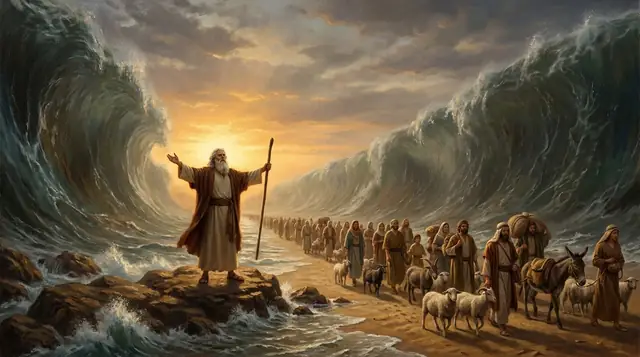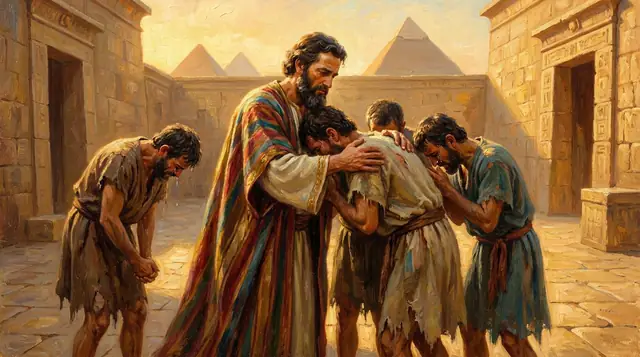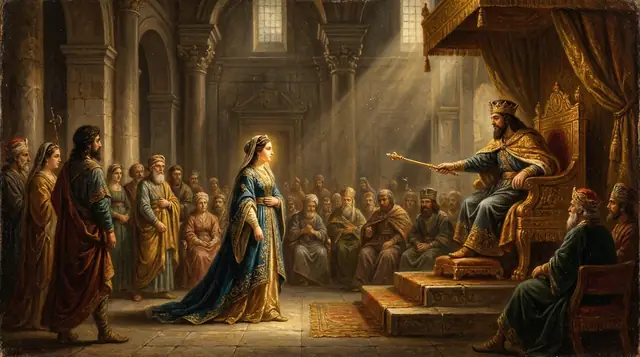
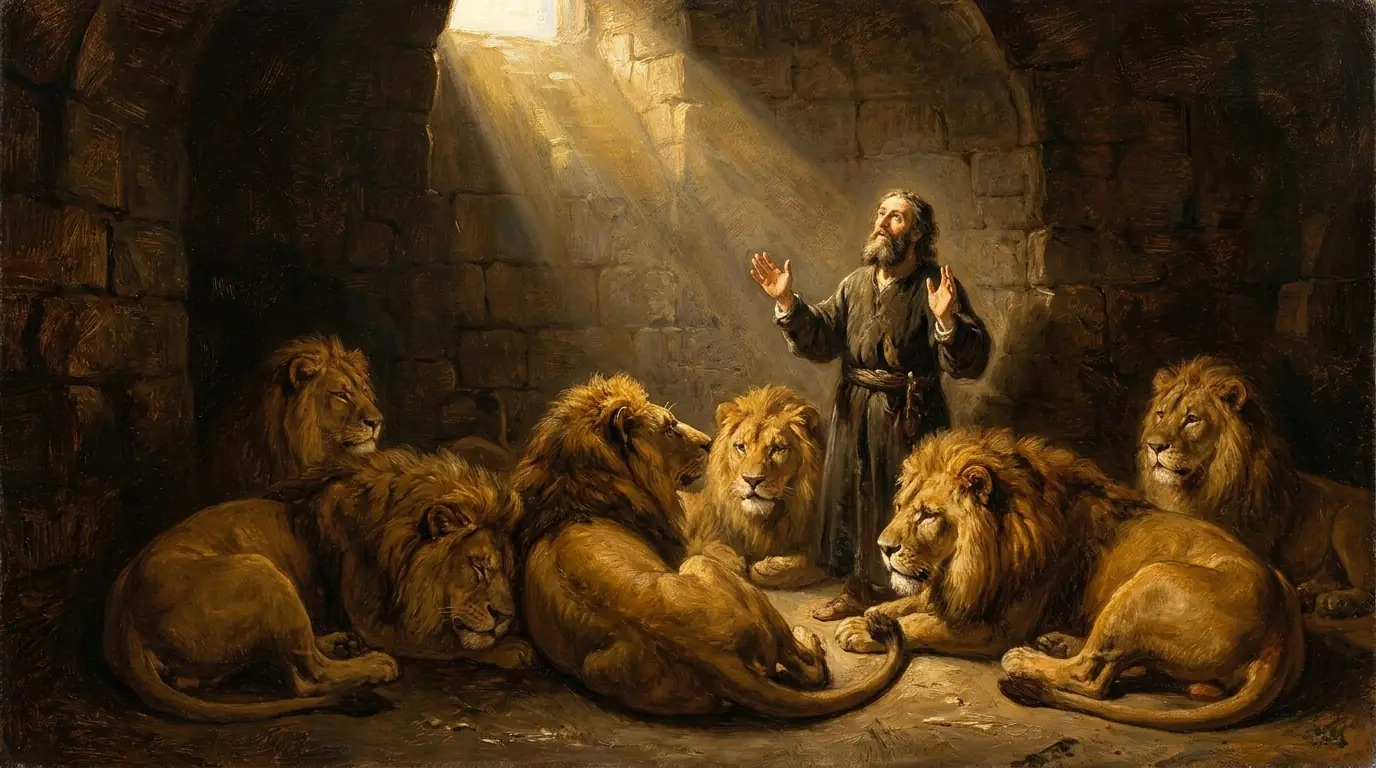
Few scenes in the Bible stay in the memory like this one: a man in a dark pit, lions all around and a sealed stone above. It comes from Daniel 6, the sixth chapter of a book that opens with young exiles and ends with visions of the future. If you enjoy Bible character stories, read the story of Moses, the story of Joseph and the story of Esther too. All three lived far from home, like Daniel.
Who was Daniel and where does his story take place?
Daniel was a young man from Judah taken to Babylon when King Nebuchadnezzar came to Jerusalem and besieged it (Daniel 1:1). The book shows him in exile, far from his land, among people who spoke another language, ate other food and worshiped other gods. There he grew up, studied and served, and the text says he remained “until the first year of King Cyrus” (Daniel 1:21). He saw several kings come and go.
In Babylon he was given a new name, Belteshazzar (Daniel 1:7). The book keeps calling him Daniel, and that loyalty to his own name and to his God is the thread running through the whole story.
Which kings appear in the book of Daniel?
Daniel serves under several kings, and each one puts him through a different test.
| King | Where he appears | What happens with Daniel |
|---|---|---|
| Nebuchadnezzar, king of Babylon | Daniel 1 to 4 | Takes Daniel into exile, asks him to explain a dream, and makes him ruler over the province (2:48) |
| Belshazzar, king of the Chaldeans | Daniel 5 (and visions in 7 and 8) | Summons Daniel to read the writing on the wall on the night he dies (5:30) |
| Darius the Mede | Daniel 6 (and 9:1; 11:1) | Has Daniel among his three administrators, falls for the decree trap and sees Daniel rescued from the den |
| Cyrus, king of Persia | Daniel 1:21; 6:28; 10:1 | Daniel is still in the kingdom during his reign |
Daniel 6 scene by scene
The chapter has 28 verses and reads like a play in seven short scenes. Here they are one at a time.
Scene 1: an official who stands out (Daniel 6:1-3)
King Darius divides the government among 120 satraps and three administrators, and Daniel is one of the three. The text says that “by his extraordinary spirit, Daniel distinguished himself” (Daniel 6:3). The king plans to set him over the whole kingdom. That is where the trouble starts, because promoting a foreigner stirs up jealousy.
Scene 2: the trap (Daniel 6:4-9)
The other administrators and satraps look for a charge against Daniel and find none, “because he was trustworthy, and no negligence or corruption was found in him” (Daniel 6:4). So they reason that the only way to accuse him is through his faith (6:5). They go to the king, flatter him and propose a decree: for thirty days, anyone who petitions any god or man except the king will be thrown into the den of lions (6:7). Since the law of the Medes and Persians could not be repealed, the decree would be fixed the moment it was signed (6:8). Darius signs it (6:9).
Scene 3: the open window (Daniel 6:10-13)
This is the heart of the chapter. Daniel learns that the decree has been signed. He keeps his windows open and his schedule the same. He does what he has always done:
“Now when Daniel learned that the document had been signed, he went into his house, where the windows of his upper room opened toward Jerusalem, and three times a day he got down on his knees, prayed, and gave thanks to his God, just as he had done before.”
His accusers are waiting. They find Daniel “petitioning and imploring his God” (Daniel 6:11) and hurry to tell the king, reminding him that the decree cannot be changed (6:12-13).
Scene 4: the king who wanted to save him (Daniel 6:14-18)
Darius realizes he was tricked. The text says he was “deeply distressed” and worked until sundown to rescue Daniel (Daniel 6:14). His advisers insist the law cannot be changed (6:15). In the end the king gives the order. What he says to Daniel as he leaves is the most surprising part of the scene:
“So the king gave the order, and they brought Daniel and threw him into the den of lions. The king said to Daniel, “May your God, whom you serve continually, deliver you!””
A stone is placed over the mouth of the den, and the king seals it with his own signet ring and with the rings of his nobles, so that nothing can change (Daniel 6:17). Then the king goes to his palace and spends the night fasting. No entertainment is brought, and sleep flees from him (6:18).
Scene 5: the morning (Daniel 6:19-23)
At first light Darius hurries to the den. He calls out “in a voice of anguish” and asks the question anyone would ask: has the God Daniel serves continually been able to deliver him from the lions? (Daniel 6:20). From the bottom comes Daniel’s answer, calm and polite. He begins by greeting the king, as if nothing had happened:
“My God sent His angel and shut the mouths of the lions. They have not hurt me, for I was found innocent in His sight, and I have done no wrong against you, O king.”
The king is overjoyed and orders Daniel lifted out. When Daniel comes up, “no wounds whatsoever were found on him, because he had trusted in his God” (Daniel 6:23).
Scene 6: the fate of the accusers (Daniel 6:24)
The king has the men who accused Daniel brought in, and they are thrown into the same den along with their children and wives. The lions overpower them before they reach the bottom (Daniel 6:24). It is a hard verse, and that is how the text tells it.
Scene 7: the king’s letter (Daniel 6:25-28)
Darius writes to the people of every nation and language in his land and decrees that in every part of his kingdom people are to tremble in fear before the God of Daniel, “For He is the living God, and He endures forever” (Daniel 6:26). The chapter ends with one short line: “So Daniel prospered during the reign of Darius and the reign of Cyrus the Persian” (6:28).
Table: scene, verse and what happens
The table links each scene to its verses.
| Scene | Verses | What happens |
|---|---|---|
| 1. An official who stands out | Daniel 6:1-3 | Darius organizes the kingdom and Daniel excels; the king plans to set him over it all |
| 2. The trap | Daniel 6:4-9 | His rivals find no fault; they win a thirty-day decree and the king signs it |
| 3. The open window | Daniel 6:10-13 | Daniel prays three times a day as always; he is caught and accused before the king |
| 4. The king wants to save him | Daniel 6:14-18 | Darius is distressed, cannot repeal the decree, seals the den and spends a sleepless night |
| 5. The morning | Daniel 6:19-23 | Daniel answers alive: God sent His angel and shut the mouths of the lions |
| 6. The accusers | Daniel 6:24 | The men who accused him are thrown into the den |
| 7. The king’s letter | Daniel 6:25-28 | Darius orders respect for Daniel’s God; Daniel prospers under Darius and Cyrus |
What does Daniel in the lions’ den mean?
The story has three simple layers.
The first is personal. Daniel had prayed all his life, and the decree did not change him. The text stresses the habit with the phrase “just as he had done before” (Daniel 6:10). Daniel’s prayer was his daily routine.
The second is about integrity. His enemies went through his work and found no fault (Daniel 6:4). Daniel is honest at his job, and that makes him believable when he talks about God. Even Darius, who did not worship Daniel’s God, describes Daniel as someone who serves God “continually” (6:16, 6:20).
The third is about who has the last word. Darius is the most powerful man in the scene, and he cannot repeal his own decree. Daniel, with no political power, walks out of the den unharmed. In the end it is the king who admits that Daniel’s God is the living God and that His kingdom “will never be destroyed” (Daniel 6:26).
If you want to follow this thread through other passages, see the Bible verses about protection.
The life of Daniel: from Daniel 1 to Daniel 12
The lions’ den is the most famous scene, but the book tells much more. The table walks through all twelve chapters.
| Chapter | King or period | What happens |
|---|---|---|
| Daniel 1 | Nebuchadnezzar | Daniel and three friends (Hananiah, Mishael and Azariah, called Shadrach, Meshach and Abednego) are taken to Babylon; Daniel decides not to defile himself with the king’s food |
| Daniel 2 | Nebuchadnezzar | The king has a dream nobody can explain; Daniel reveals and interprets it and is made ruler over the province |
| Daniel 3 | Nebuchadnezzar | The three friends refuse to worship the golden statue and are thrown into the blazing furnace, from which they come out unharmed |
| Daniel 4 | Nebuchadnezzar | A dream about a tree and the humbling of the king, who later regains his understanding and praises the Most High |
| Daniel 5 | Belshazzar | A hand writes on the wall during a feast; Daniel reads and explains the message on the night the king dies |
| Daniel 6 | Darius the Mede | The decree, the prayer with open windows and the den of lions |
| Daniel 7 to 12 | Belshazzar, Darius and Cyrus | Daniel’s visions of kingdoms and of the future, with the prayer of Daniel 9 and words of comfort from the angel (10:19) |
Daniel 1: a small decision at the king’s table
The young exiles were to eat from the king’s food during three years of training. Daniel made a decision: he “made up his mind that he would not defile himself with the king’s food or wine” (Daniel 1:8). He asked for a ten-day test with vegetables and water (1:12), and at the end of that time the four looked healthier than the other young men (1:15).
Daniel 2: the king’s dream
Nebuchadnezzar had dreams that troubled his spirit, and sleep escaped him (Daniel 2:1). None of the wise men could tell him what he had dreamed or what it meant. Daniel prayed with his three friends, and that night the mystery was revealed to him. His first reaction was to praise God:
“Blessed be the name of God forever and ever, for wisdom and power belong to Him.”
Then Daniel explained the dream, and Nebuchadnezzar admitted, “Your God is truly the God of gods and Lord of kings” (Daniel 2:47). He made Daniel ruler over the entire province of Babylon (2:48).
Daniel 3: the three friends in the fiery furnace
Nebuchadnezzar made a golden statue sixty cubits high (Daniel 3:1) and ordered everyone to worship it, on pain of being thrown into the blazing furnace (3:6). Shadrach, Meshach and Abednego refused. They told the king that the God they serve is able to deliver them, and then added words that became famous for their courage:
“But even if He does not, let it be known to you, O king, that we will not serve your gods or worship the golden statue you have set up.”
They were bound and thrown into the fire. When the king looked, he was amazed: “I see four men, unbound and unharmed, walking around in the fire” (Daniel 3:25). When they came out, not a hair of their heads was singed and there was no smell of fire on them (3:27).
Daniel 5: the writing on the wall
King Belshazzar held a great feast for a thousand of his nobles and had the gold and silver vessels brought that Nebuchadnezzar had taken from the temple in Jerusalem (Daniel 5:1-2). Suddenly “the fingers of a human hand appeared and wrote on the plaster of the wall” (5:5). Nobody could read it. The queen remembered Daniel (5:10-12), and Daniel read and explained the message:
“MENE means that God has numbered the days of your reign and brought it to an end. TEKEL means that you have been weighed on the scales and found deficient.”
The third word, PERES, meant that the kingdom would be divided and given to the Medes and Persians (Daniel 5:28). The text adds that Daniel received the purple robe and the gold chain, and that Belshazzar was slain that very night (5:29-30). Then “Darius the Mede received the kingdom at the age of sixty-two” (5:31), and with that verse the den chapter begins.
Daniel 7 to 12: the visions in one line
The second half of the book changes style: instead of court stories, Daniel receives visions of kingdoms that rise and fall, of the Ancient of Days and of “One like the Son of Man coming with the clouds of heaven” (Daniel 7:13), and the book closes with a promise about those who sleep in the dust of the earth (12:2-3). It is the hardest part of the book, and it rewards a slow reading.
Simple lessons from Daniel in the den
A child and a grandparent can take the same lessons from this story.
- Constant prayer. Daniel prayed three times a day before the decree and kept praying after it (Daniel 6:10). When prayer is already a habit, you do not have to decide it all over again in every crisis.
- Quiet courage. Daniel went on with his life and left the outcome in God’s hands. His three friends did the same at the furnace: “But even if He does not” (Daniel 3:18).
- Integrity at work. His enemies searched his record for a fault and found none (Daniel 6:4). A good name is built over years, with small tasks done well.
- Fear does not get to rule. Daniel spent a night in a pit and came out saying God had answered. For anyone facing a hard night, there is a guide to Bible verses about fear.
- Even a king can learn. Darius began the story by signing the decree and ended it by writing to every people to respect Daniel’s God (Daniel 6:25-26). A faithful life reaches further than the person living it imagines.
How do you tell the story of Daniel to children?
A short version in plain words can follow these steps. It takes about three minutes aloud and works well at bedtime.
- 01There was a good man named Daniel who lived far from home, in a country where the king was named Darius.
- 02Daniel did his work very well and the king liked him. Some of the king’s other helpers felt jealous.
- 03The jealous men made a law: for thirty days nobody could ask anything of God, only of the king.
- 04Daniel heard about it and, just like always, opened the window that faced Jerusalem and prayed three times a day.
- 05The jealous men saw him and told the king. The king was very sad, but the law was already signed, so he had to put Daniel in the den of lions.
- 06The king could not sleep all night. He told Daniel he hoped Daniel’s God, whom Daniel always served, would save him.
- 07In the morning the king ran to the den and called out to Daniel. Daniel answered that God had sent an angel to shut the lions’ mouths.
- 08The king was overjoyed. Daniel came out without a scratch, because he had trusted in his God.
Afterward you can ask: what did Daniel do every day? What would we ask God for today when we are afraid?
How long does it take to read or listen to Daniel 6 and the whole book?
Daniel has 12 chapters. In the Berean Standard Bible text (without section headings) they add up to about 10,600 words. At 175 words per minute, reading or listening to the whole book takes roughly 1 hour. These are approximate times: the real length depends on the voice and the speed you choose.
| Path | Words (BSB) | Approximate time at 175 words per minute |
|---|---|---|
| Daniel 6 (the lions’ den) | 813 | 5 min |
| Daniel 3 (the fiery furnace) | 861 | 5 min |
| Daniel 1 to 6 (the stories) | 5,703 | 33 min |
| Daniel 7 to 12 (the visions) | 4,898 | 28 min |
| The whole book (12 chapters) | 10,601 | 1 h 1 min |
If you prefer hearing to reading, the guide on how to listen to the Bible explains the options.
A short prayer with Daniel
To begin the day with a short prayer, try the morning Bible verses, which follow a similar spirit of steadiness and trust.
To keep going with people who trusted God far from home, the story of Joseph and the story of Esther are the natural next steps.