
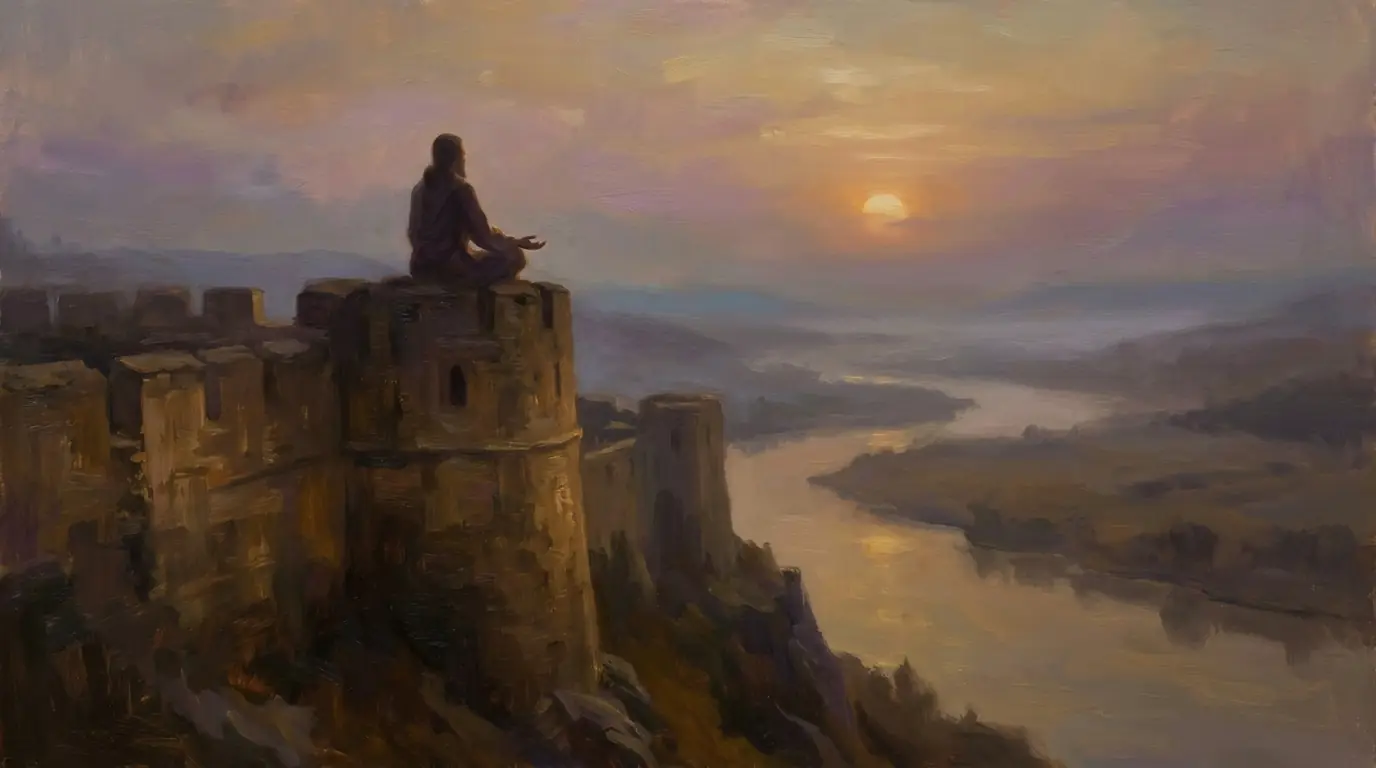
Sometimes the mind will not stop. It is two in the morning, the house is quiet, and inside the noise keeps going: the bills, the conversation that went badly, what people will think, what is coming next. Psalm 62 opens with a sentence for that hour: 'In God alone my soul finds rest.' It has only 12 verses, its title says it belongs to David, and it talks about a safe place where the heart can finally go still. The whole psalm is printed below in the Berean Standard Bible. After that it is explained section by section, with a table of its pictures, a second table on where people look for security, and a five-minute exercise to practice it.
Psalm 62 in full
“For the choirmaster. According to Jeduthun. A Psalm of David.”
“In God alone my soul finds rest; my salvation comes from Him. He alone is my rock and my salvation. He is my fortress; I will never be shaken. How long will you threaten a man? Will all of you throw him down like a leaning wall or a tottering fence? They fully intend to cast him down from his lofty perch; they delight in lies; with their mouths they bless, but inwardly they curse. Selah”
“Rest in God alone, O my soul, for my hope comes from Him. He alone is my rock and my salvation; He is my fortress; I will not be shaken. My salvation and my honor rest on God, my strong rock; my refuge is in God. Trust in Him at all times, O people; pour out your hearts before Him. God is our refuge. Selah”
“Lowborn men are but a vapor, the exalted but a lie. Weighed on the scale, they go up; together they are but a vapor. Place no trust in extortion, or false hope in stolen goods. If your riches increase, do not set your heart upon them. God has spoken once; I have heard this twice: that power belongs to God, and loving devotion to You, O Lord. For You will repay each man according to his deeds.”
Who wrote Psalm 62, and in what situation?
The title says 'A Psalm of David' and addresses it 'for the choirmaster,' the person in charge of the music. It also names Jeduthun, a name that appears in the books of Chronicles among those responsible for temple music. That is why the psalm was read and sung together, and why it moves from the 'I' at the start to the 'we' of verse 8.
The title does not say when in his life David wrote it. The text does show the pressure: there are people who threaten a man, who want to throw him down from his 'lofty perch,' and who bless with their mouths while they curse inside. Anyone who has felt set up, at work, in the family, or in the neighborhood, recognizes the scene. What stands out is that the psalm spends more verses resting in God than describing the attack. The enemy shows up in two verses. God shows up in almost all the others.
It sits close to other psalms about refuge. If it helps you, keep going with Psalm 46, where God is refuge and strength, and Psalm 91, about living under His shadow.
Verses 1 and 2: the quiet soul and the rock
The psalm begins with the word 'alone,' which returns four times in the first six verses in the Berean Standard Bible. That word shows a heart that has already chosen where to rest. 'In God alone my soul finds rest' describes an inner quiet, the calm of someone who stops arguing with himself. And it adds: 'my salvation comes from Him,' the help that only God gives.
Right away come the pictures of firmness. God is 'my rock,' 'my salvation,' and 'my fortress.' A rock does not move when the wind arrives. That is why David can say 'I will never be shaken.' He speaks with the confidence of someone standing on something solid. A fortress adds height and walls: a place where you are out of reach.
Verses 3 and 4: the wall that only looks solid
Here David speaks to the people attacking him: 'How long will you threaten a man?' The question sounds tired, like someone who has put up with a lot. Then comes a very visual picture: they are like 'a leaning wall or a tottering fence.' A tilted wall and an old fence look solid from far away and come down with one push. The strength of those who attack is only appearance.
Verse 4 describes precisely a kind of harm we know well today: the person who smiles to your face and talks against you behind your back. 'With their mouths they bless, but inwardly they curse.' David says it without decoration, and the 'Selah' that follows invites a pause to think about it before moving on.
Verses 5 to 7: David talks to his own soul
In verse 5 David addresses his own soul: 'Rest in God alone, O my soul.' There is a very human detail here. In verse 1 he said his soul finds rest, and now he asks for it again. Resting in God is practiced many times, day after day, and David gives the order to himself when the noise returns.
Verses 6 and 7 repeat and widen the opening. The word 'honor' appears, and David leaves his good name in God's hands. Then comes a sentence of great strength: 'my salvation and my honor rest on God, my strong rock; my refuge is in God.' Rock, fortress, and refuge answer the three needs of anyone under pressure: something firm to stand on, something high to be safe in, and something close to hide in.
Verse 8: pour out your heart
In this verse the psalm opens to everyone: 'Trust in Him at all times, O people.' The invitation David gave himself now goes out to the whole community. Then comes one of the most loved phrases of the psalm: 'pour out your hearts before Him.' To pour out is to let everything go, the pretty and the ugly, without tidying the words. It is honest prayer. You can tell God what is hard to tell any person.
The verse ends with a short declaration that is easy to memorize: 'God is our refuge.' A refuge is a place of protection, like the porch roof that covers you from the rain. If you are living through a season of fear, the Bible verses about peace gather more sentences to keep close.
Verses 9 and 10: the real weight of things
Here the psalm does something curious: it puts things on a scale. Human beings, says verse 9, are 'but a vapor' when they are weighed on the scale. No power, no title, and no famous last name weigh much before God. The enemy who frightens so much does not either.
Verse 10 gives practical warnings: 'Place no trust in extortion, or false hope in stolen goods. If your riches increase, do not set your heart upon them.' The text accepts that riches may grow and asks that the heart stay somewhere else. Working, saving, and taking care of what you have are good habits. The heart rests in God.
Verses 11 and 12: God has spoken once
The close brings a sentence of old wisdom: 'God has spoken once; I have heard this twice: that power belongs to God.' It is a way of saying that David heard the same truth again and again until it stuck: strength belongs to God. Nobody can take from God what is His.
The last sentence adds kindness: 'and loving devotion to You, O Lord. For You will repay each man according to his deeds.' Power and loving devotion go together in this psalm. God is firm as a rock and near as a refuge. A note in the Berean Standard Bible says verse 12 is cited in Romans 2:6, where Paul recalls that God gives to each person according to what he has done.
Psalm 62 at a glance: section, picture, and key verse
| Section | Picture | Key verse |
|---|---|---|
| Verses 1-2 | Rock, salvation, and fortress | Verse 1: 'In God alone my soul finds rest' |
| Verses 3-4 | A leaning wall and a tottering fence (those who attack) | Verse 3: 'How long will you threaten a man?' |
| Verses 5-7 | Rock, fortress, and refuge | Verse 7: 'my strong rock; my refuge is in God' |
| Verse 8 | A heart poured out and a refuge | Verse 8: 'pour out your hearts before Him' |
| Verses 9-10 | A scale and riches that grow | Verse 10: 'do not set your heart upon them' |
| Verses 11-12 | The word spoken once and loving devotion | Verse 11: 'power belongs to God' |
Where do people look for security, and what does Psalm 62 say?
Everyone looks for a place to feel safe. Psalm 62 walks through the most common places and points to one. The table sets side by side what we tend to lean on and what the psalm says about each, in everyday words.
| Where we look for security | What the psalm says | Verse |
|---|---|---|
| Money and savings | Riches may grow, and the heart rests in God | 10 |
| Power and strength | Power belongs to God, and He holds up the one who trusts Him | 11 |
| Reputation and applause | What weighs most is the honor that comes from God, and He guards it | 7 and 9 |
| A good position or an important name | God holds up the one who leans on Him and gives a solid base | 2 and 6 |
| Controlling everything with my own hands | The soul can be still when God is the rock | 1 and 5 |
| Friends and family | They are a huge gift, and the final refuge is God | 8 |
| Keeping all my feelings inside | God invites you to pour out your heart before Him | 8 |
What do the most quoted verses of Psalm 62 mean?
Psalm 62:1 and the quiet soul
“In God alone my soul finds rest; my salvation comes from Him.”
This is the most searched verse and the one most often printed on cards. It speaks of a rest that reaches the deepest part of a person. It helps someone who cannot sleep, someone waiting on a medical result, someone facing a debt or a conflict. It says calm has a place where it can be found.
Psalm 62:5 and the order we give ourselves
“Rest in God alone, O my soul, for my hope comes from Him.”
This is a sentence to repeat under your breath. When the mind fills with noise, you can say it to yourself slowly, the way you would talk to a frightened child. And it says where hope lives: in Him.
Psalm 62:7 and the pictures together
“My salvation and my honor rest on God, my strong rock; my refuge is in God.”
Here are salvation, honor, rock, and refuge in one sentence. For many people it is the verse that holds up a hard day. It can be memorized in pieces: salvation, honor, rock, refuge.
Psalm 62:8 and the prayer that tells everything
“Trust in Him at all times, O people; pour out your hearts before Him. God is our refuge.”
It works as a guide for praying when the words will not come. You start by trusting, go on to pour out your heart, and end with the certainty of refuge. Many people read this verse before an important appointment or during a long night.
How do you practice quiet before God in 5 minutes?
The psalm talks about a soul that finds rest, and that stillness is learned with practice. This simple exercise takes five minutes and can be done at home, in a parked car, or on a park bench.
- 01Minute 1: sit where nobody will interrupt and silence your phone notifications. Breathe in deeply three times, slowly.
- 02Minute 2: read verses 1 and 2 softly. Repeat 'In God alone my soul finds rest' until the words settle.
- 03Minute 3: pour out your heart, as verse 8 says. Tell God in your own words what weighs on you today, without tidying or polishing it.
- 04Minute 4: stay in silence. When a thought arrives, picture yourself setting it on the rock of verse 2 and coming back to your breathing.
- 05Minute 5: tell your soul what verse 5 says, 'Rest in God alone,' and give thanks for one concrete thing from today.
Some situations where this exercise helps: the night before an interview or an exam, the minutes in a doctor's waiting room, the morning after an argument, a worry about money at the end of the month. If your mind wanders at first, that is normal. Each time you return to the verse, you practice what the psalm teaches.
If you want a written prayer for moments of deep unrest, there is the prayer for anxiety, and the Bible verses about trusting God offer short sentences to carry in your pocket.
A short prayer with Psalm 62
'Lord, my mind will not stop and I am tired. Today I want to rest in You. You are my rock, my fortress, and my refuge. I tell You what weighs on me, and I leave it in Your hands. Quiet my soul. Teach me to put my heart in You, with the things that pass in second place. Thank You for being my refuge. Amen.'
Does Psalm 62 promise there will never be problems?
The psalm describes a man under pressure who still has enemies and hard times. The promise it offers is a place of rest in the middle of them: 'I will not be shaken.' David speaks of a calm that arrives in spite of circumstances. Other psalms, like Psalm 37, keep company with those who wait for God to act.
What should I read after Psalm 62?
To keep going in the same line of calm and refuge, Psalm 46 and Psalm 91 are the two natural next steps. The Bible verses about peace and the Bible verses about trusting God gather short sentences for each moment. And to see where this psalm sits among the others, look at the most popular psalms.