Few stories in the Bible are as well known as this one. A father, two sons, an inheritance, a party. Jesus tells it in the Gospel of Luke, and it fits in twenty-two verses that take about four minutes to read. Even so, people of every age come back to it whenever they feel far from home, or tired of waiting at home.
In this article you will find the full text in the Berean Standard Bible, the reason Jesus told the story, a scene-by-scene explanation and two tables to keep everything clear. At the end there is a personal question and a short prayer. If you are looking for more passages on the theme, we have a list of Bible verses about forgiveness.
What is the parable of the prodigal son about?
It is about a young man who asks for the share of the estate that would come to him, travels to a distant country and spends it all. A famine hits, he ends up feeding pigs, and he decides to go back to his father's house and ask for work as a hired servant. The father sees him coming from far away, runs, embraces him and throws a feast. The older brother, who never left, becomes angry and refuses to go in. Jesus ends the story with the father pleading with him to come inside.
The word “prodigal” means spending too much, without limit. That is why the younger son gets the name. Many scholars prefer to call it the parable of the loving father, because in the second half the father does most of the acting.
Who was Jesus talking to when he told this parable?
To understand it well, you have to read the beginning of the chapter. Luke 15 opens with a tense scene. On one side, people the society looked down on come close to Jesus. On the other, the teachers of the law criticize him for it.
“Now all the tax collectors and sinners were gathering around to listen to Jesus. So the Pharisees and scribes began to grumble: “This man welcomes sinners and eats with them.” Then Jesus told them this parable:”
Jesus answers with three stories in a row. In the first two, something is lost, someone searches until it is found and there is a celebration at the end. After the first one he explains the meaning:
“In the same way, I tell you that there will be more joy in heaven over one sinner who repents than over ninety-nine righteous ones who do not need to repent.”
The coin story ends the same way: “In the same way, I tell you, there is joy in the presence of God’s angels over one sinner who repents.” That ending says a lot: every time someone returns, heaven celebrates. The third parable, the one about the lost son, is the longest and the most human, and it is the one many people call “the prodigal son.”
| Parable | What is lost | Who searches | How it ends | Verses |
|---|---|---|---|---|
| The lost sheep | One sheep out of a hundred | The shepherd, who leaves the ninety-nine | A party with friends and neighbors | Luke 15:4-7 |
| The lost coin | One coin out of ten | The woman, who lights a lamp and sweeps the house | A party with friends and neighbors | Luke 15:8-10 |
| The lost son | One son out of two | The father, who waits and goes out to meet him | A feast with music and dancing, and an older brother standing outside | Luke 15:11-32 |
Notice one thing. In all three stories, the one who is lost matters a great deal to the one who lost it. And in all three, the joy of finding is big. The Pharisees criticized Jesus for sitting at the table with sinners. Jesus answers with three pictures in which eating and celebrating with the one who returns is the most natural thing in the world.
The full parable: Luke 15:11-32 (Berean Standard Bible)
Here is the whole text as it appears in the Berean Standard Bible, which is in the public domain. We split it into five parts so you can read it slowly.
“Then Jesus said, “There was a man who had two sons. The younger son said to him, ‘Father, give me my share of the estate.’ So he divided his property between them. After a few days, the younger son got everything together and journeyed to a distant country, where he squandered his wealth in wild living. After he had spent all he had, a severe famine swept through that country, and he began to be in need. So he went and hired himself out to a citizen of that country, who sent him into his fields to feed the pigs. He longed to fill his belly with the pods the pigs were eating, but no one would give him a thing.”
“Finally he came to his senses and said, ‘How many of my father’s hired servants have plenty of food? But here I am, starving to death! I will get up and go back to my father and say to him, “Father, I have sinned against heaven and against you. I am no longer worthy to be called your son. Make me like one of your hired servants.”’”
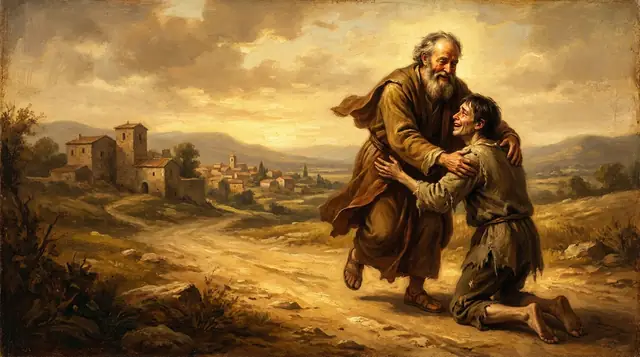
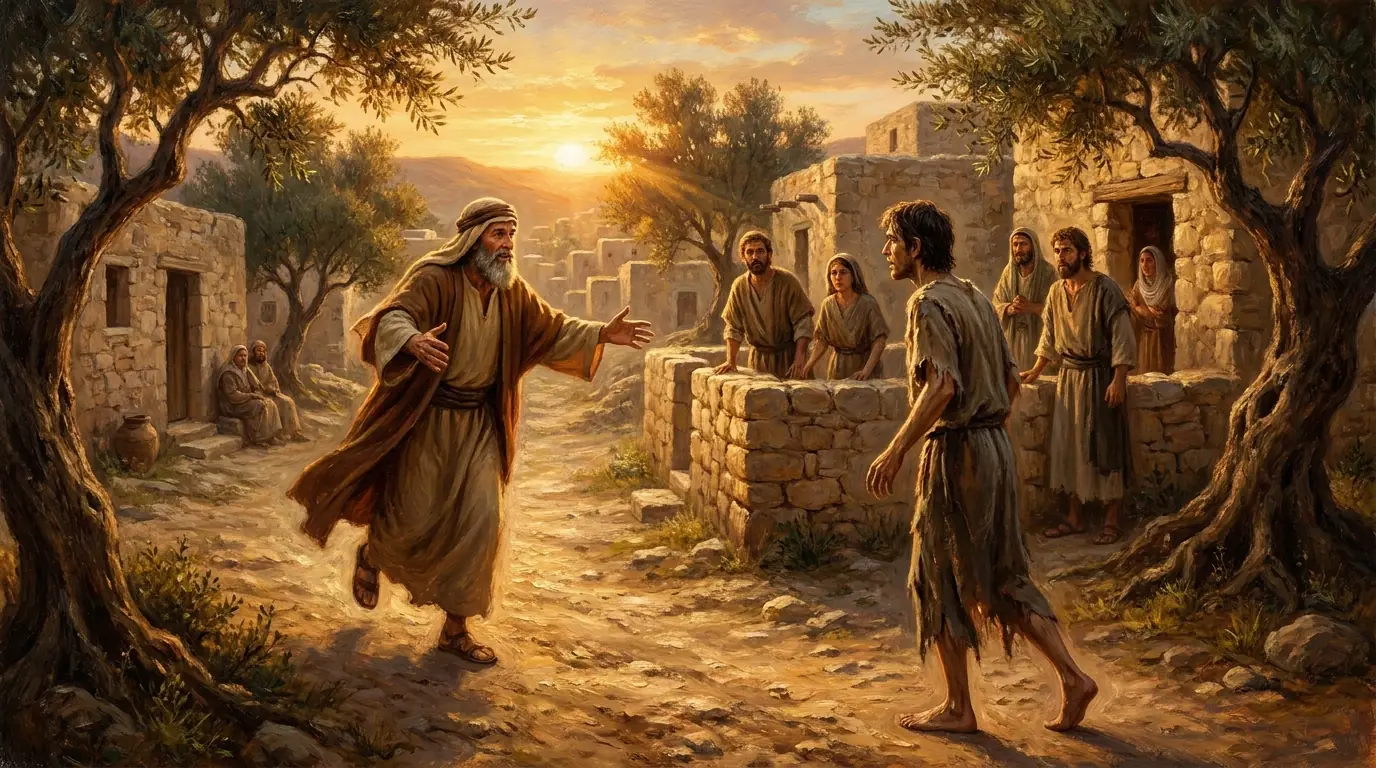
“So he got up and went to his father. But while he was still in the distance, his father saw him and was filled with compassion. He ran to his son, embraced him, and kissed him. The son declared, ‘Father, I have sinned against heaven and against you. I am no longer worthy to be called your son.’ But the father said to his servants, ‘Quick! Bring the best robe and put it on him. Put a ring on his finger and sandals on his feet. Bring the fattened calf and kill it. Let us feast and celebrate. For this son of mine was dead and is alive again! He was lost and is found!’ So they began to celebrate.”
“Meanwhile the older son was in the field, and as he approached the house, he heard music and dancing. So he called one of the servants and asked what was going on. ‘Your brother has returned,’ he said, ‘and your father has killed the fattened calf, because he has him back safe and sound.’ The older son became angry and refused to go in. So his father came out and pleaded with him.”
“But he answered his father, ‘Look, all these years I have served you and never disobeyed a commandment of yours. Yet you never gave me even a young goat so I could celebrate with my friends. But when this son of yours returns from squandering your wealth with prostitutes, you kill the fattened calf for him!’ ‘Son, you are always with me,’ the father said, ‘and all that is mine is yours. But it was fitting to celebrate and be glad, because this brother of yours was dead and is alive again; he was lost and is found.’””
The parable explained, scene by scene
Scene 1: the request and the departure (Luke 15:11-13)
The younger son says to his father: give me my share. Under the law of Moses (Deuteronomy 21:17), the oldest son received a double portion. With two sons, the younger would be owed one third of the property. What stands out is the timing of the request: the father was still alive. Asking for an inheritance early was very unusual and hurt any family.
The father does not argue. He divides the property. That gesture already says something about his character: he lets his son choose, even knowing it might go badly. A few days later the young man gathers everything and travels to “a distant country.” There he squanders his wealth “in wild living.”
Scene 2: the famine and the pigs (Luke 15:14-16)
When the money runs out, a severe famine arrives. No one helps him. He hires himself out to a citizen of that country, who sends him to feed pigs. For an Israelite, pigs were unclean animals (Leviticus 11:7), so this was the lowest job a young Jewish man could take. Jesus paints the picture: the young man is so hungry that he longs to eat the pods the pigs are eating, and no one gives him a thing.
This is the lowest point of the story. He has no money, no friends, no food and no home. And right here is where the turn happens.
Scene 3: “he came to his senses” (Luke 15:17-19)
The text says he “came to his senses,” and he thinks of his father's house. He remembers that even the hired servants there have plenty of food. He decides to get up and go. He rehearses a speech: admit he sinned against heaven and against his father, accept that he is no longer worthy to be called a son, and ask to be treated like a hired servant.
That speech is very human. When someone returns after failing, they often carry their sentences ready. The young man does not ask to be a son again. He settles for a servant's place. Jesus does not explain whether his repentance was perfect or mixed with hunger. What Jesus tells us is that the young man got up and went back.
Scene 4: the father runs (Luke 15:20-24)
This is the central scene. “While he was still in the distance, his father saw him and was filled with compassion.” That means the father was watching the road. And instead of waiting with his arms crossed, “He ran to his son, embraced him, and kissed him.” Many scholars note that an older man running down the road was not a common picture in that world. Jesus chooses it on purpose.
The son starts his speech but never reaches the end. In verse 21 he says he sinned and is no longer worthy to be called a son. The part about “Make me like one of your hired servants” does not come out, because the father interrupts with orders to the servants. Bring the best robe, a ring and sandals, kill the fattened calf, let the feast begin. His words sum it all up: “For this son of mine was dead and is alive again! He was lost and is found!”
Scene 5: the older brother (Luke 15:25-32)
Here the story takes a turn many readers forget. The older son comes in from the field, hears the music and asks what is going on. He learns that his brother has returned and that his father killed the fattened calf. He becomes angry and refuses to go in. The father goes out again. Earlier he went out to the road to receive the younger son. Now he goes out to the door to plead with the older one.
The older son has his reasons, and he states them frankly: years of work, obedience and not even a young goat to celebrate with friends. Notice how he speaks. He says “this son of yours,” without saying “my brother.” The father answers with a different word: “this brother of yours.” He reminds him that all he has belongs to the older son too, and that it was right to celebrate.
Jesus never says whether the older brother went in. He leaves the ending open. The Pharisees listening were exactly the older brother of the story, and the door to the feast stayed open for them too.
Who are the three characters and what does each one teach?
The parable has three main characters. This table sums up what each one does, what each one feels according to the text and what we can learn.
| Character | What he does | What he feels | What he teaches |
|---|---|---|---|
| The younger son | Asks for the inheritance, leaves, wastes it, goes hungry, returns | Impatience at first, shame and hunger later, hope on the way back | Coming back is possible. The first step is to get up and go |
| The father | Divides the property, waits, sees from far away, runs, embraces, dresses, throws a feast and goes out to plead with the older son | Compassion and joy | God receives the one who returns and goes out to find the one standing outside, too |
| The older son | Works in the field, hears about the feast, gets angry, stays out and complains | Anger, comparison and a sense of unfairness | A person can be at home and far from the father's heart. The father's joy is for him as well |
What first-century customs help explain the parable?
Some details of the story become clearer when you know how people lived then. This table includes only what most scholars accept. Where there is doubt, we say so.
| Detail | What the text says | How it was understood then | What it says today |
|---|---|---|---|
| Asking for the inheritance early | “Father, give me my share of the estate.” | An inheritance was normally received when the father died. Asking earlier was unusual and painful | A request that broke trust, and the father still respects it |
| Feeding pigs | He is sent “into his fields to feed the pigs” | Pigs were unclean animals for Israelites (Leviticus 11:7). It was the lowest job possible | Hitting rock bottom |
| Longing for the pods | He longed to fill his belly with what the pigs ate | Those pods were animal food. Wanting them showed extreme poverty | No one gave him anything: he was alone |
| The best robe | “Quick! Bring the best robe and put it on him.” | A robe of honor, the kind given to an important guest | The father restores him as a son, in public |
| The ring | “Put a ring on his finger” | A ring could serve as a seal for signing. Giving the ring meant giving trust and authority, as in Genesis 41:42 | He gets his place in the family back |
| The sandals | “and sandals on his feet” | Servants often went barefoot. Sandals marked a free person | He is a son |
| The fattened calf | “Bring the fattened calf and kill it.” | It was kept for special occasions, and its meat could feed many guests | A feast for the whole community |
| Music and dancing | The older son hears “music and dancing” | The parties of an important house had music and dancing | The father's joy is visible and loud |
Which of the three characters am I today?
Reading this parable honestly means asking who we identify with. We change characters as life changes. These questions can help.
If you feel like the younger son
Maybe you drifted away from faith, from family or from your relationship with God. Maybe you spent years, money or health on things that did not deliver what they promised. You may feel shame. The parable shows that the way back starts with a simple decision: get up. And that the father is watching the road. Psalm 51 is a prayer of David after a serious wrong, when he turned back to God. You can read it slowly and borrow its words.
If you feel like the older son
Maybe you have kept every rule for years, served at church, cared for the family, and you feel no one notices. When someone who failed receives affection, something inside protests. That is a human reaction, and the father does not scold it. He goes out and speaks tenderly: everything I have is yours. The invitation is to walk into the feast and be glad for your brother.
If you feel like the father
Maybe you are waiting for a son, a daughter or a relative who left. The parable does not say when that person will return. It shows how to wait: with the door open, with no grudges stored up and with your eyes on the road. Pray for them calmly. If you want a ready-made prayer, we have a prayer for my children you can use.
A short prayer for coming home
You do not need a rehearsed speech like the younger son's. These simple words are enough to begin. Read them slowly, or say them in your own words.
What else should I read on this theme?
If this parable spoke to you, other texts talk with it. Psalm 103 says in verse 13 that God has compassion on his children like a father. The prayer Jesus taught begins with the word “Father,” and we explain it in the Lord's Prayer meaning. And for the days when it is hard to believe a fresh start is possible, we gathered Bible verses about hope.
One last thought. Luke 15 has three parables so that nobody misses the most important point: God cares about the one who is lost, searches, and celebrates when he finds. You can read the chapter today and notice which scene you stop at.