
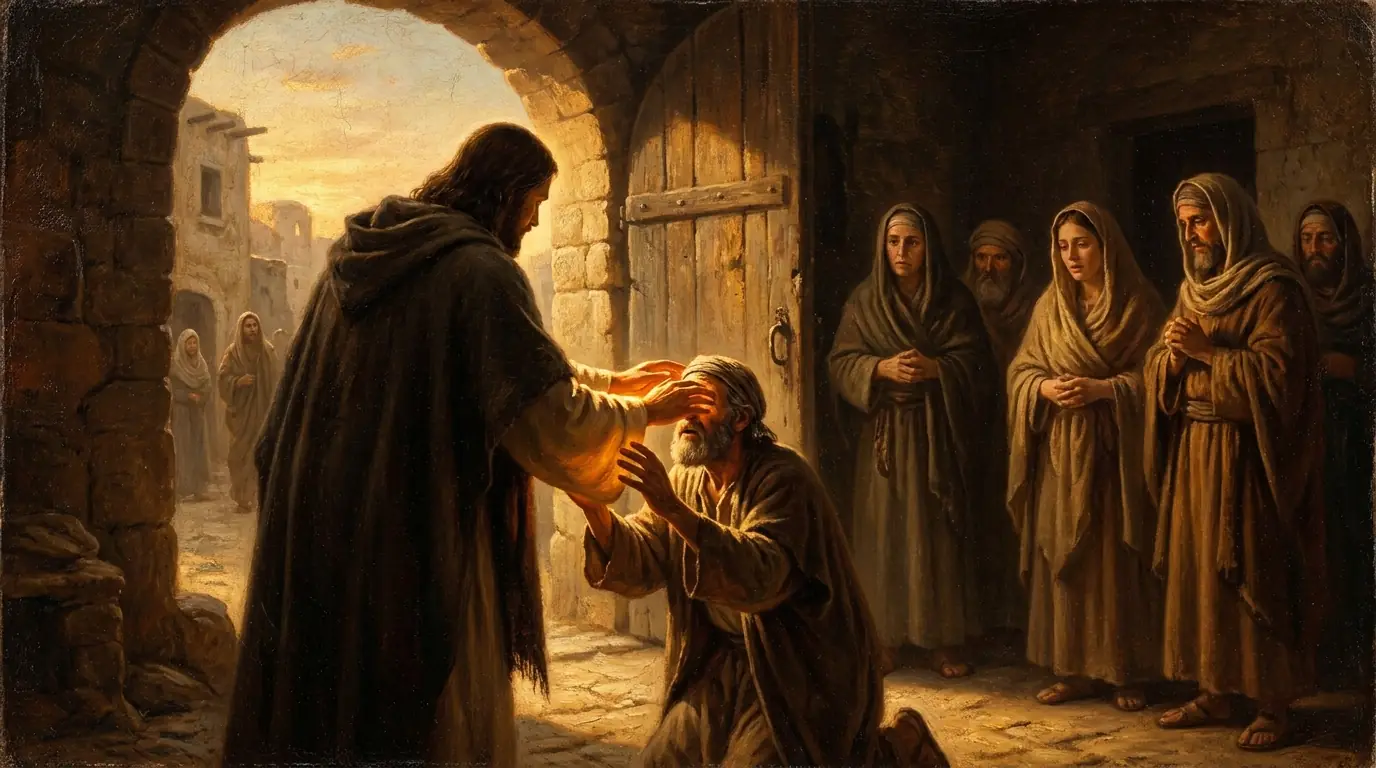
Search for Bible verses about healing and the internet hands you one promise, repeated in different accents: pray the right way, have enough faith, and the body is restored. The Bible records both sides of that coin, sometimes in the same letter. James tells the church to call the elders and anoint the sick with oil, expecting the prayer of faith to restore them. Paul asks three times for a thorn in his own flesh to be removed and gets a no: the answer he receives is grace, not the removal of the pain. A prophet begs to be healed in one verse and, a few chapters later, in the same book, curses the day he was born, with no report that the pain was ever resolved. Neither scene cancels the other. This article tries to read them together, without picking only the side that fits on a social media caption.
James 5:14-16: the instruction to pray for the sick
“Is any one of you sick? He should call the elders of the church to pray over him and anoint him with oil in the name of the Lord. And the prayer offered in faith will restore the one who is sick. The Lord will raise him up. If he has sinned, he will be forgiven.”
Notice what the text asks for: a summons, and it runs in one direction: the sick person seeks out the elders, and the scene gathers several people around a bed. Oil was, in the first century, also a common remedy, used on wounds and skin; the anointing here carries both meanings, the symbolic and the practical, without James needing to choose between them. The promise is real, 'the prayer offered in faith will restore the one who is sick', and it is also the only promise of this kind in the entire letter of James, which already suggests it is not treated as an automatic rule elsewhere in the New Testament, as the next verses in this article show.
“Therefore confess your sins to each other and pray for each other so that you may be healed. The prayer of a righteous man has great power to prevail.”
The next verse widens the scene: the healing asked for here is not only physical. 'Confess your sins to each other' ties the prayer for healing to relational restoration, inside a community that carries each other's sins and sicknesses together. James cites Elijah right after this as an example of someone who prayed fervently (James 5:17-18), because the prayer of an ordinary person, praying persistently, is the model the letter offers. That makes healing a community practice, repeated with humility, on no fixed schedule, with no guaranteed formula tied to the right prayer technique.
Psalm 103:2-4, 'heals all your diseases,' read as praise
“Bless the LORD, O my soul, and do not forget all His kind deeds— He who forgives all your iniquities and heals all your diseases, who redeems your life from the Pit and crowns you with loving devotion and compassion,”
It's worth reading this psalm for what it is: a retrospective hymn of praise, not a contractual clause about the future. David is stacking up the LORD's kind deeds, forgiveness, healing, redemption from the Pit, a crown of compassion, in the same totalizing language praise psalms tend to use, piling 'all' on top of 'all' to describe the extent of God's kindness, not to promise that no disease will ever reach someone who trusts Him. David himself, who wrote these lines, would die of old age decades later (1 Kings 2:10), and that does not contradict the psalm. 'Heals all your diseases' functions here the way the whole of Psalm 103 functions: sung gratitude, looking back at what God has already done, not a policy on what He will do about every future illness.
Psalm 147:2-4, healing for the brokenhearted
“The LORD builds up Jerusalem; He gathers the exiles of Israel. He heals the brokenhearted and binds up their wounds. He determines the number of the stars; He calls them each by name.”
This psalm was written after the exile, in a season of rebuilding, walls raised again, scattered people coming home. Healing appears in that context next to physical sickness, exile, loss, and dispersion, treating the brokenhearted as needing healing too, along with the body. The next line, about counting the stars and calling each one by name, works as a comparison: the same God who knows the name of every star knows the name of every hurt. This is healing described at relational scale, someone who sees up close, more than a formula about what will happen to a specific diagnosis.
Jeremiah 17:14: the prophet asks to be healed himself
“Heal me, O LORD, and I will be healed; save me, and I will be saved, for You are my praise.”
This is a request, not a statement about what has already happened. Jeremiah speaks in the first person, pleading for something he has not yet received, and the verb repeats, 'heal me... and I will be healed', like someone who needs to insist in order to convince himself of his own plea. The same prophet who writes this verse is, in Jeremiah 20:14-18, the author of the darkest page in the whole book: he curses the day he was born, with no record that the pain was ever resolved. Asking to be healed, in the same book, coexists with a wound that stays open in another chapter, and neither passage is edited to fit more neatly with the other.
Isaiah 53:4-5: two healings, two New Testament quotations
“But He was pierced for our transgressions, He was crushed for our iniquities; the punishment that brought us peace was upon Him, and by His stripes we are healed.”
This verse comes from the portrait of the Suffering Servant, in Isaiah 52:13–53:12, and the New Testament quotes it twice, in two different ways, worth showing both, because together they prevent a one-sided reading.
“He Himself bore our sins in His body on the tree, so that we might die to sin and live to righteousness. 'By His stripes you are healed.'”
Peter quotes 'by His stripes you are healed' right after speaking about dying to sin and living to righteousness. The healing he describes is, first, healing from sin, moral and spiritual, not a reversed diagnosis.
“When evening came, many who were demon-possessed were brought to Jesus, and He drove out the spirits with a word and healed all the sick. This was to fulfill what was spoken through the prophet Isaiah: 'He took on our infirmities and carried our diseases.'”
Matthew, on the other hand, quotes the verse before it, Isaiah 53:4, not 53:5, to describe real physical healings Jesus performed during His own ministry. The two quotations complement each other, and together they show that the whole passage carries both dimensions, physical and spiritual, without one erasing the other. Honest reading takes in both, and using only 53:5, filtered through Peter, would treat it as if it were a promise that every physical illness will always be reversed in this life: the very disciples who witnessed the healings in Matthew 8, including Peter himself, would still die of natural causes decades later.
Matthew 11:28, rest promised, not necessarily a cure
“Come to Me, all you who are weary and burdened, and I will give you rest.”
Jesus's invitation here is broad enough to include those who are sick, but the word used is rest, not healing. 'Weary and burdened' covers physical exhaustion, emotional weight, spiritual heaviness, categories that overlap with sickness without being limited to it. It's a promise of immediate company and relief, something that can be received today, regardless of whether the body is still sick tomorrow. Reading this verse as a guarantee of physical healing stretches the word beyond what it promises; reading it as an invitation to carry the weight near someone, instead of alone, is what the text actually offers.
2 Corinthians 12:7-9: the thorn that was not removed
“So to keep me from becoming conceited, I was given a thorn in my flesh, a messenger of Satan, to torment me.”
Paul never says what that thorn was, tradition speculates about an eye problem, a chronic illness, a constant physical pain, and the ambiguity is, in a way, the point: the text stays general enough to cover any persistent affliction.
“Three times I pleaded with the Lord to take it away from me. But He said to me, 'My grace is sufficient for you, for My power is perfected in weakness.' Therefore I will boast all the more gladly in my weaknesses, so that the power of Christ may rest on me.”
Three requests, made by an apostle who saw others healed through him at other moments in his ministry, and the answer was sufficient grace, without removal of the thorn. This is, within the New Testament, the clearest case of a fervent, repeated prayer that does not end in physical healing, and Paul himself records it without trying to rewrite the outcome. He treats the thorn's persistence as the place where God's strength shows up in a different way, and never as a lack of faith.
2 Timothy 4:20 and 1 Timothy 5:23. Trophimus left sick, and Timothy's remedy
“Erastus has remained at Corinth, and Trophimus I left sick in Miletus.”
This sentence almost slips by inside a list of farewells, but it carries a heavy detail: Paul, the same man who saw healings happen through him in Acts, left a traveling companion sick behind him, with no healing reported. There's no explanation, no excuse, no promise that Trophimus would be fine, just the fact, recorded without embarrassment, in the last letter Paul wrote.
“Stop drinking only water and use a little wine instead, because of your stomach and your frequent ailments.”
Paul recommends a remedy of the period, wine, used as a common treatment for stomach problems in the first century, to a young leader who apparently suffered from recurring illness. He tells Timothy to get practical care, available in that context, and never suggests that praying harder is the answer or that the illness continuing is a lack of faith. It's worth remembering, too, who wrote the most detailed account of Jesus's life and the early church: Luke.
“Luke, the beloved physician, and Demas send you greetings.”
Luke was a physician by profession, and he is called that, with affection, inside the New Testament itself. An evangelist and historian of the Christian faith practicing medicine sits comfortably within Scripture. It's part of the picture.
Revelation 21:3-4: the final healing, still to come
“And I heard a loud voice from the throne saying: 'Behold, the dwelling place of God is with man, and He will dwell with them. They will be His people, and God Himself will be with them as their God.' He will wipe away every tear from their eyes, and there will be no more death or mourning or crying or pain, for the former things have passed away.”
This is the one place in the entire Bible where the absence of pain and death is promised without condition, without exception, and without any prayer requirement attached. Notice where it sits: at the end of the story, after 'the former things have passed away.' The healings that happen now keep their value, and this passage puts them in context. The New Testament describes the present as a time when some healings happen and others don't, alongside the promise of a complete healing that has not yet arrived. Reading any verse about healing as if it were already Revelation 21 rushes Scripture's own clock.
What these passages don't say, read together
None of them treats illness that continues after prayer as a sign of hidden sin or insufficient faith. Paul's thorn remains. Trophimus is left sick in Miletus with no report of healing. Timothy keeps having illnesses frequent enough to need a remedy recommended by letter. And none of them treats seeking medical treatment as lesser than praying. Paul prescribes wine for the stomach in the same tone he asks people to pray for each other, and Luke, a physician by profession, writes a fifth of the New Testament without that being treated as tension to be resolved.
How to read these verses without promising a guaranteed cure
- 01Read the whole chapter before memorizing the verse. Isaiah 53:5 changes meaning depending on which New Testament quotation you read alongside it. Matthew 8 or 1 Peter 2.
- 02Separate physical healing from spiritual healing when the text does. Psalm 103 is retrospective praise; 2 Corinthians 12 is a prayer that was not answered the way it was asked. Treating them as the same promise forces both.
- 03Never use these verses to suggest someone is sick because of a lack of faith. Trophimus, Timothy, and Paul himself all remained sick after praying, and none of them is corrected for it in the text.
- 04Treat medical care and prayer as partners, not opposites. The Bible uses both, in the same letter, sometimes in the same sentence.
How do the healing passages compare?
Healing passages speak to different situations. The table shows what each one teaches, and the care you need when you read it.
| Passage | What it teaches | Read it with care |
|---|---|---|
| James 5:14-16 | Pray with the elders for the sick, and pray for one another. | It asks for prayer alongside, and never in place of, a doctor's care. |
| Psalm 103:2-4 | Praise God for forgiving and healing. | It is a song of praise, and it gives no guarantee for every illness. |
| Jeremiah 17:14 | A prayer: heal me, and I will be healed. | The prophet asks with humility. |
| Isaiah 53:5 and 1 Peter 2:24 | The suffering servant carries our wounds. | The New Testament links the verse to sin and to healing, so read both quotations. |
| Matthew 11:28 | Jesus offers rest to the weary. | Rest can come even when the illness stays. |
| 2 Corinthians 12:7-9 | Paul's thorn stays, and grace is enough. | Some prayers are answered with strength for the road. |
| 1 Timothy 5:23 | Timothy is told to take a little wine for his stomach. | Even inside the church, people used medicine. |
| Revelation 21:3-4 | God will wipe away every tear. | It is a promise about the end, and it points to a future healing. |
Keeping it together
In Terra Gospel you can highlight any of these verses in one of four colors, write your own note, and keep it all under Favourites, including on the days when praying for someone sick feels like the only thing you can do. Reading, highlights, notes, favourites and the verse of the day are free in English, Portuguese and Spanish; the narrated audio Bible is part of Premium.
When healing is slow, Bible verses about strength and Bible verses about peace can help you keep going, and Psalm 91 and what it promises explains a psalm often read in sickness. For the long ache of loss, see Bible verses about grief.