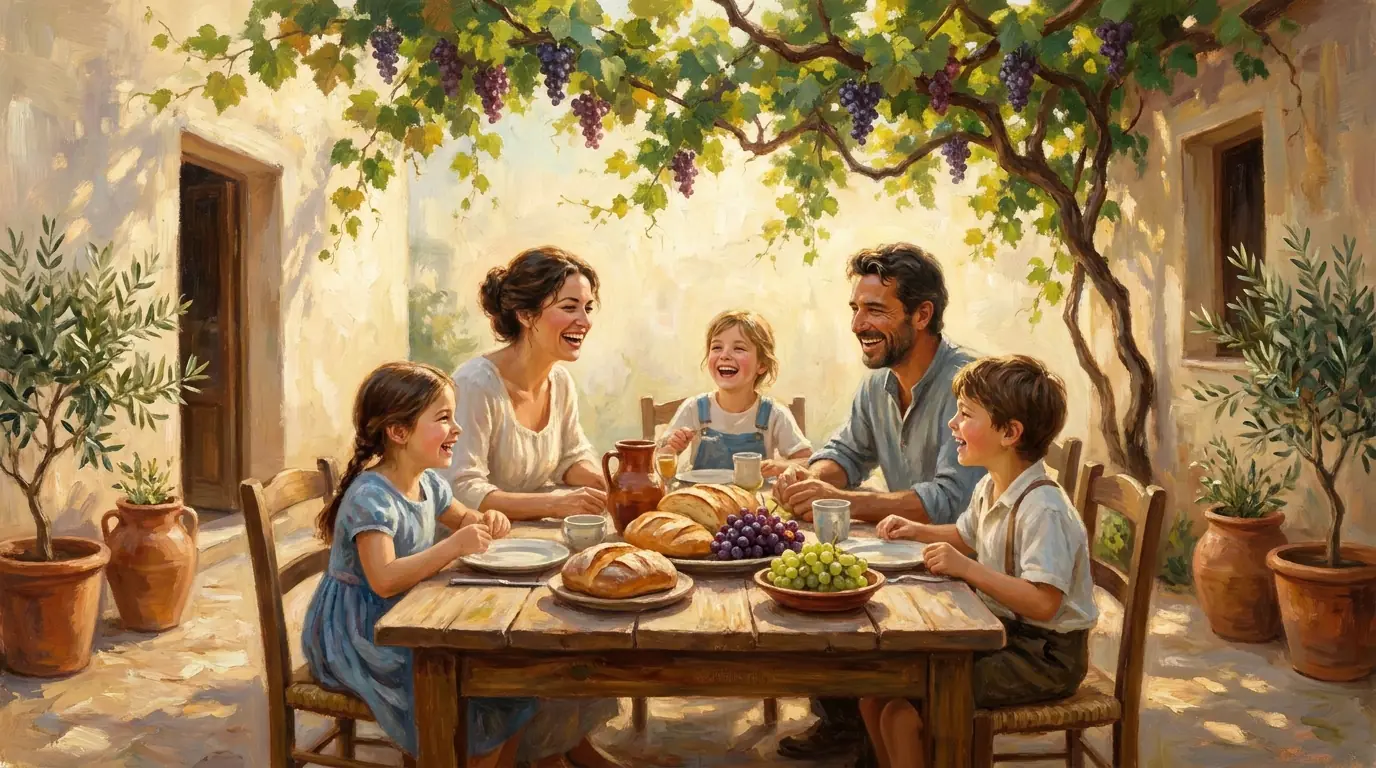
Few passages in the Bible smell as much like a kitchen as this one. A table, people sitting around it, bread earned by everyday work, children growing up and grandparents watching them do it. Psalm 128 has only six verses and fits on a greeting card, which is why it is so often chosen for weddings, silver anniversaries, housewarmings and family birthdays. It is printed below in full, in the Berean Standard Bible. After that comes a verse-by-verse explanation, its images of the vine and the olive shoot in a table, practical ideas for a ceremony or a card, and a short prayer for the family. It is written with every kind of family in mind: the one with a mom and a dad, the one with a single parent, the one raised by grandparents, the one formed by adoption or a second marriage, and the one that has not arrived yet.
Psalm 128 in full
“A song of ascents.”
“Blessed are all who fear the LORD, who walk in His ways! For when you eat the fruit of your labor, blessings and prosperity will be yours. Your wife will be like a fruitful vine flourishing within your house, your sons like olive shoots sitting around your table. In this way indeed shall blessing come to the man who fears the LORD. May the LORD bless you from Zion, that you may see the prosperity of Jerusalem all the days of your life, that you may see your children’s children. Peace be upon Israel!”
What is a song of ascents, and where does Psalm 128 come from?
The title reads 'A song of ascents.' It is one of fifteen psalms, 120 through 134, that all carry that same title. Many scholars think these were the songs pilgrims sang as they went up to Jerusalem for the festivals, since the city sat on high ground and you had to climb to reach it. That is the most common explanation, although experts do not agree on every detail, so it is best held as a good clue and not as a closed fact.
Picture the scene. A family walks for days on dirt roads, kids tired, bags on their backs. Songs help on the road because singing shortens the miles. And the song that comes out is this one, a song about a house, bread and a table, the very things those travelers left behind and hope to find again when they get home. It is a traveling song that is really about home.
If you like the flavor of these pilgrim songs, Psalm 121 belongs to the same collection and speaks about God's care along the road.
Verse by verse: what does Psalm 128 say?
Verse 1: the front door
'Blessed are all who fear the LORD, who walk in His ways!' To be 'blessed' means happy and fortunate in the best sense, someone for whom things are going well on the inside. The line puts the condition right at the start: fearing the LORD. In the Bible that fear means deep respect and trust, the attitude of a child who loves his father and therefore listens to him. The text says nothing about dread of punishment. And 'walk in His ways' adds something practical: this is a life you walk, day by day, and never just a Sunday feeling.
Notice the first words too, 'all who.' The verse opens the door to anyone. It asks for no last name and no position, so the lines about the house and the table reach everyone who listens with that attitude.
Verse 2: daily bread
'For when you eat the fruit of your labor, blessings and prosperity will be yours.' This verse is a compliment to honest work. In a world where many people worked the land or a workshop, eating 'the fruit of your labor' was a sign that things were going well: what a person planted, he harvested, and he could eat it without fear. Today it fits the person who makes it to the end of the month on a paycheck, the one who runs her own shop, the delivery driver and the home health aide. It is a simple and very real blessing: that your effort would be enough for the table.
One detail that moves people: the blessing in this verse is measured in bread on the table and in 'blessings and prosperity,' with no mention of getting rich. It is a blessing at the scale of a home, with food on the plate and peace in the heart.
Verse 3: the vine and the olive shoots
Here is the heart of the psalm, with two images: 'Your wife will be like a fruitful vine flourishing within your house, your sons like olive shoots sitting around your table.' A vine that gives grapes beside the house is a picture of joy, shade, fruit and life growing right up against the wall. Olive trees, for their part, lived for centuries and gave oil for food, light and medicine. The 'olive shoots' are the young sprouts that come up around the big tree. Around the table sit children who are growing strong, with a future ahead of them.
It helps to read this image through the eyes of its time. The psalm speaks from a house about three thousand years ago, with a father who works, a mother and several children. The Bible also shows other households, like the one Ruth and Naomi formed, two women who looked after each other and made a home. What this verse teaches beyond the snapshot of its era is the heart of the picture: a house where there is life, fruit, care and a seat at the table for each person. That table can be set by many kinds of families.
Verse 4: the conclusion
'In this way indeed shall blessing come to the man who fears the LORD.' The poet closes the first half with a summary: this is what a blessed life looks like. Table, work, home, children. It is such an everyday scene that it almost looks small, and that is where its strength lies. The blessing of this psalm is the one you live on an ordinary Tuesday at dinnertime.
Verses 5 and 6: the blessing spoken over you
In verse 5 the tone shifts. Now the poet wishes, like someone saying goodbye with a hug: 'May the LORD bless you from Zion, that you may see the prosperity of Jerusalem all the days of your life.' Zion is the hill where the temple stood, the place where the people felt God close by. The blessing is sent from there. And 'seeing the prosperity of Jerusalem' means seeing the whole community flourish and live in peace, since a healthy family lives better inside a healthy community.
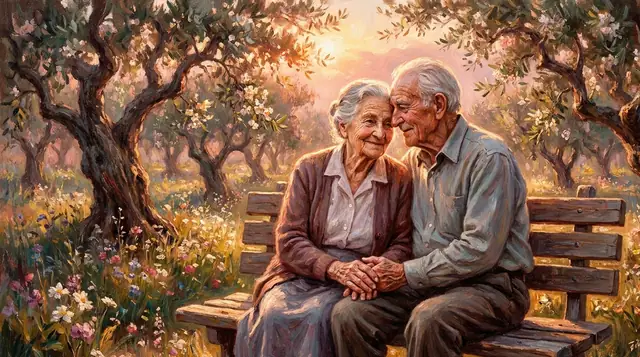
Verse 6 is the tenderest: 'that you may see your children’s children. Peace be upon Israel!' Seeing grandchildren was the great joy of old age. A blessed family is one where life carries on, generation after generation, and where grandparents get to watch the little ones play. The last line, 'Peace be upon Israel,' stretches the wish out to the whole people. Peace for the house and peace for the nation are asked for in the same breath.
The images of the psalm in a table: what they mean and how to live them today
Psalm 128 uses few words and many images. This table translates each one into life today, so it works for someone reading in a house with Wi-Fi and central air.
| Image in the psalm | What it means | How to live it today |
|---|---|---|
| The one who fears the LORD and walks in His ways (v. 1) | Respect and trust in God that shows up in everyday life | Pray before meals, say sorry at home, choose honesty at work |
| Eating the fruit of your labor (v. 2) | Honest effort is enough to live in peace | Give thanks for your paycheck, take care of what you have, work without cheating anyone |
| A fruitful vine beside the house (v. 3) | A home with joy, care and life that bears fruit | Look after the bonds in your house: a kind text, dessert without phones |
| Olive shoots around the table (v. 3) | Children growing strong around the meeting place | Sit down and eat together at least once a day and listen to each person |
| May the LORD bless you from Zion (v. 5) | The blessing comes from God and is asked for in community | Pray with your family and ask a blessing on one another |
| Your children’s children (v. 6) | Life goes on and is enjoyed across several generations | Tell stories to the grandchildren, leave letters, keep the good traditions |
| Peace upon Israel (v. 6) | Peace at home joins with peace for everyone | Pray for your neighborhood, your country and people living through war |
Does Psalm 128 fit every kind of family?
It is an honest question and deserves a careful answer. The text of the psalm speaks of a man, his wife and his children, because that was the household the poet was describing. Today families have many faces. There are mothers raising kids alone, widowed fathers, grandmothers who took in their grandchildren, older siblings holding the house together, couples without children, people who live alone and count their friends as family, adopted children and families formed by second marriages.
For all of them, the psalm keeps what matters most. The blessing of Psalm 128 has three ingredients anyone can live: respect and trust in God, work that is enough for the table, and a home with a place for everyone. A woman raising her children alone can ask that her table be like that table. A grandfather raising his grandson can take the olive shoots as his own picture. A person without children can read 'your children’s children' as a wish that the good life reaches them in another way, through nieces, nephews, godchildren and neighbors.
How do you use Psalm 128 at a wedding?
It is one of the psalms most often chosen for weddings, and it is easy to see why. In a few lines there is work, home, children and joy, and it sounds gentle read aloud. Here are some concrete ways to use it.
- As a reading during the ceremony: a relative or close friend reads verses 1 to 4 in a calm voice, without rushing. It takes under a minute. Rehearse once so that words like 'blessed' and 'olive shoots' come out naturally.
- As the closing of the ceremony: the officiant or a guest reads verses 5 and 6 as a blessing over the couple. It is a lovely way to end, because these are words that wish someone well.
- On the guest book, the sign at the reception or the favors: a short line like 'Your sons like olive shoots sitting around your table' or 'May the LORD bless you from Zion' looks great printed on a sign or a napkin.
- On the invitation: verses 1 and 4 give the card a calm and grateful tone.
- In the parents' toast: read verse 6, 'that you may see your children’s children,' and wish the couple a long life full of family.
One practical suggestion for the officiant: if the couple already has children from another relationship or does not plan to have any, you can adapt the comments without touching the biblical text. Just explain that 'the table' stands for all the loved ones who sit around it, whatever shape that family takes.
How do you use Psalm 128 for silver and golden anniversaries?
Verse 6, 'your children’s children,' is a gift for couples who have many years together. They look at a table full of children and grandchildren and the psalm speaks straight to them. This table offers ideas for each moment.
| Occasion | How to use the psalm | Suggested verses |
|---|---|---|
| Wedding, civil or religious | Reading at the ceremony or closing blessing | 1-4 to read, 5-6 as a blessing |
| First anniversary | A handwritten card or letter to your spouse | 2 and 3 |
| Silver anniversary (25 years) | Reading at the party or family lunch, with the children present | 3 and 6 |
| Golden anniversary (50 years) | A blessing from the children and grandchildren to the grandparents | 5 and 6 |
| A parent's or grandparent's birthday | A card from the whole family | 6 |
| Baptism or birth of a child | A blessing over the baby and the family | 3 and 5 |
A simple tradition for silver and golden anniversaries: have each child or grandchild read one verse aloud, one per person, until all six are done. That way the honorees hear the whole blessing from the mouths of their descendants.
How do you bless a home with Psalm 128?
Psalm 128 is also a blessing for the home. It works on the day you move into a house, at a housewarming, when the new table arrives, or simply when the family wants to give thanks. A simple way to do it:
- 01Gather everyone who lives in the house, kids included. A home is blessed best with everyone present.
- 02Someone reads the whole psalm aloud, slowly. If there are children, each one can read a verse.
- 03Each person says out loud one thing they are thankful for in that house, just one, however small.
- 04Say a short prayer asking for protection, peace and joy for everyone who walks through that door.
- 05Finish with something good to eat, around the table. The psalm asks for a table with people sitting at it, so the blessing is sealed by eating together.
Lines from Psalm 128 for a card or a message
If you want to write by hand, here are short texts to go with the verse. They are warm and in simple words, so you can adjust them for each person.
- For newlyweds: 'May your home have a big table and always one more seat. May God bless your work, your joy and your road. Psalm 128:1-2.'
- For a silver anniversary: 'Twenty-five years at the same table. May God give you many more and may you see your children’s children grow up. Psalm 128:6.'
- For a new house: 'May this house be like a fruitful vine: cheerful, shady and with room for everyone. May God bless each person who walks through this door.'
- For a single mom or dad: 'Your table is a blessed table too. May every shoot growing at your side fill your heart. God sees you and holds you up.'
- For grandparents: 'Seeing you at the table with the grandkids around you is the best blessing we could ask for. Thank you for being the roots. Psalm 128:6.'
A short prayer for the family with Psalm 128
This prayer can be read at dinner, before a trip or on any night. It is meant to be said out loud and to fit any kind of family:
'Lord, thank You for this home and for each person who sits at this table. Thank You for today's bread and for the work of our hands. Bless each one of us, the big and the small, the ones close by and the ones far away. Watch over those who live alone, those who raise children alone and those who miss someone. Make this house a place of peace, where we listen to each other and forgive each other. May the little ones grow strong, and may the older ones see theirs grow. Bless us from Your house, and let peace reach our neighborhood and our country. Amen.'
To keep going on this topic, you can read the prayer for my family, with more words for every situation, and the prayer for my children, for the moments when the worry centers on the kids.
What should you read after Psalm 128?
If this psalm spoke to you, the Bible verses about love gather texts for couples, family and friendship. For Mother's Day, the Mother's Day Bible verses have lines ready for cards. And to keep going with psalms for the road and for care, Psalm 121 is another pilgrim song, about God's protection along the way, and the most popular psalms show where this one sits among the rest.