
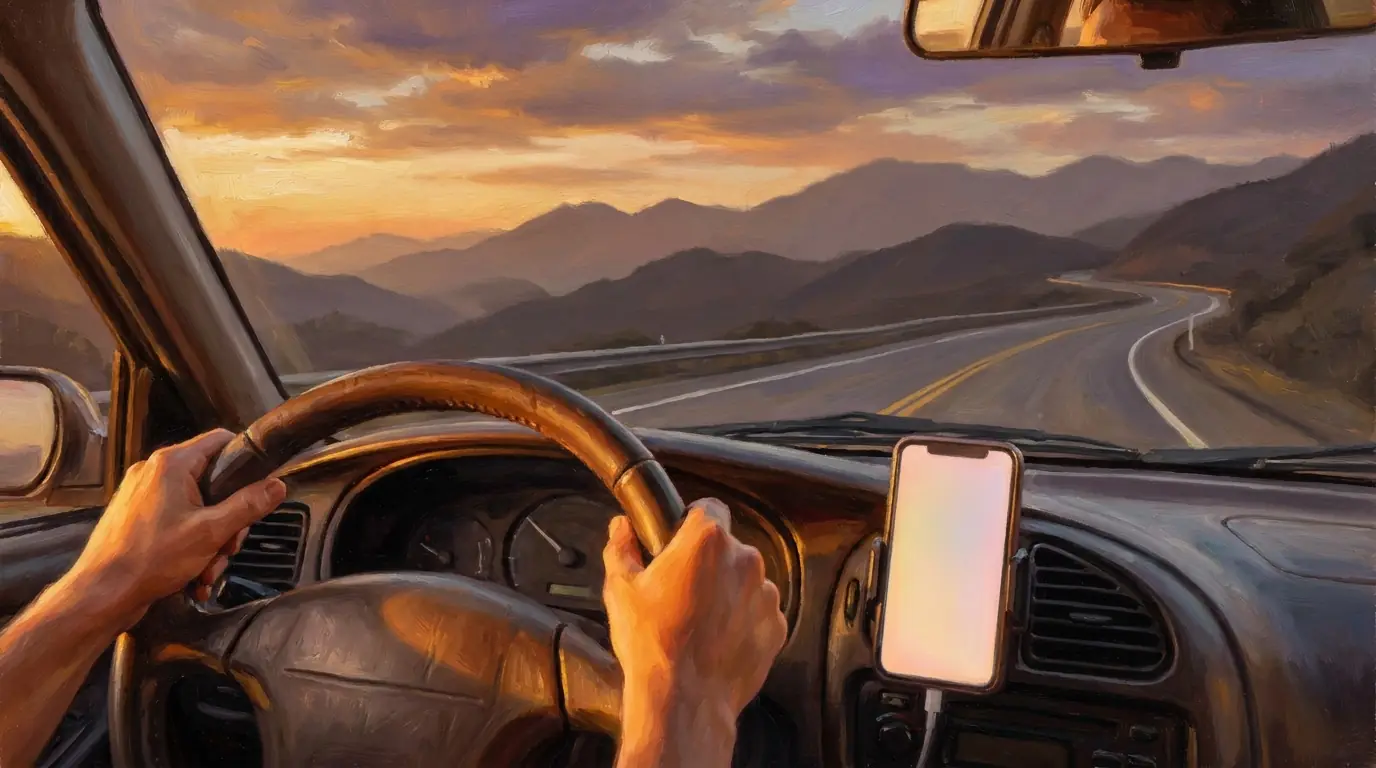
Most people skip Bible reading because the day filled up before it started: a commute, a load of laundry, a run, dishes that do not do themselves. None of that time is available for a book in your hands. All of it is available for a voice in your ears.
This is a full way to take in Scripture, closer to how most people met the Bible for most of history, when a congregation heard a letter read aloud because barely anyone owned a copy or could read one. An audio Bible needs no new block of your day. It asks you to point a habit you already have, driving to work, folding towels, walking the dog, at something worth hearing while you do it.
Press play before you go
Start here, because it is not optional. Choose your chapter and set the volume before the car is moving: the same way you would set up a podcast or a playlist. Once you are on the road, use your steering wheel controls or a voice command if your phone offers one; do not reach for the screen, scroll a chapter list, or type anything while driving. No benefit of a daily Bible habit is worth a moment of not watching the road.
How much dead time you actually have
Add it up honestly and the number is usually bigger than it feels. A twenty-minute commute each way is over two hours a week before you have done anything else. A gym session, a walk, or a stretch of cooking or cleaning easily adds another two or three.
| Activity | Typical time | Weekly total |
|---|---|---|
| Commute (both ways) | 20–40 min/day | ~2.5–4.5 hours |
| Workout or run | 30–45 min, 3–4x/week | ~1.5–3 hours |
| Chores, dishes, laundry, cleaning | 15–20 min/day | ~2 hours |
| Walking the dog or a daily walk | 15–20 min/day | ~2 hours |
Even counting only the commute row, most people already have more listening time in an average week than they think, enough, at a normal narration pace, to move through real ground in Scripture rather than a verse here and there.
None of these categories need to run separately. A twenty-minute commute already covers a chapter or two; stack a workout on top and you are hearing real chunks of a book most days, without ever setting aside a dedicated "Bible time" block. The habit rides on time that already exists rather than time you have to go find.
“Consequently, faith comes by hearing, and hearing by the word of Christ.”
How much of the Bible that actually adds up to
Terra Gospel's narrated Bible runs about 75 hours end to end at a normal pace: a figure worth keeping in mind before setting expectations for any single book. The New Testament is roughly a quarter of that by word count, which puts it at an estimated 18 to 20 hours of listening. That is a calculated estimate that fits no single recording exactly: narration speed and translation both shift it by a few hours in either direction, but it is close enough to plan around.
At twenty minutes a day, that estimate puts the New Testament within reach in nine or ten weeks: a bit over two months. At forty minutes a day, roughly a commute plus a workout, it drops to around five weeks. Neither number needs to be exact to be useful: it shows that a habit measured in minutes a day, kept for a season rather than abandoned after four days, is enough to hear the whole New Testament once, cover to cover.
Where to start when your hands are busy
Not every book suits listening while you are also driving, lifting, or scrubbing a pan. Genealogies and legal codes ask for attention you do not have to spare in traffic; fast narrative and short letters do not.
| Book | Why it works here | Try |
|---|---|---|
| Mark | Shortest Gospel, moves fast, easy to follow in and out of attention | Mark 1–8 over a week |
| Acts | Story-driven, high stakes, reads like a travel narrative | Acts 1–12 |
| Philippians | One short letter, one sitting, one commute | Whole letter, one drive |
| Psalms | Short units; missing a verse does not lose the thread | Psalm 23, 34, 100 |
| Proverbs | Self-contained lines, no plot to track | One chapter a day |
What to save for a quieter moment: Leviticus and Numbers, whose lists need your eyes as much as your ears; the genealogies opening Genesis 5, Chronicles and Matthew; and anything you would want to pause and reread, which a moving car will not let you do.
“And you shall teach them diligently to your children and speak of them when you sit at home and when you walk along the road, when you lie down and when you get up.”
That instruction was written for a culture that did not separate ordinary life from the life of faith into two calendars. The road, the house, lying down, getting up: all of it was on the list. A commute is a modern version of "when you walk along the road," and it asks the same question it always did: what fills that time by default.
Keeping your attention when your hands are busy
Listening while doing something else is a real skill, and a full form of paying attention. It gets easier with repetition, the same way following a podcast host gets easier once you know their voice and pace: the first week of listening while driving asks more of you than the fifth does. A few habits make the difference between Scripture playing in the background and Scripture actually landing:
- Repeat familiar ground before pushing into new territory. A chapter you already half-know holds your attention less demandingly than something entirely unfamiliar, and that is fine for a first pass.
- Save your hardest listening, dense arguments, unfamiliar names, for your easiest task. Play Romans while folding laundry, not while merging onto a highway.
- Let a missed sentence go. You cannot rewind on the road, and chasing every word turns listening into work instead of habit.
- Re-listen to a chapter a day or two later if it mattered. The second pass, at a red light or on the couch, is where the depth usually happens.
- Keep the speed slow enough to follow the sentence, not just the words. Faster is not the goal; finishing the chapter with something retained is.
- Match the volume to the room. In a loud car or a noisy gym, turn it up rather than straining to fill in gaps; in a quiet kitchen, a lower volume with clearly spoken words beats sound turned up to compete with a running tap.
A four-week plan for the car, the gym and the kitchen
Rather than committing to the whole New Testament on day one, start with a month built around the dead time you already have.
- 01Week 1: Mark, one to two chapters a day on your commute. Fast narrative, the easiest possible entry point.
- 02Week 2: Philippians, once at the start of the week and once again at the end, in one sitting each time.
- 03Week 3: Acts 1–12, spread across drives, walks or a gym week.
- 04Week 4, Psalms, one a day during a chore that repeats daily, dishes, a walk, folding clothes.
By the end of the month you will have heard a Gospel, a letter twice over, half of Acts and a handful of Psalms, and, more usefully, you will know which parts of your week actually hold a listening habit and which do not.
“But his delight is in the Law of the LORD, and on His law he meditates day and night.”
What should you do when the road needs your full attention?
Some moments behind the wheel ask for everything you have: heavy rain, a complicated junction, a stretch of construction. In those moments, pause the audio, or turn it down, and give the road your full focus. The chapter will still be there when traffic clears. Nothing in Scripture asks you to trade safety for progress.
A useful rule is to treat the narration like a passenger. A good passenger goes quiet when the driving gets tricky and picks the conversation up again when things ease.
A short checklist before you leave
- 01Choose the chapter and set the volume while the car is parked.
- 02Check that your phone is charged and connected to the car speakers or a headset. The narrated Bible in Terra Gospel streams, so you need a data connection.
- 03Turn on background music only if the road noise is loud.
- 04Decide what you will do if the signal drops. A favourite psalm you know by heart, or a few minutes of silent prayer, can fill the gap.
- 05Say a short prayer for the trip.
“The LORD will guard you from all evil; He will preserve your soul. The LORD will watch over your coming and going, both now and forevermore.”
The psalm was written for pilgrims on the road, and it fits a modern commute well. Many drivers like to read or listen to these two verses just before pulling out.
What if you drive for work?
Drivers who spend most of the day on the road have an extra reason to plan. Delivery drivers, taxi drivers and salespeople can put a book on repeat for a week, or listen to one Gospel across the whole workweek. Hearing the same story several times often shows you details that a single pass misses. Keep the volume moderate so you can hear traffic, and take a proper break at least every couple of hours.
If you drive with children, choose a short story such as Jonah, Ruth or Daniel 3 and stop to ask them what they think will happen next. A car is a good place for a conversation.
Does listening count as reading?
It is a fair question, and worth answering honestly rather than reassuring you past it. For following a story, absorbing a letter's argument, or simply spending time in the text, listening holds up well. It is real intake, not a lesser substitute. For close study of a difficult verse, cross-referencing, or work that needs you to stop and look back, the page still wins, because a moving car will not let you pause on a phrase. Most people who keep the habit end up doing both: listening for the miles, reading for the study.
“Let the word of Christ richly dwell within you as you teach and admonish one another with all wisdom, and as you sing psalms, hymns, and spiritual songs with gratitude in your hearts to God.”
What to do when you miss a day
Missing a day is not a reason to start over at Genesis. Pick up the next chapter where you left off rather than replaying what you missed: a habit measured in guilt gets abandoned faster than one measured in minutes. If a whole week slips, choose one short book and start it fresh rather than trying to make up everything at once.
Setting this up in Terra Gospel
In Terra Gospel, reading the full Bible, the verse of the day, notes, highlights and favourites are free, in English, Portuguese and Spanish. The narrated Bible: every chapter read aloud, with adjustable speed from 0.75× to 2×, optional background music, automatic continuation into the next chapter, and a timer for when you want the audio to stop, is part of the Premium subscription, priced locally in your country's app store. Set your book before you start the car, press play once, and let auto-advance carry the rest.
For the other end of the day, see the audio Bible for sleep. To choose an app, read the best audio Bible apps, and how long it takes to read the Bible tells you how many drives each book needs.